

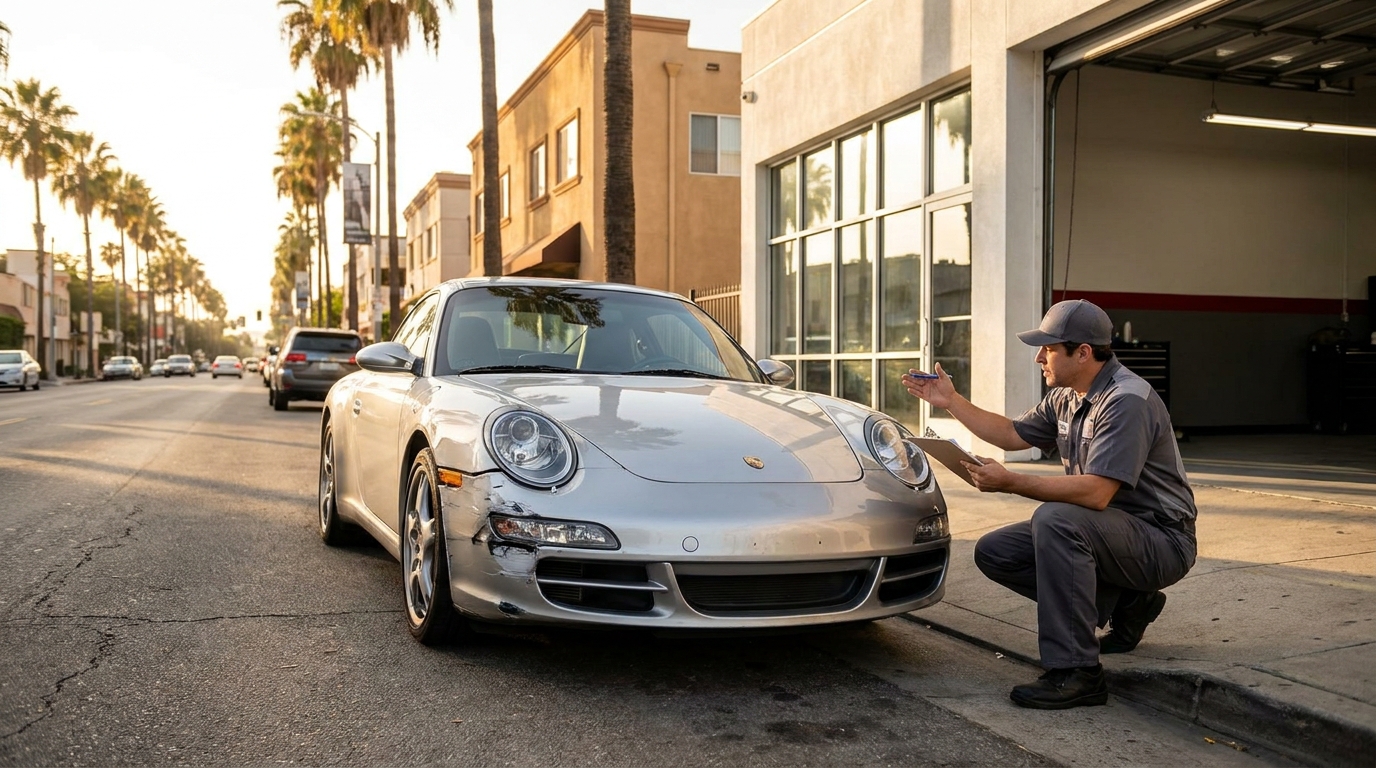
What Does an Auto Body Shop in West Hollywood Actually Cost?
If you need an auto body shop in West Hollywood, expect labor rates around $98 per hour, which is among the highest in Los Angeles County. That rate, combined with the area’s high share of European and exotic vehicles, means WeHo repair bills run noticeably higher than the SoCal average. The table below breaks down realistic cost ranges by damage tier for typical WeHo vehicles.
| Damage Tier | Examples | Typical WeHo Cost Range |
|---|---|---|
| Minor cosmetic | Bumper scuffs, door dings, light scratches | $500 – $2,000 |
| Bumper repair / replace | Cracked or sensor-equipped bumper covers | $1,000 – $3,500 |
| Multi-panel collision | Sideswipe: door + fender + rocker | $3,500 – $8,000 |
| Major / structural | Frame damage, front-end or rear-end collision | $5,000 – $25,000+ |
| Exotic / carbon fiber | Ferrari, Lamborghini, carbon body panels | $10,000 – $40,000+ |
Paint work adds $500 to $3,000 depending on the number of panels, finish type (tri-coat, matte, or pearl), and whether blending is required across adjacent panels. For a deeper look at how fender bender repair costs stack up across LA neighborhoods, that guide covers the full breakdown.
Why Do WeHo Repairs Cost More Than Other LA Neighborhoods?
Three factors drive the premium. First, shop labor rates in West Hollywood average $98/hr versus $56/hr in Van Nuys, a 75% gap for the same work. Second, the corridor from WeHo through Beverly Hills has a high concentration of German, British, and Italian vehicles with aluminum-intensive construction, carbon fiber components, and complex ADAS sensor suites, all of which require specialized equipment and longer repair times. Third, OEM parts pricing for luxury brands is significantly higher than for domestic models.
If your vehicle is a Porsche, Mercedes-Benz, BMW, Bentley, or Tesla, the shop must be brand-certified to use OEM procedures. A non-certified shop can still accept the car, but it may use aftermarket parts or repair methods that void factory warranties. See our full guide on finding and verifying an OEM-certified collision center in Los Angeles to confirm a shop’s credentials before you commit.
What Is ADAS Calibration and Why Is It on My WeHo Repair Estimate?
ADAS (advanced driver assistance systems) includes radar, cameras, ultrasonic sensors, and lidar used for lane-keeping, adaptive cruise, automatic emergency braking, and blind-spot monitoring. After any collision that moves or replaces a sensor, bumper cover, windshield, or front/rear fascia, those systems must be recalibrated before the car is safe to drive.
Single-system calibration runs $150 to $600; multi-system work on a luxury vehicle can reach $400 to $800 or more. For perspective, AAA research found the average cost to replace and recalibrate ADAS components after a minor front collision was roughly $1,540, and after a minor rear collision approximately $684. On a sensor-dense vehicle like a Tesla Model S or a Porsche Cayenne, ADAS calibration is not optional and is not included in basic labor rates. If your estimate omits it, ask specifically.
What Are the Most Common WeHo Damage Scenarios?
West Hollywood’s street grid creates specific, repeating damage patterns that differ from freeway-heavy suburbs:
- Valet and parking-structure scrapes: Tight lots on Santa Monica Blvd, Melrose, and La Cienega produce door dings, sideswipes, and bumper corner damage. Our guide to valet damage in Los Angeles explains who pays and how to document the claim.
- Hit-and-run on parked cars: High street-parking density means a significant share of WeHo claims involve parked vehicles with no at-fault driver to pursue.
- Sideswipes on Sunset and Santa Monica Blvd: Lane-change collisions at low speed are common but can involve multiple panels and ADAS sensors.
- Bumper scuffs in valet queues: Low-speed but cosmetically expensive on carbon or painted sport bumpers.
- Shopping-cart dings in Pavilions or Trader Joe’s lots: Small dents that are often PDR candidates if paint is intact.
How Do You Choose a Qualified Auto Body Shop in West Hollywood?
Use this checklist to compare shops before approving any estimate:
| Criteria | What to Look For | Why It Matters |
|---|---|---|
| I-CAR Gold Class | Listed on icar.com shop locator | Technicians meet ongoing training standards |
| OEM / brand certification | Verified on the brand’s own locator (Porsche, BMW, Tesla, etc.) | Required for OEM procedures and warranty protection |
| Written warranty | Covers workmanship and materials, no time limit on structural work | Protects you if a repair fails after pickup |
| ADAS calibration in-house | Shop has factory-level calibration equipment | Avoids sublet delays and ensures correct calibration |
| Direct insurance billing | Shop bills insurer directly (DRP or non-DRP) | Reduces out-of-pocket complexity |
| Supplement handling | Shop documents hidden damage and negotiates with adjuster | Hidden damage found during teardown must be approved; good shops handle this for you |
Many West Hollywood shops hold Direct Repair Program (DRP) agreements with major carriers including State Farm, Geico, Progressive, Allstate, Farmers, USAA, and Mercury. DRP status speeds up the claims process, but it does not mean you are required to use that shop. You keep the choice regardless.
What Are Your California Insurance Rights After a WeHo Collision?
California Insurance Code Section 758.5 prohibits your insurer from requiring you to use any specific repair shop. Your insurer can recommend a preferred shop, but it cannot coerce, intimidate, or financially penalize you for choosing a different licensed facility. Once you name your shop, the insurer must send the claim assignment there.
Additional rights under California’s Auto Body Repair Consumer Bill of Rights include:
- The right to an itemized written estimate and a detailed invoice before and after repairs.
- The right to be told whether OEM, aftermarket, or reconditioned parts will be used.
- The right to get an independent estimate from any licensed shop, even if you are pursuing an insurance claim.
- The right to rental car or loss-of-use coverage information from your insurer.
If an adjuster pushes back, cite California Insurance Code Section 758.5 directly and note that the California Department of Insurance enforces this protection. Violations can be reported to the CDI or the Bureau of Automotive Repair.
What Is a Supplement and Why Does It Appear on WeHo Luxury Repair Bills?
A supplement is a revised repair estimate submitted to the insurer after a shop disassembles a vehicle and discovers damage not visible in the initial inspection. On aluminum-bodied or high-complexity vehicles, supplements are common, not exceptions. A WeHo shop repairing a BMW 7 Series or Bentley Continental, for example, may find buckled inner structure, damaged wiring harnesses, or failed radar mounts only after the bumper cover is removed. The shop documents these findings, photographs them, and negotiates the additional line items with the adjuster. A qualified shop handles this process; you should not have to fight it alone.
Common Mistakes to Avoid
- Accepting the insurer’s shop without asking questions. Their preferred shop works under different financial incentives than a shop you choose independently.
- Skipping ADAS calibration to save money. An uncalibrated lane-keeping or emergency braking system is a safety hazard. Insurers are required to cover necessary calibration as part of a covered repair.
- Choosing a shop based on proximity alone. A WeHo zip code does not guarantee OEM certification or luxury-vehicle experience. Verify credentials on brand-specific locators.
- Approving a repair before the supplement is settled. If the shop finds additional damage, the insurer needs to approve the supplement before work proceeds, or you may absorb the cost.
- Ignoring written warranty terms. Get the warranty in writing; verbal commitments are unenforceable in a dispute.
- Using non-OEM parts on a leased or under-warranty vehicle. Aftermarket parts can void your manufacturer’s warranty on affected systems.
Frequently Asked Questions
How much does collision repair cost at a West Hollywood auto body shop?
Minor cosmetic work on a standard vehicle starts around $500 to $2,000. Bumper repair or replacement on a luxury vehicle with sensors runs $1,000 to $3,500. Multi-panel or structural repairs range from $5,000 to $25,000 or more. WeHo’s average shop labor rate is approximately $98 per hour, making it one of the higher-cost repair markets in greater LA.
Do I have to use the body shop my insurance company recommends in California?
No. California Insurance Code Section 758.5 gives you the right to choose any licensed auto body shop. Your insurer can suggest a preferred shop, but it cannot require it, penalize you financially for going elsewhere, or steer you away from a shop you have already chosen.
What is ADAS calibration and will insurance cover it?
ADAS calibration resets the sensors and cameras that control safety features like automatic braking, lane-keeping, and blind-spot warnings after collision repairs move or replace those components. It typically costs $150 to $600 per system and is covered under a standard collision or comprehensive claim when it is a required part of the repair. Always confirm it is included in your estimate.
How do I verify that a WeHo shop is OEM-certified for my vehicle?
Go to the brand’s own certified-shop locator. Porsche, BMW, Mercedes-Benz, Tesla, and most luxury brands maintain searchable databases. I-CAR Gold Class status can be confirmed at icar.com. Do not rely solely on the shop’s website claim; verify on the brand’s official tool.
What is a supplement in collision repair?
A supplement is an updated estimate submitted after teardown reveals hidden damage that was not visible during the initial inspection. The shop photographs the findings and negotiates the additional line items with your insurance adjuster. This is a normal part of complex collision repairs, especially on aluminum or sensor-heavy vehicles common in West Hollywood.
0 Comments