

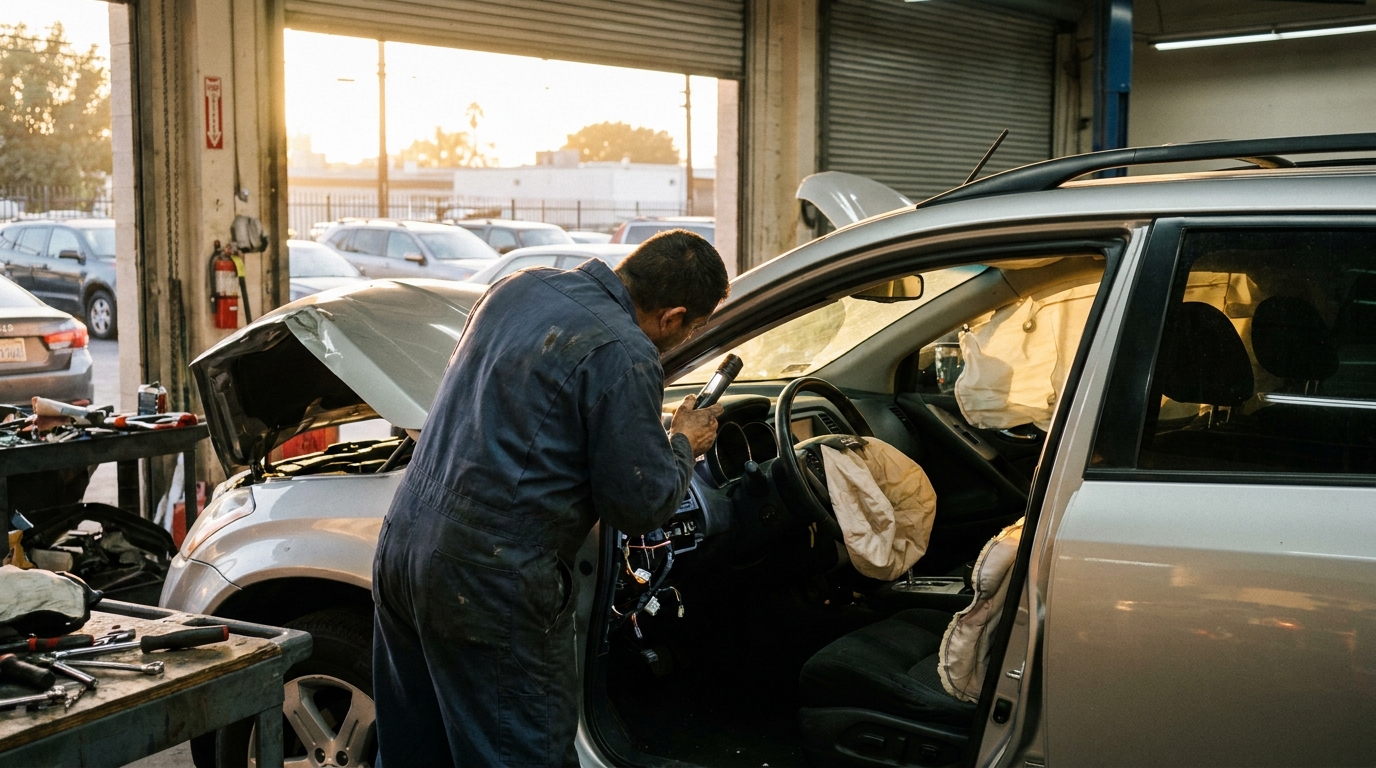
If My Airbags Deployed in LA, Is My Car Automatically Totaled?
No. Deployed airbags do not automatically total a car. Whether your vehicle is declared a total loss in Los Angeles depends on one specific calculation: if the cost to repair it, plus the vehicle’s salvage value, equals or exceeds the car’s pre-accident Actual Cash Value (ACV), California law treats it as a total loss. That formula, not the bags themselves, is what decides your outcome.
California is one of a handful of states that uses a Total Loss Formula (TLF) rather than a fixed percentage. In practice, most insurers acting under that formula arrive at a tipping point somewhere around 65–75% of ACV. The airbags are an expensive line item in the repair estimate, but they are rarely the only factor that pushes a car over that threshold. Hidden structural, suspension, and sensor damage usually does more of the heavy lifting.
What Does the Full SRS System Repair Actually Cover?
When airbags deploy, the repair isn’t just “put new bags in.” The Supplemental Restraint System (SRS) is an interconnected network, and virtually every component in that network is compromised or must be verified after a deployment. Here is what a thorough Los Angeles body shop puts on the estimate:
- Airbag modules (the bags themselves): Deployed airbags cannot legally be refurbished or reused, they are single-use devices and must be replaced with new units.
- Inflator canisters: The propellant charge that fills the bag is spent after deployment and must be replaced along with the bag assembly.
- Impact/crash sensors: These detect the collision force and trigger deployment. Damaged sensors must be replaced for the system to function; sensor replacement parts alone typically run $70–$350 each, before labor.
- SRS control module: This is the brain of the system. After a deployment, the module locks and stores crash data. It must be reset, reprogrammed, or replaced before the car is roadworthy. (More on this critical cost lever below.)
- Seatbelt pretensioners: These fire simultaneously with the airbags, locking the belt tight. They are pyrotechnic devices, once fired, they require replacement, typically $80–$350 per seat.
- Steering wheel and column components: The driver’s bag is housed in the steering wheel hub; the clock spring and column shroud are frequently damaged during deployment.
- Dashboard and knee-bolster panels: The passenger bag tears through the dash. Depending on construction, the entire dash assembly may need replacement on modern vehicles.
- Wiring harness segments: The SRS wiring runs throughout the cabin and is often singed, pinched, or pulled during the deployment event.
What Does Airbag Deployment Repair Cost in Los Angeles?
LA body shops bill labor at approximately $56–$98 per hour for collision work, and SRS repairs are labor-intensive. The table below reflects the realistic ranges you should expect on an estimate here, using OEM parts, which most insurers and certified shops require for safety-system components.
| SRS Component | Typical Part Cost | Notes |
|---|---|---|
| Driver airbag (steering wheel) | $400–$1,200 | Higher on luxury/sport vehicles with integrated controls |
| Passenger airbag (dash) | $600–$1,800 | Often requires dash panel replacement |
| Side curtain airbags (per side) | $500–$1,300 | Headliner removal adds significant labor |
| Impact/crash sensors | $70–$350 each | A frontal crash may affect 2–4 sensors |
| Seatbelt pretensioners | $80–$350 each | One per occupied seat that activated |
| SRS control module (replace) | $400–$1,200 | New module requires VIN programming |
| SRS control module (reset/reprogram) | $50–$150 | Only possible if module hardware is undamaged |
| Dashboard assembly | $800–$3,500+ | Varies widely by make/model |
| Full SRS system rebuild (typical) | $5,000–$15,000 | Before front-end or structural repairs |
A single airbag replacement runs roughly $1,000–$2,000 all-in for most mainstream vehicles. When multiple bags deploy, which is common in moderate-to-severe frontal collisions on LA freeways, the full system rebuild lands between $5,000 and $15,000 before any sheet metal, bumper, or frame work is added to the estimate. On luxury SUVs and EVs, that ceiling is higher still.
The SRS Control Module: Reset vs. Replace, and Why It Matters for Totaling
This is the decision most competing guides skip entirely, and it’s one of the most important cost levers on your repair estimate. After a deployment, the SRS control module (sometimes called the airbag ECU) stores a crash data snapshot and locks itself out. The shop has two options:
- Reset/reprogram the original module: If the module’s hardware survived the crash undamaged, a qualified technician can clear the crash data, reset the module, and reprogram it to the vehicle. Cost: approximately $50–$150. The car keeps its original VIN-matched module, which avoids compatibility issues.
- Replace the module: If the module is physically damaged or the insurer requires a new unit, expect to pay $400–$1,200 for the part, plus programming time. A new module must be VIN-flashed to your specific vehicle before the SRS system will operate.
The difference between a $100 reset and a $1,000 replacement is real money, money that could determine whether your car clears California’s total-loss threshold. A good LA body shop will scan the module before writing it off as unserviceable. If yours doesn’t, that’s a red flag worth asking about directly.
Is It Worth Fixing a Car After Airbags Deploy in Los Angeles?
The answer is almost entirely a function of your vehicle’s ACV. Use this framework to make the call before the insurer does:
| Scenario | Example Vehicle ACV | Estimated Repair Cost | Likely Outcome |
|---|---|---|---|
| Older economy sedan, frontal crash, two airbags deployed | $6,000 | $5,000–$7,000 | Almost certainly totaled |
| 3-year-old midsize crossover, moderate front impact | $28,000 | $9,000–$13,000 | Borderline, frame/ADAS damage decides it |
| Late-model luxury SUV or EV, frontal collision | $65,000 | $12,000–$18,000 | Usually repairable, not totaled |
| Porsche or high-end performance car | $90,000+ | $15,000–$25,000 | Repairable if structure is sound |
For vehicles with high ACV, think a late-model Mercedes GLE, a Tesla Model Y, or a Rivian, airbag deployment is expensive but very rarely fatal to the repair path. For older, lower-value cars, the SRS repair alone often exceeds the total-loss threshold before the front-end damage is even itemized. If you’re on the borderline, understanding California’s TLF and pushing the shop to confirm the module is resettable (rather than replaced) can make the difference.
What Hidden Damage Actually Pushes Los Angeles Cars Over the Total-Loss Line?
Airbag deployment is a symptom of a high-force impact. The bags themselves are rarely what totals the car, it’s the structural and mechanical damage that triggered the deployment in the first place. Any LA shop doing this repair correctly inspects all of the following before writing a final estimate:
- Frame and unibody rails: Frontal collisions compress the front rails. Even a millimeter of permanent deformation that a frame machine can’t correct means structural compromise, see our detailed breakdown in what a body shop actually finds after front-end impacts.
- Subframe and suspension geometry: A hard enough hit to deploy bags will often bend the subframe, shift control arm mounting points, or damage the steering rack. Alignment alone won’t catch this, it requires a full suspension inspection on a lift.
- Cooling system and radiator support: The radiator support is the first thing to collapse in a frontal crash. If it’s bent beyond straightening, it adds to the estimate and, critically, to the total-loss math.
- ADAS sensors and cameras: Front radar modules, forward-facing cameras, and ultrasonic sensors are mounted in the bumper fascia and grille area, the exact zone that absorbs a frontal collision. Every one of them must be physically inspected and electronically recalibrated after the repair is complete.
- EV-specific considerations: On electric vehicles, a frontal collision that deploys airbags may also trigger the battery management system’s crash detection, which can lock the battery pack and require a manufacturer-level diagnostic reset before the vehicle moves at all.
Why ADAS Recalibration After Airbag Deployment Is Not Optional
This cost gets quietly left off many initial estimates and then surfaces as a supplement, which delays your repair and surprises your budget. When a frontal collision deploys airbags, the bumper and grille area is replaced or realigned. Forward-facing cameras, radar cruise control modules, lane-keep assist sensors, and automatic emergency braking systems all depend on precise physical mounting angles and software calibration targets. Moving the bumper assembly even slightly throws every one of those systems out of spec.
Static calibration (done in the shop using target boards) runs roughly $150–$400 per system. Dynamic calibration (requiring a test drive on specific road types) can add another $100–$300. On a vehicle with five ADAS functions, that’s $750–$2,000 added to the repair. It also must appear on the estimate before you authorize the job, not after. For a deeper look at what this work actually involves, see our guide to ADAS calibration costs and what shops often omit from the initial estimate.
What Happens to Your Car’s Value After a Documented Airbag Deployment?
Even a perfectly repaired vehicle carries a CARFAX entry showing airbag deployment and a collision claim. In Los Angeles’s competitive used-car market, that record reduces private resale value and trade-in offers, a hit known as diminished value. California allows vehicle owners to pursue a diminished value claim against the at-fault driver’s insurer. To support that claim, your shop should document the pre-repair condition with photographs, retain the original removed parts where possible, and produce a detailed repair order that shows every component replaced.
If you’re keeping the vehicle, the repair record also becomes relevant at lease return if you’re in a leased car, or at the time of future sale. A detailed, properly documented repair from a certified shop limits that exposure. For more on how California handles diminished value claims and what documentation matters, our rear-end collision repair breakdown covers the claim process in detail.
What If Your Insurer Totals the Car but You Want to Keep It?
You can keep a vehicle your insurer has totaled. The process works like this in California:
- The insurer pays you the ACV minus the vehicle’s salvage value (what they would have received selling the wreck).
- The title is converted to a salvage title, which follows the VIN permanently.
- Before you can legally drive the car on California roads, it must pass a California Bureau of Automotive Repair (BAR) inspection and be re-titled as a rebuilt/reconstructed vehicle.
- Future insurance on a rebuilt-title car is often limited to liability only, and some insurers won’t write comprehensive or collision coverage on it at all.
- The airbag system must still be fully repaired to pass inspection, you cannot drive legally with deployed or missing airbags.
Keeping a totaled car only makes financial sense if you can source parts and labor at significantly below the insurer’s repair estimate, and if the structural damage is limited. For high-ACV vehicles where the total-loss call is borderline, it sometimes makes more sense to dispute the insurer’s ACV figure than to accept the salvage route.
Common Mistakes to Avoid
- Assuming deployed airbags automatically total the car. They don’t. The California TLF formula is what decides, and a high-ACV vehicle often comes through a full SRS rebuild without crossing the threshold.
- Letting the shop replace the SRS module without checking if it can be reset. A $50–$150 reset versus a $1,000+ replacement is a significant difference. Always ask whether the module was scanned before replacement was recommended.
- Skipping ADAS recalibration to save money. An uncalibrated forward radar or emergency-braking camera is not a cosmetic issue, it’s a safety system that will not function correctly in the next emergency. California shops are required to disclose this work; make sure it’s on the estimate.
- Accepting a liability-only coverage response for your own airbag damage. Liability coverage pays for the other driver’s car. Your airbag repairs go through your own collision coverage, subject to your deductible. If you only carry liability, you’re paying out of pocket.
- Ignoring hidden structural damage on the assumption the estimate covers it. Initial estimates are often written from visible damage. Supplement cycles after teardown routinely add frame, suspension, and cooling-system damage that wasn’t visible until the bumper came off. Confirm your shop has a supplement process and that your insurer has agreed to cover it.
- Accepting the insurer’s ACV without checking it. Los Angeles used-car values are higher than national averages. If your insurer is using a national database, their ACV figure may be low. A body shop with experience handling CA claims can help you document local comparable values.
Frequently Asked Questions
Does airbag deployment automatically total a car in California?
No. California uses a Total Loss Formula, not a fixed percentage threshold. A car is totaled when repair cost plus salvage value equals or exceeds the vehicle’s ACV. In practice, this often means repair costs above roughly 65–75% of ACV trigger a total-loss declaration, but a high-value vehicle can sustain a full SRS rebuild and remain repairable.
How much does it cost to fix airbags after a crash in Los Angeles?
Replacing a single airbag typically costs $1,000–$2,000 all-in. A full SRS system rebuild covering multiple bags, sensors, pretensioners, and the control module commonly runs $5,000–$15,000 in LA before any front-end or structural repairs are added. Luxury and EV models sit at the higher end of that range due to proprietary parts and programming costs.
Can the SRS airbag control module be reset instead of replaced?
Yes, if the module’s hardware is undamaged. A qualified technician can clear crash data and reprogram the original module for roughly $50–$150. If the module itself was physically damaged in the crash, it must be replaced for $400–$1,200 plus programming time. Always ask the shop to scan the module before writing it off, this distinction can meaningfully change the total repair cost.
Will my insurance cover airbag replacement after a crash?
Collision coverage typically pays for airbag repairs if the car is not declared a total loss, subject to your deductible. Liability-only policies do not cover your own airbag damage. If another driver was at fault, their liability policy should cover the full repair cost, including the SRS system and any ADAS recalibration required.
Does a deployed airbag show up on CARFAX and hurt resale value?
Yes. A deployment event tied to an insurance claim will appear on the vehicle history report. In the Los Angeles used-car market, a CARFAX showing airbag deployment reduces private-party resale value and trade-in offers. California allows the registered owner to pursue a diminished value claim against the at-fault driver’s insurer, but it requires documented evidence of the pre- and post-repair condition.
0 Comments