

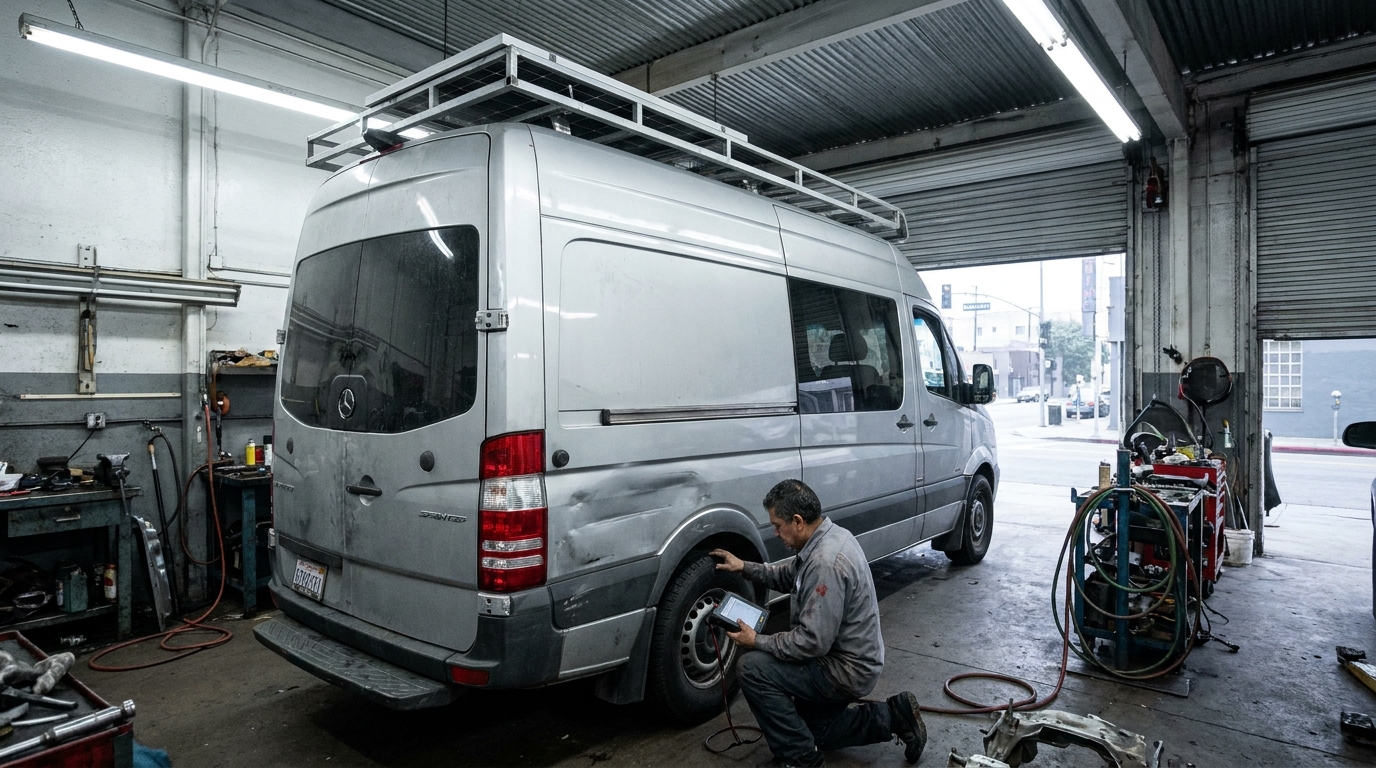
What Does Camper Van Collision Repair in Los Angeles Actually Cost?
Camper van collision repair in Los Angeles runs from roughly $1,200 for a minor panel dent on a bare Sprinter to well over $38,000 once structural damage and a six-figure conversion build are factored in. The wide range exists because a converted Sprinter or Transit is two vehicles in one: a commercial chassis and a custom-built interior, and most body shops only price the first half.
The table below uses repair-tier definitions consistent with what LA-area shops and insurers actually use. OC-based competitors list starting figures of $1,500 for collision and refinish work, but those figures do not reflect conversion interiors at all. The numbers below do.
| Damage Level | What It Typically Covers | Sprinter/Transit Cargo Van Only | Sprinter/Transit with Conversion Build |
|---|---|---|---|
| Minor | Single panel dent, scuff, door ding, broken lamp | $1,200 – $5,500 | $1,200 – $7,500 (add interior access or cabinetry displacement) |
| Moderate | Multi-panel damage, bumper replacement, mild frame pull | $6,500 – $15,000 | $9,000 – $22,000 (sidewall lining, electrical rerouting, solar disruption) |
| Major | Structural involvement, roof damage, full corner crush | $18,000 – $38,000 | $28,000 – $60,000+ (interior rebuild, frame correction, ADAS recalibration) |
Labor rate is a critical variable. OC shops publicly post body and paint at around $210 per hour and diagnostics at $285 per hour. LA-county rates from certified shops run $155 to $250 per hour for body work, and ADAS scan and recalibration adds $285 to $1,800 on top of that depending on the systems involved. Factor those rates into any estimate you receive.
Why Do Insurers Lowball Sprinter and Transit Conversion Claims?
Adjusters pull vehicle data from VIN lookups, and your VIN still describes a cargo van. Unless your policy explicitly covers the conversion, the estimate reflects the empty shell, not what you built inside it.
A documented real-world example makes this concrete: a 2022 Sprinter 3500 170 EXT camper conversion was rear-ended at a stoplight. The carrier’s initial estimate was $11,840, covering rear doors, a bumper, tail lamps, and a quarter-panel refinish. It did not include a single interior line item. After the shop itemized the build with current replacement-cost documentation, the corrected repair invoice came to $36,649 over 46 days. The build had cost $47,300 to construct, with a replacement cost at current pricing of roughly $42,000. The adjuster was not trying to defraud the owner. The estimating system simply did not know the van was anything other than a cargo hauler.
This is the core problem: the carrier pays for the chassis and ignores the build. Very few shops can tell an adjuster what it costs to reskin a sidewall when that wall has a lithium battery bank, a 400-watt solar array, a shower, and a full cabinet run bonded to its interior surface. That gap is why conversion owners get underpaid on claims, and it is entirely preventable with the right documentation file built before a loss occurs.
For more on how California collision claim supplements work, see our full guide on fender bender repair cost in Los Angeles, which covers the supplement process from initial estimate through correction.
Why Are Sprinter and Transit Bodies Harder to Repair Than a Standard Car?
Three structural factors drive costs and timelines up on tall-van repairs that most owners do not anticipate until they get the estimate.
- Mixed material construction. Modern Sprinters and Transits combine aluminum outer panels with high-strength steel structural members. Aluminum cannot be welded alongside steel, requires dedicated tools, and demands a shop with a segregated aluminum repair bay, the same requirement that affects F-150 and luxury-vehicle repairs. Any shop that repairs both materials in the same space risks metal contamination that compromises both materials.
- Tall, long panel geometry. A 170-inch extended high-roof Sprinter has side panels that are roughly six feet tall and ten feet long. A single sidewall replacement involves more square footage than the entire body of a mid-size sedan. Straightening, refinishing, and blending those panels without witness lines requires experienced technicians and a large-enough spray booth, which eliminates most standard car shops from the pool.
- Parts lead times. Sprinter body panels, especially for extended-wheelbase and 4×4 variants, are not stocked at every regional warehouse. Parts delays of two to six weeks are common in LA, which extends the repair timeline and your rental or loaner coverage window.
What Is ADAS Recalibration and Why Does It Add to the Bill?
Any modern Sprinter or Transit equipped with lane-keep assist, automatic emergency braking, blind-spot monitoring, or a 360-degree camera system must have those sensors recalibrated after any structural repair. This is not optional, and skipping it creates liability if the van is in a subsequent collision where the ADAS failed to function correctly.
Recalibration requires a flat, measured space, specific target equipment, and OEM or approved scan tools. The cost runs from $285 for a basic post-repair scan up to $1,800 when multiple systems need static and dynamic recalibration. Many owners receive their repair estimate, approve it, and then see ADAS recalibration appear on the final invoice as a surprise line item. Ask for it to be scoped and estimated upfront.
If your van has a factory or aftermarket backup camera integrated into the rear door or hatch, a rear collision almost certainly affects camera alignment or wiring, triggering a full system recalibration requirement even on an otherwise modest repair.
Repair vs. Total Loss: The Conversion Complicates Everything
California insurers total a vehicle when the repair cost exceeds a certain percentage of the vehicle’s actual cash value (ACV). On a standard cargo van, that calculation is straightforward. On a conversion, it depends entirely on how the insurer values the vehicle.
| Scenario | What the Insurer Sees | Risk to the Owner |
|---|---|---|
| Standard auto policy, no conversion endorsement | A used cargo van worth $30,000–$50,000 | Total-loss payout ignores the conversion build entirely |
| Auto policy with conversion documented as stated value | Van plus conversion, up to the stated amount | Underpaid if stated value was set before upgrades were added |
| Specialty RV policy, agreed value basis | Full agreed value of van plus conversion at current pricing | Best protection; total-loss payout reflects the real asset |
If the repair estimate comes in at $28,000 on a van the insurer values at $35,000 (cargo shell only), the carrier may push for a total loss, leaving you with a settlement that does not cover rebuilding a $45,000 conversion interior. That is why the valuation fight happens before and after a claim, not just during the repair itself.
The diminished value issue is equally significant on conversions. Even after a perfect structural repair, a vehicle with frame or unibody damage on its CARFAX carries less market value. On a six-figure Sprinter build, that diminished value gap can run $8,000 to $20,000 and is claimable in California under a third-party claim. A shop that documents pre-repair condition thoroughly gives you the evidence base to support that claim.
For context on how California diminished value claims work generally, our guide on collision repair rights in West Hollywood covers the state framework in detail.
How to Document Your Camper Van Build Before and After a Loss
The difference between an $11,840 payout and a $36,649 payout on the same van, same damage, same shop, is documentation. Here is the pre-loss file every conversion owner in LA should build before they need it.
- Itemized build receipt or invoice. Every component, every labor hour from the builder, broken out by line item. If you built it yourself, create a materials list with supplier invoices. Lump-sum builder invoices are not enough.
- Stage-by-stage construction photos. Photos of bare walls before insulation, insulation before headliner, electrical rough-in before cabinetry, and finished interior. These prove what is inside the wall the adjuster cannot open without disassembly.
- Current replacement-cost pricing. At claim time, price each major component at today’s supplier cost, not what you paid. Solar panels, lithium batteries, Webasto heaters, and water systems appreciate or change in price. The claim should reflect replacement cost, not original purchase price.
- Third-party appraisal with agreed or stated value endorsement. An independent appraisal attached to your policy locks in the build value before a loss. Most specialty RV carriers require one at binding for builds above $50,000. The appraisal also supports a partial claim by establishing pre-loss condition on a documented date.
- Post-upgrade updates. Reappraise and update your insurer after any major addition: a lithium upgrade, a new roof fan system, new cabinetry, or a solar expansion. A file that reflects your van as it sat three years ago is better than nothing, but it will not pay for the upgrades you added since.
For California owners, one additional note: California does not require RV registration for most converted vans. You can keep your standard vehicle registration and obtain specialty vehicle or RV insurance to cover the full conversion value separately. The insurance classification is independent of the DMV registration classification, which matters because some owners delay switching coverage because they assume re-registration is required first.
If your van is on a standard auto policy and has never been disclosed as a conversion, that is worth fixing before any claim arises. Some carriers will deny or limit payment on interior conversion damage if the modifications were never disclosed to the underwriter at policy inception.
What to Do Immediately After a Collision in Los Angeles
- Document at the scene. Photograph every angle of both vehicles, the point of impact, and the interior of your van if any cargo wall, cabinetry, or component was displaced or crushed. Many rear impacts shift interior framing even when the door appears undamaged.
- Do not let the carrier’s preferred shop write the only estimate. In California, you have the right to choose your own repair facility. The insurer’s direct-repair shop may not have the aluminum-body tooling, the tall-van spray booth, or the ADAS calibration equipment to handle a Sprinter conversion correctly.
- Request a written conversion-aware estimate. Any LA body shop writing an estimate on your converted van should inspect the interior, not just the exterior panels. If the estimator does not open the rear doors and check the interior framing, sidewall attachment, and electrical routing, the estimate will be incomplete.
- File the supplement proactively. Once your shop has opened the van and found additional damage, the supplement is the mechanism for correcting the carrier’s initial low estimate. A shop experienced with conversion claims knows how to write a supplement that documents interior scope line by line. If you need to understand the supplement process, our guide on collision repair in Pasadena walks through the California supplement and reinspection process.
- Track loss of use. California carriers are required to cover reasonable rental or loss-of-use costs during the repair period. On a 30-to-60-day Sprinter conversion repair, that adds up. Document every day the van is out of service and every dollar you spend on alternative transportation.
Common Mistakes to Avoid
- Accepting the first estimate as final. On any converted van, the first estimate almost always omits interior scope. It is a starting point, not the settlement.
- Using a shop without tall-van or aluminum capability. A shop that cannot fit a 170 EXT high-roof in its spray booth or does not have segregated aluminum repair tools will produce substandard work regardless of price.
- Skipping ADAS recalibration. Declining recalibration to reduce the invoice creates liability and can void safety system warranties. Confirm it is included and completed before you take delivery.
- Claiming original build cost instead of replacement cost. Insurers dispute depreciation on build costs. Replacement cost, priced at today’s supplier pricing with written supplier quotes attached, is harder to discount and tends to result in larger approved supplements.
- Not updating your insurer after major additions. Adding a $6,000 lithium battery system or a $3,500 solar upgrade without notifying your carrier leaves that investment unprotected.
- Assuming a standard auto policy covers the conversion. Standard auto policies cover the vehicle as manufactured. Interior conversion equipment is treated inconsistently at best and excluded at worst, depending on the carrier and policy language.
- Letting the van sit unrepaired while negotiating. Structural corrosion can accelerate in exposed areas, secondary damage can compound, and carriers may argue additional damage occurred after the loss event. Get it into a shop for at least a protective wrap and documentation while the claim is active.
Frequently Asked Questions
How much does camper van collision repair cost in Los Angeles?
Minor damage to a Sprinter or Transit conversion runs $1,200 to $7,500. Moderate damage involving multiple panels, bumper replacement, and any interior disruption runs $9,000 to $22,000. Major structural damage with interior rebuild scope runs $28,000 to $60,000 or more. The chassis repair alone is priced similarly to a large commercial van, but conversion interior access, disassembly, component replacement, and reinstallation add significant scope that most standard estimates do not capture.
Does insurance cover a camper van conversion after a collision?
It depends on your policy. A standard auto policy covers the vehicle as manufactured, which means a cargo van, not a conversion. Unless you have a specialty RV policy or a stated-value or agreed-value endorsement that explicitly covers the conversion build, the carrier will estimate the van as an empty shell and exclude the interior entirely. California does not require you to re-register as an RV to get specialty coverage; you can obtain it on a standard registration.
What does frame damage cost to repair on a Sprinter van in LA?
Frame or structural correction on a Sprinter typically starts around $5,000 as a standalone procedure and escalates to $15,000 to $28,000 when combined with panel replacement, refinishing, and mandatory ADAS recalibration. Sprinter frames use high-strength steel that requires specific straightening equipment. If the structural damage also requires interior disassembly to access the frame mounting points, labor costs increase further.
What is ADAS recalibration and do I have to pay for it?
ADAS (Advanced Driver Assistance Systems) recalibration re-zeroes your van’s cameras, radar, and sensor systems after any repair that moves or replaces structural components. It is mandatory on any sensor-equipped Sprinter or Transit after structural work, not optional. The cost runs $285 to $1,800 depending on the number of systems involved. If your insurer approved the structural repair, they should also approve recalibration as a required part of restoring the vehicle to pre-loss condition. Push back if they attempt to exclude it.
How do I prove my van’s conversion value to the insurance company?
You need an itemized build receipt or invoice broken out by component, stage-by-stage construction photographs, and current replacement-cost pricing from suppliers for each major component. If you have a third-party appraisal attached to a stated-value or agreed-value endorsement, that is your strongest position. At claim time, price each item at current replacement cost, not original purchase cost, and attach written supplier quotes. Lump-sum invoices and verbal descriptions are routinely discounted by adjusters. A shop experienced in conversion claims can help write the supplement in the documented format carriers are required to respond to.
0 Comments