

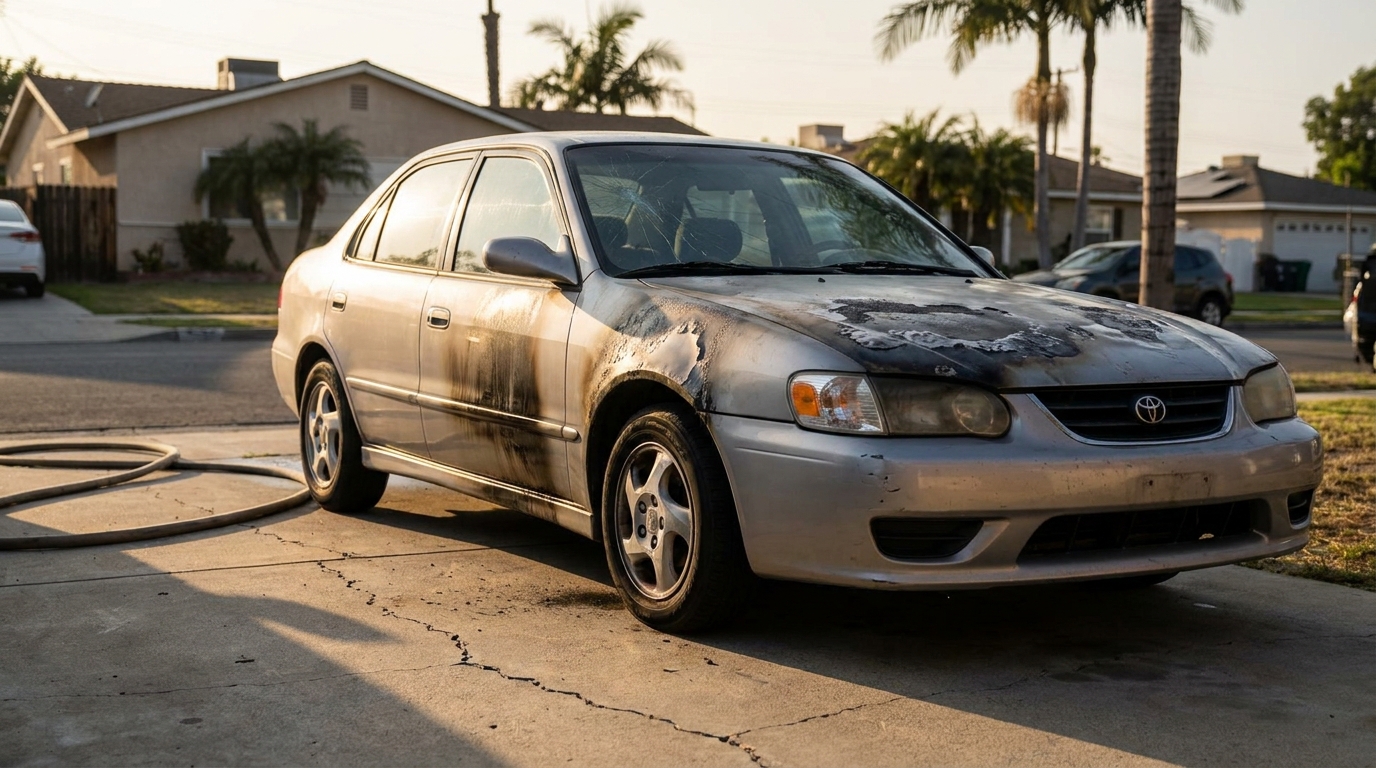
What Does Car Fire Damage Repair in Los Angeles Actually Involve?
If your car was burned, scorched, or exposed to heavy wildfire smoke in Los Angeles, the first thing a body shop needs to do is separate what you can see from what the heat has done internally. Car fire damage repair in Los Angeles is almost never a simple repaint and buff job. The visible blistered paint or melted trim is usually the least expensive part. The bills that surprise owners are the ones hiding underneath: a wiring harness that conducted heat through the firewall, ADAS cameras with heat-compromised housings, airbag modules that triggered or deformed, and structural adhesives on aluminum unibodies that lose their bond strength well below the temperature at which paint bubbles. A shop that only quotes what it can see on walk-around will write you a low estimate that explodes once the car is on the lift.
Which Type of Fire Happened to Your Car, and Which Coverage Applies?
The coverage question comes first because it dictates your deductible, your claim track, and whether you have coverage at all. There are four distinct scenarios, and they do not all route through the same coverage.
| Fire Scenario | Coverage That Applies | Typical Deductible | Fault Treatment |
|---|---|---|---|
| Engine or electrical fire (car not in a crash) | Comprehensive | $500 most common; range $100–$2,000 | Non-fault; minor premium impact |
| Wildfire burns parked car (Eaton, Palisades, etc.) | Comprehensive | $500–$1,000 | Non-fault; minor premium impact |
| Smoke and soot only, car did not burn, parked near wildfire | Comprehensive (in most policies) | $500 most common | Non-fault |
| Fire breaks out after a crash you caused | Collision | $500–$1,000 | At-fault; larger premium impact |
| Stranger sets your car on fire (arson) | Comprehensive | $500 most common | Non-fault |
| Owner intentionally burns the car | Denied, insurance fraud | N/A | Claim denied; potential criminal exposure |
Important: Liability-only policies do not cover your own vehicle’s fire damage under any scenario. Comprehensive coverage costs roughly $20 per month on average, with a common $500 deductible. Multiple comprehensive claims in a short window can affect renewal eligibility even though each individual claim is treated as non-fault. If you are in a wildfire-prone area of LA, also check whether your insurer has imposed a binding moratorium on adding or increasing comprehensive coverage while an active fire is burning nearby, these moratoriums are real, and the time to confirm your coverage is before fire season, not during it.
Is a Fire-Damaged Car Repairable or a Total Loss in California?
California uses the Total Loss Formula (TLF), not a fixed percentage threshold. Under Vehicle Code Section 544, a vehicle is a total loss when it is “uneconomical to repair”, a judgment call applied through a specific calculation: if repair cost plus salvage value equals or exceeds the car’s actual cash value (ACV), the insurer declares a total loss. Most California carriers also apply internal guidelines in the 70–80% of ACV range as a trigger for deeper review, but that range is company policy, not state law. The insurer must provide a written valuation explanation under Insurance Code Section 560.
Fire damage is particularly prone to triggering total losses even on cars that look fixable from ten feet away. Here is why:
- Wiring harness damage: Heat travels through electrical conduits far beyond the visible burn zone. Replacing a complete wiring harness on a modern vehicle often runs $3,000–$8,000 in parts and labor alone, before anything else is touched.
- ADAS sensors and cameras: Cameras, radar units, and ultrasonic sensors have temperature limits well below an underhood fire temperature. Replacement plus calibration can add $500–$1,500 per system, and most fire-damaged cars have multiple compromised units. See our guide on airbag deployment and total-loss decisions in Los Angeles for how sensor damage stacks up in the TLF math.
- Airbag module deformation: Even if bags did not deploy, the heat-sensitive pyrotechnic charges and control modules on a car that sustained engine-compartment fire temperatures are typically flagged for replacement by manufacturer service bulletins.
- EV and hybrid battery packs: Thermal events in or near an EV battery can compromise individual cells that do not show damage on a visual inspection. High-voltage battery replacement costs on EVs frequently exceed the car’s ACV outright, making almost every significant EV fire a total loss. For LA-specific EV repair context, the guide on EV battery damage and total-loss decisions covers this in detail.
- Structural adhesives on aluminum unibodies: Luxury vehicles (BMW, Mercedes, Audi, Porsche) and many newer mainstream vehicles use structural bonding adhesives that begin losing shear strength at temperatures routinely reached in an underhood fire. A car can pass a visual frame inspection and still have compromised structural integrity.
The practical result: a car with $8,000 in visible fire damage and a salvage value of $6,000 on a vehicle with an ACV of $12,000 is a total loss in California before the hidden damage estimate is even written. ($8,000 + $6,000 = $14,000 >= $12,000 ACV.)
What Does Car Fire Damage Repair Actually Cost If It Is Repairable?
When repair is economically justified, costs depend on how far the fire spread, what the car’s systems are, and how much interior and paint work is needed alongside the mechanical repair. The ranges below reflect what LA body shops encounter on fire-damaged vehicles that insurers and owners choose to repair.
| Damage Category | What’s Involved | Typical LA Cost Range |
|---|---|---|
| Smoke and soot exterior only (no burn) | Chemical decontamination, clay bar, respray or reclear of soot-etched panels, HVAC cabin filter, interior detail | $800–$2,500 |
| Smoke odor, interior and HVAC | Ozone treatment, odor-absorbing media in HVAC plenum, seat and headliner cleaning or replacement | $500–$2,000 |
| Localized engine bay fire (caught early) | Damaged wiring sections, melted plastic covers, heat-damaged hoses, repaint of hood underside, engine flush | $2,500–$7,000 |
| Full underhood fire with cabin intrusion | Full or partial wiring harness, firewall insulation, dash components, structural inspection, multiple ADAS sensors | $8,000–$20,000+ |
| Exterior body and paint (fire-blistered panels) | Panel replacement or metal work, primer, color match, respray; luxury makes run 20–40% higher | $1,500–$6,000 per panel |
| ADAS recalibration (post-repair) | Front camera, radar, surround-view per system after sensor or windshield replacement | $500–$1,500 per system |
For context, standard LA collision repair ranges from roughly $300 for minor damage to $5,000 or more for major structural work. Fire repairs rarely fall in the minor category. A vehicle that looks like a $3,000 repair on the outside often carries $12,000+ in total documented damage once wiring, sensors, and odor remediation are fully scoped, which is precisely why so many fire-damaged cars end up as total losses.
What Does Smoke and Soot Damage Repair Cover for Cars That Did Not Burn?
After the January 2025 Eaton and Palisades Fires, thousands of LA vehicles parked in affected neighborhoods came away with no visible fire damage but heavy soot deposits, toxic ash contamination in HVAC systems, and clearcoat etching from acidic smoke particulates. These vehicles did not burn, but they are not undamaged.
Most comprehensive auto policies cover smoke and soot damage to a vehicle that did not burn, subject to your deductible. What a shop actually does for these cars:
- Chemical decontamination wash: Ash and soot contain toxic heavy metals and acids. A standard car wash spreads contamination and scratches clearcoat. Proper decon uses a pH-neutral pre-soak, followed by a clay bar process to lift embedded particles.
- Clearcoat evaluation and respray: Acidic soot etches clearcoat in as little as 24–48 hours, especially on dark colors. Panels that appear dull or hazy after decontamination often need a full reclear or color-and-clear respray, which cannot be polished away. Single-panel respray in LA runs $500–$900; multiple panels move quickly toward $2,000–$4,000.
- Cabin air filter and HVAC cleaning: Cabin filters trap fine particles but cannot stop ultrafine smoke particulates from coating evaporator coils. Replacement filters run $30–$80 in parts; professional HVAC treatment with an antimicrobial fogging agent adds $200–$400.
- Ozone and odor treatment: High-concentration ozone generators placed inside the sealed cabin oxidize smoke compounds. This typically requires 4–8 hours in a controlled environment and runs $300–$600 at a professional shop. Persistent odor may need a second treatment or headliner and seat foam replacement.
On AB 1795, the Smoke Damage Recovery Act signed by Governor Newsom in September 2026: the law establishes California’s first enforceable standards for smoke damage claims and creates a presumption that smoke damage within a wildfire impact zone resulted from that wildfire. The law is primarily structured around residential property claims, but it signals the direction California regulators are moving on wildfire smoke as a covered peril broadly. Vehicle owners filing smoke-only comprehensive claims should document soot presence with photos and timestamps, retain decontamination receipts, and push back if an adjuster argues cosmetic-only classification on panels showing clearcoat etch.
How Does the Comprehensive Claim Work for a Fire-Damaged Car in California?
Filing a comprehensive claim for fire damage follows a specific sequence. Missing a step, especially documentation, can slow payment or reduce your settlement.
- Step 1, Secure the fire or incident report. For wildfires, CAL FIRE or the LA County Fire Department will have an incident report. For engine fires or arson, call LAPD or your local department to document the event. Insurers require this; it establishes the cause and confirms a covered peril.
- Step 2, Photograph before anything is moved or touched. Capture the damage from every angle, including the engine bay, undercarriage, interior, and all four exterior panels. Timestamped photos from your phone are acceptable evidence.
- Step 3, File the claim immediately. Call your insurer or file online. Specify comprehensive, not collision. Provide the fire/incident report number. Ask for your deductible amount in writing and confirm rental car or loss-of-use coverage.
- Step 4, Get an independent estimate before the adjuster inspects. An insurer’s drive-in appraiser often writes a surface estimate. A body shop teardown, where components are removed and wiring is traced, catches hidden damage that a drive-in misses. Request a supplement process in writing if the shop finds additional damage after teardown.
- Step 5, Understand the betterment and depreciation lines. Insurers may apply depreciation to worn components (tires, battery, interior fabric) replaced as part of fire repair. This is called betterment. You pay the depreciated portion; the insurer pays the balance. Negotiate line items that are clearly fire-caused rather than pre-existing wear.
- Step 6, If totaled, verify the ACV before signing. The insurer must provide a written valuation. Compare it against recent sales of identical makes, models, trims, and mileage in the LA market. California Civil Code Section 3333 allows you to claim diminished value as a separate item if the car is repaired rather than totaled, vehicles typically lose 10–25% of market value after significant fire damage, and you have a two-year statute of limitations to pursue that claim.
Common Mistakes to Avoid
- Washing a soot-covered car at a regular car wash. Abrasive brushes grind ash particles into clearcoat. Rinse gently with a hose first; use a decontamination-specific pre-soak or bring it to a body shop before any automated wash.
- Accepting the first drive-in estimate as final. Fire damage has a documented tendency to hide. An adjuster who spends twenty minutes on a walk-around cannot see a wiring harness failure or a heat-compromised airbag module. Get a full teardown estimate from a qualified shop.
- Filing under collision when comprehensive is correct. Routing a fire claim through collision raises your at-fault incident count and will affect your premium more at renewal. Confirm the correct coverage type with your agent before you file.
- Waiting to add comprehensive coverage during an active fire. Insurers impose binding moratoriums on new or increased comprehensive coverage within a proximity radius of an active wildfire. Add coverage before fire season, not when you smell smoke.
- Signing a total-loss settlement without checking LA-market comparables. ACV calculations on older or lower-volume vehicles in LA are frequently undervalued by national tools. Pull local listings for your exact trim and mileage before accepting.
- Skipping odor treatment and assuming the smell fades. Smoke compounds bond to porous materials, foam, carpet backing, headliner fabric, and do not dissipate on their own. A car that smells like smoke at resale or lease return carries a documented value hit, and professional ozone treatment is the only reliable solution.
Frequently Asked Questions
Does comprehensive insurance cover wildfire damage to a parked car in Los Angeles?
Yes. A car burned or damaged by a wildfire while parked is covered under comprehensive, not collision. Comprehensive also typically covers smoke and soot damage to a car that was not directly burned but was parked in the path of wildfire smoke. Your deductible applies, and the claim is treated as non-fault, so the premium impact is generally smaller than an at-fault collision claim.
How does California decide if a fire-damaged car is a total loss?
California uses the Total Loss Formula under Vehicle Code Section 544: if repair cost plus salvage value equals or exceeds the vehicle’s actual cash value, the car is a total loss. There is no fixed percentage in state law. Most California insurers also apply internal guidelines around 70–80% of ACV as a threshold for deeper review, but that is company policy. Fire damage frequently triggers total-loss findings because hidden costs, wiring, sensors, structural adhesives, push the repair estimate far above what the car looks like on the surface.
What if my car smells like smoke but was not burned?
Smoke and soot damage to a car that did not burn is generally covered under comprehensive. A body shop will assess clearcoat etching from acidic particulates, contamination in the HVAC system, and cabin odor. Ozone treatment, HVAC cleaning, and potentially a panel respray are the standard scope. Document soot presence with photos and timestamps before having the car cleaned, and file a comprehensive claim with your fire or incident report.
Does filing a comprehensive fire claim raise my insurance rates in California?
A single comprehensive claim for fire, including wildfire, engine fire, or arson, is treated as a non-fault event. The premium impact is typically smaller than an at-fault collision claim. However, multiple comprehensive claims within a short window, such as two wildfire claims in two fire seasons, can affect your renewal eligibility or trigger a surcharge with some carriers. Check your policy’s claims frequency language before filing.
Can I claim diminished value after a fire repair in California?
Yes. California Civil Code Section 3333 allows you to claim diminished value, the difference between your car’s market value before the fire and its market value after repair. Fire-damaged and repaired vehicles typically lose 10–25% of their pre-loss market value, and a body shop can document the repair scope to support that claim. You have a two-year statute of limitations to file a diminished value claim in California. For more on what shops document and how the process works, see our post on diminished value and parked-car damage claims.
0 Comments