

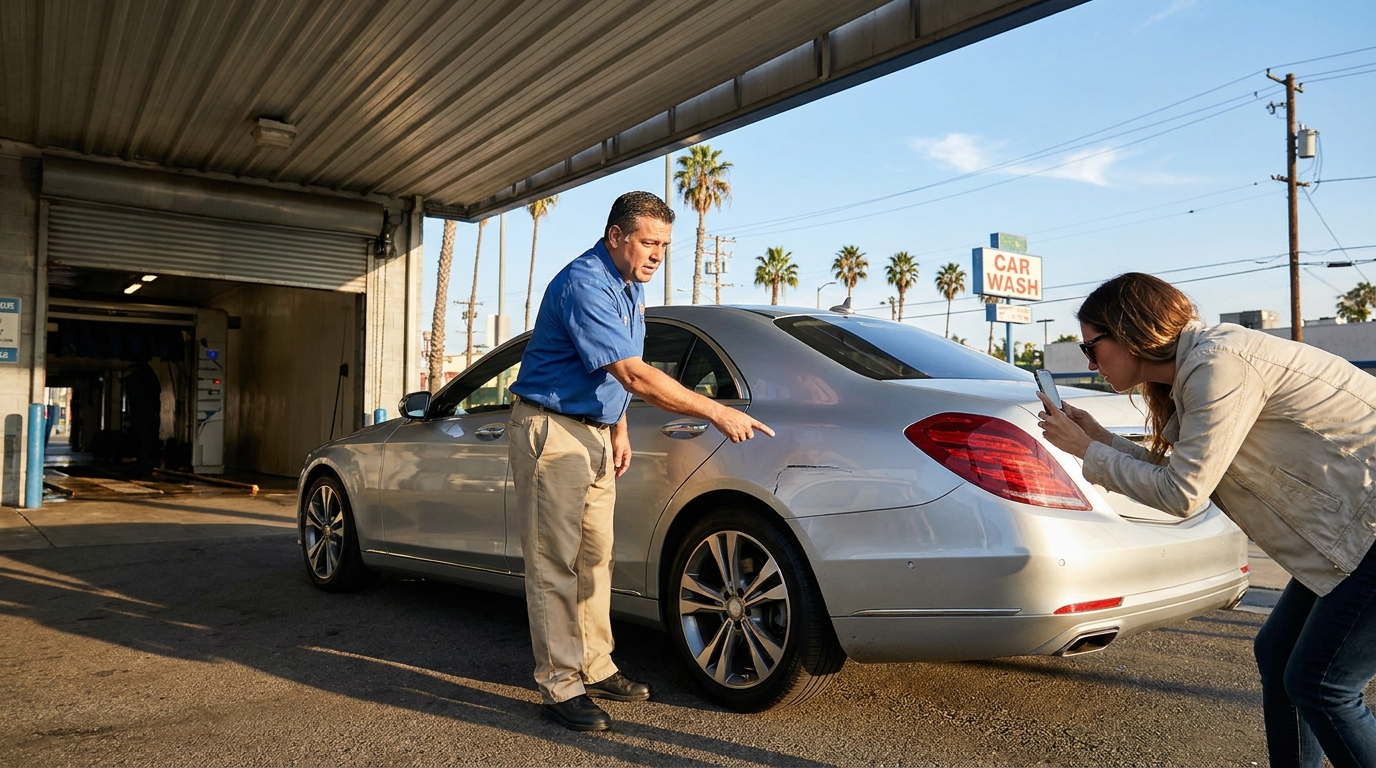
Who Pays for Car Wash Damage in Los Angeles?
The short answer: the car wash pays when its equipment or employees caused the damage; you pay (or your insurer pays) when driver error or a pre-existing condition was the cause. California law, specifically Civil Code §1714, holds businesses accountable when they fail to take reasonable care of someone else’s property, and a car wash is no exception. The legal concept behind this is bailment: the moment an automated or attendant-operated wash takes control of your vehicle, a mutual-benefit bailment is created, and the wash owes you a duty of ordinary care. If your car enters the wash undamaged and exits scratched, many courts presume the wash was negligent and require it to prove otherwise, not you.
Critically for Los Angeles drivers: California Civil Code §1714 means a disclaimer sign posted at the entrance does not automatically protect the car wash from liability if its equipment was poorly maintained or its employees were improperly trained. A receipt disclaimer may limit some liability, but California courts have historically refused to let businesses use boilerplate language to excuse their own negligence.
When Is the Car Wash Liable vs. When Are You?
Fault is usually clear once you know what to look for. The car wash is typically liable when damage results from malfunctioning machinery, dirty or worn brushes, insufficient employee training, or a safety-protocol failure. You are typically liable when you ignored posted instructions, for example, leaving an antenna up, failing to fold a power mirror, or carrying aftermarket accessories that the conveyor snagged. Self-serve coin-operated washes where you operate the equipment yourself present a different situation: because the wash never takes meaningful possession or control, bailment may not apply and the duty-of-care argument is weaker.
| Situation | Who Is Typically Liable | Why |
|---|---|---|
| Equipment malfunction tears off mirror | Car wash | Failure to maintain machinery to a safe standard |
| Dirty brushes leave swirl marks across hood | Car wash | Failure to keep equipment clean and safe for paint |
| Driver leaves antenna up; antenna snaps | Driver | Ignored posted instructions; foreseeable result |
| Aftermarket spoiler ripped off by conveyor | Driver (usually) | Non-OEM accessory not compatible with the equipment |
| Employee misaligns vehicle; door strikes guide rail | Car wash | Employee error during attendant-controlled placement |
| Self-serve wand scratches paint | Driver | No bailment; driver operated the equipment |
Does Insurance Cover Car Wash Damage in California?
Three coverage paths exist, and knowing the deductible math before you choose one can save you money.
- Car wash’s general liability insurance: If the wash is at fault, file a claim directly with its insurer. Request the incident report and the manager’s insurance information on the spot. You owe nothing toward your own deductible. If an insurer pays you first, it can pursue the wash through subrogation.
- Your comprehensive coverage: Applies when an object (a broken brush arm, a guide rail) strikes your stationary vehicle. Comprehensive covers non-collision contact damage. Your deductible applies.
- Your collision coverage: May apply if the damage is classified as a moving collision inside the wash (your car hitting a fixed object). Your deductible applies, and a claim could affect your rate.
The deductible rule: Get a written repair estimate from a body shop before filing any claim against your own policy. If the repair costs less than your deductible, common for single-panel swirl correction or a minor bumper scuff, paying out of pocket is smarter. A body shop estimate is free and gives you the hard number you need to make that call. For car wash damage repair in Los Angeles, many cosmetic fixes fall under a $500 deductible, making a direct claim unnecessary.
You can also document diminished value: any reportable repair on your CARFAX record can reduce resale value. A body shop can prepare a written diminished-value statement to support a claim against the wash’s insurer. See our guide on keyed car repair in Los Angeles for a parallel example of how the deductible decision works across cosmetic paint damage.
What Does Car Wash Damage Repair Cost in Los Angeles?
LA body shops run labor rates of roughly $100–$150 per hour, with Westside shops (Beverly Hills, Santa Monica, West Hollywood) typically at the top of that range and San Fernando Valley and East LA shops trending lower. That gap over national averages means quotes here commonly run 20–30% higher than what online estimators show. Here are realistic cost ranges by damage type:
| Damage Type | Repair Method | Typical LA Cost Range |
|---|---|---|
| Swirl marks / clear-coat haze (single panel) | Machine polish / paint correction | $150–$400 |
| Swirl marks across full vehicle | Multi-stage paint correction | $400–$900 |
| Deep scratch to color coat (single panel) | Wet-sand, spot repaint, blend adjacent panel | $500–$1,100 |
| Brush-induced ding / shallow dent, no paint break | Paintless dent repair (PDR) | $100–$350 per dent |
| Bumper cover, cracked or pulled | R&I, repair or replace, repaint, blend | $600–$1,400 |
| Side mirror, snapped off | OEM replacement assembly + paint match | $350–$900 (higher on luxury/EV) |
| Antenna snapped | Replacement part + fitting | $80–$250 |
| Trim molding / emblem torn off | OEM or aftermarket replace + adhesive/clip set | $150–$500 |
| Windshield chip from debris | Resin injection repair | $100–$200 |
| Full single-panel repaint (e.g., hood or fender) | Prep, prime, color, clear, blend neighbor panel | $700–$1,500 |
Luxury vehicles, EVs, and cars with specialty finishes (pearl, matte, tri-coat, OEM wrapped panels on models like the Rivian or Cybertruck) add 25–50% to paint and parts costs. If your car has a camera or sensor integrated into the mirror or bumper, recalibration adds another $150–$400. For Tesla and other EV-specific body repair scenarios, see our breakdown on Tesla bumper repair in Los Angeles.
Polish It Out or Repaint? How to Tell the Difference
This is the most important decision after car wash damage, and no ranking page actually explains it. Your car’s paint has four layers: primer, color coat, clear coat, and (on some newer vehicles) a ceramic or PPF topcoat. Car wash damage almost always hits the clear coat first. Here is how to read what you have:
- Swirl marks or light haze: Look at the panel in direct sunlight or under a shop light. Fine circular scratches visible only in strong light, with no depth you can feel with a fingernail, are surface clear-coat abrasion. A machine polish with a cutting compound removes the damaged surface layer and restores clarity. No repainting required.
- Deeper scratches with white or grey edges: Run your fingernail across the scratch. If it catches, the clear coat is breached and the color coat is exposed. This requires wet-sanding to level the surface, a spot color application, a fresh clear coat, and blending into the adjacent panel so the repair is invisible. Machine polish alone will not fix it.
- White, chalky, or peeling clear coat around the scratch: Clear-coat failure has begun. The affected area needs full-panel prep and repaint. Polishing a failing clear coat accelerates the delamination. For context on how UV and environmental stress accelerate this in Southern California, see our post on wildfire ash paint damage repair in Los Angeles, which covers the same polish-vs-repaint threshold for chemically etched finishes.
- Brush-induced small dents with intact paint: If the paint surface is unbroken and the dent has no sharp creases, paintless dent repair (PDR) is the correct method. A PDR technician uses metal rods and glue tabs to massage the panel back to factory shape from behind, with no filler or repainting. For a detailed breakdown of when PDR qualifies, see our guide on paintless dent repair Los Angeles cost.
The LA Playbook: What to Do at the Car Wash Right Now
What you do in the first 15 minutes determines how smoothly any claim goes. Many SoCal tunnel and express washes post liability disclaimers, but as noted above, California law limits how much those disclaimers actually protect a negligent operator. Documentation is your leverage.
- Stop before leaving the property. Once you drive off-site, proving the damage happened at that wash becomes significantly harder.
- Photograph your car before entering. Most modern phones timestamp and geotag photos. A pre-wash photo proving the panel was damage-free is your strongest piece of evidence.
- Photograph all damage immediately after exiting. Capture the full panel, a close-up showing depth, and any equipment debris on the car (brush bristles, roller material).
- Request an incident report from the manager. Ask for a copy in writing, including the manager’s name, the date, the time, and the equipment involved. If they refuse, note that refusal and document it.
- Get the wash’s insurance information. A legitimate business will have general liability coverage. If they will not provide it, that is a red flag for a small-claims filing.
- Get a written body shop estimate before accepting any settlement offer. Many washes will offer a lowball cash settlement on the spot. A shop estimate locks in the actual scope and cost of the repair.
- Check for CCTV footage. Ask the manager to preserve footage of your vehicle moving through the wash. In California, businesses are not required to keep footage indefinitely, and it can be deleted quickly.
Common Mistakes to Avoid
- Leaving the car wash property before documenting damage. You lose your ability to prove cause-and-effect once you drive away.
- Accepting a verbal apology as a resolution. Get everything in writing, including any offer to pay for repairs.
- Filing an insurance claim without a shop estimate first. If the repair costs less than your deductible, filing raises your rate for no benefit.
- Assuming a disclaimer sign ends your claim. Under California Civil Code §1714, negligence by the wash cannot be waived simply by posting a sign.
- Using a polishing compound on a scratch that has breached the color coat. It removes more clear coat without fixing the damage and can make a repaint more expensive.
- Choosing a mirror or trim replacement based on price alone. Aftermarket assemblies often lack the paint code matching and clip fitment of OEM parts, leading to color mismatch or rattling.
- Neglecting to document diminished value. If the repair goes on your vehicle history, a written diminished-value estimate supports a full-cost claim against the wash’s insurer.
Frequently Asked Questions
Who pays when a car wash scratches my car in Los Angeles?
If the wash’s equipment or employees caused the damage, the car wash’s general liability insurer is responsible. California Civil Code §1714 holds businesses to a duty of reasonable care, and the bailment principle means the wash must prove it was not negligent once you show the car entered undamaged and exited scratched. If fault is disputed or the wash is uninsured, your own comprehensive or collision coverage is the backup, subject to your deductible.
Does a disclaimer sign at the car wash protect them from paying?
Not automatically, and especially not in California. The state’s Civil Code limits how much a disclaimer can protect a negligent business. A sign that says “not responsible for damage” does not override a legally imposed duty of care. Courts look at whether the damage resulted from the wash’s own negligence, and if it did, the disclaimer is unlikely to hold. Documentation of the damage and the wash’s conditions is what makes or breaks the claim.
What does car wash scratch repair cost in Los Angeles?
Surface swirl marks buffed by a machine polish run $150–$400 for one panel, or $400–$900 for a full vehicle correction. A deeper scratch that has breached the color coat requires wet-sanding, a spot repaint, and a blend coat on the adjacent panel, typically $500–$1,100 per panel at LA rates. A full single-panel repaint runs $700–$1,500. LA shop labor rates of $100–$150 per hour mean quotes here run 20–30% above national online estimators.
Should I file an insurance claim or pay out of pocket for car wash damage?
Get a written body shop estimate first. If the repair cost is below your deductible, filing a claim against your own policy is rarely worth it, you pay the full repair cost anyway and risk a rate increase. If the repair exceeds your deductible and the wash disputes liability, filing with your insurer and letting them pursue the wash through subrogation is often the cleaner path. If the wash accepts fault, have them pay the shop directly.
Can a car wash rip off my mirror and not pay for it?
No, if the wash’s equipment caused the mirror to detach. A side mirror replacement in Los Angeles costs $350–$900 depending on the vehicle, whether it has integrated cameras or turn signals, and whether OEM or aftermarket parts are used. The wash’s general liability insurance should cover the part, labor, and any paint matching. If they refuse, a small-claims filing (up to $12,500 in California as of 2024) is a realistic and low-cost option for mirror and trim damage.
0 Comments