

What Happens When a City Vehicle Hits Your Car in Los Angeles?
A city vehicle hit your car in Los Angeles, now you need two things answered fast: what did it actually break, and how do you get the government to pay for it? The repair scope and the claim deadline depend on which type of municipal vehicle struck you and how hard. Skip either step and you either overpay or forfeit your right to reimbursement entirely.
What Does a Street Sweeper, City Bus, or Government Truck Actually Damage?
Each municipal vehicle creates a distinct damage pattern. Knowing what your car suffered helps you push back if an adjuster tries to minimize the scope.
Street Sweeper Strikes
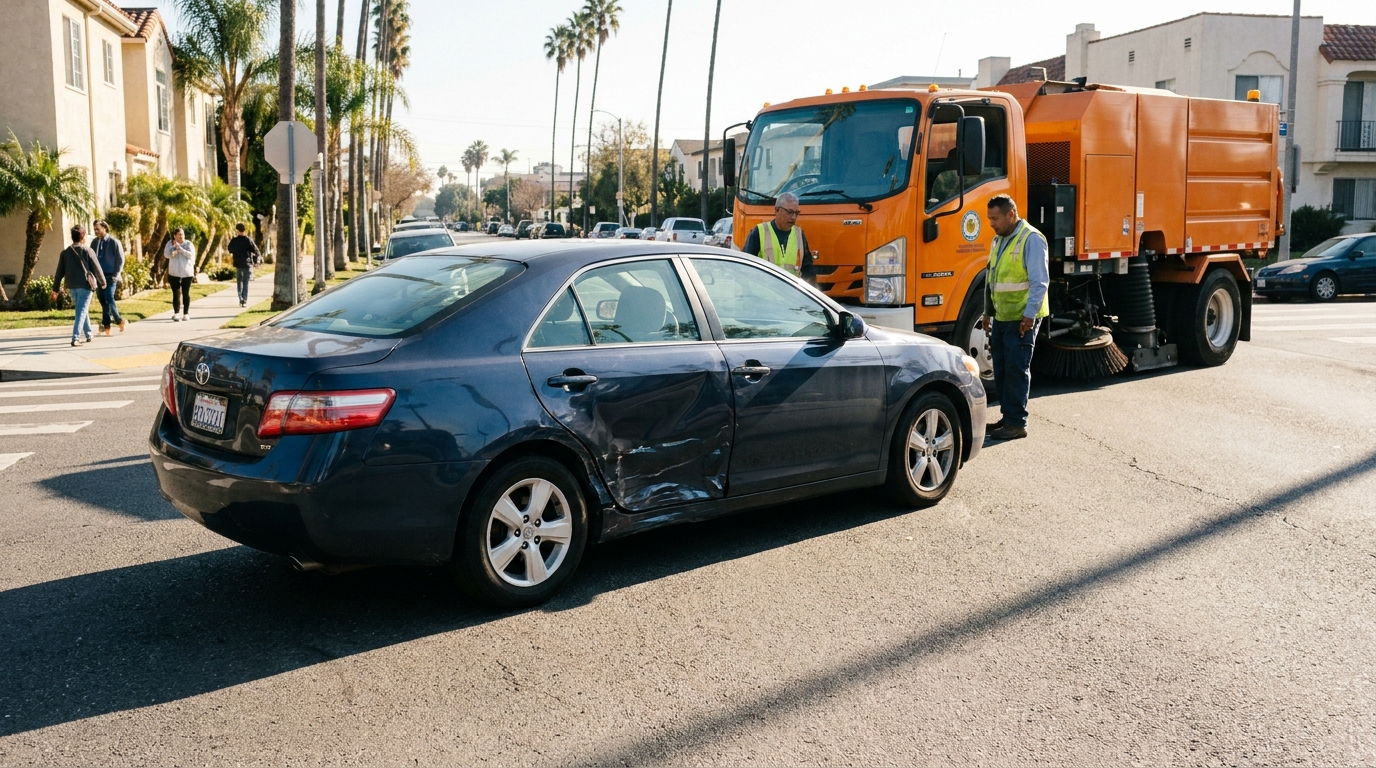
Street sweepers operate at low speed, but their rotating cylindrical brushes and heavy steel chassis extend low to the ground and wide toward parked cars. A sweeper contact is almost never just a paint scratch. The brush head typically catches the rocker panel, rear quarter panel, and sometimes the rear wheel and tire. If the chassis itself makes contact, the rear door, lower body, and fender can crumple inward. Because the strike occurs at the vehicle’s lowest point, wheel arch liners and suspension components can be disturbed even when the outer sheet metal looks minor. ADAS sensors mounted behind rear bumper fascias may be knocked out of alignment.
City Bus Strikes
A city bus weighs between 25,000 and 40,000 pounds. Even a low-speed bus sideswipe or pull-out from a bus stop carries enough energy to bend structural rails, not just deform outer panels. Common damage includes crushed doors, bent B-pillars, deployed side curtain airbags, and pushed-in rocker structure. Because modern vehicles use their door sills as load-bearing frame rails, a bus strike at door height can push the vehicle out of its factory frame dimensions. That requires a frame-straightening rack and post-repair dimensional verification before the car is safe to drive. See our detailed guide on what a body shop actually finds after a collision for how hidden structural damage gets documented.
Police Cars, Sanitation Trucks, and Other Government Vehicles
Police cruisers are typically heavier than civilian sedans and are often push-bumper equipped. A rear-end or side strike from a patrol car commonly damages bumper assemblies, trunk lids, quarter panels, and tail light housings, plus any sensors in the rear fascia. Sanitation trucks and DWP utility trucks are large enough to produce full structural impact when they back up into a parked car, a scenario that can result in a total-loss determination on smaller vehicles.
Repair Cost Ranges: Municipal Vehicle Damage at a Glance
| Strike Type | Primary Damage Zones | Typical Repair Range (Los Angeles) | Structural Risk? |
|---|---|---|---|
| Street sweeper brush contact | Rocker, rear quarter, wheel arch | $900 – $4,500 | Low to moderate |
| Street sweeper chassis contact | Rocker, quarter, door, suspension | $2,500 – $9,000+ | Moderate to high |
| Bus sideswipe (low speed) | Doors, B-pillar, rocker | $3,500 – $12,000 | High, frame check required |
| Government truck backing into car | Bumper, trunk, quarter panel | $1,800 – $8,000 | Moderate |
| Police cruiser rear-end strike | Bumper assembly, trunk, sensors | $2,000 – $7,500 | Moderate, ADAS calibration likely |
Any vehicle with radar, camera, or ultrasonic sensors in the struck zone will need ADAS recalibration after repair, a step that commonly adds $300 to $1,200 to the invoice depending on the number of systems involved. Tesla owners and luxury-vehicle owners should account for brand-specific calibration requirements on top of panel repair costs.
What Do You Do in the First 48 Hours After a City Vehicle Hits Your Car?
The evidence you collect at the scene and immediately after directly determines how strong your municipal claim is. Do all of the following before leaving:
- Photograph the unit number, every LADOT, LAPD, LA Metro, or sanitation vehicle has a unit/fleet number on the door or cab. This is the single most critical piece of identification.
- Photograph the agency decals, the markings tell you which entity operates the vehicle (City of LA, LA County, LA Metro, LAUSD, Caltrans, or a private contractor), which determines where you file.
- Document all visible damage immediately, shoot every panel, all four corners, the undercarriage if accessible, and any fluids on the ground.
- Get the driver’s information, name, badge or employee number, and the agency they work for.
- Collect witness contact information, independent witness names and phone numbers carry significant weight in a disputed claim.
- Request a police report, call LAPD non-emergency (877-275-5273) if officers were not already at the scene. A police report number is referenced on Form 100-A.
- Note road and GPS coordinates, the claim form requires the precise location of the incident, including nearest cross street.
- Bring your car to a body shop within 72 hours, a written repair estimate from a licensed shop, along with a technician’s causation note tying specific damage to the type of impact described, is the most useful document you can submit with your claim.
Which Entity Do You File Against, and Why Getting This Wrong Is Costly?
Filing against the wrong government entity is the single most common reason valid municipal vehicle claims are rejected. Each agency maintains its own claims process. Filing with the City of Los Angeles when the vehicle belonged to LA Metro does nothing, and time continues to run against you.
| Vehicle Type | Likely Operating Entity | Where to File |
|---|---|---|
| Street sweeper | City of LA Bureau of Sanitation OR private contractor | City Clerk (City of LA) or contractor’s insurer |
| City bus (Metro) | LA Metro (separate from City of LA) | LA Metro Claims, not the LA City Clerk |
| DASH or LADOT bus | City of LA Department of Transportation | LA City Clerk, Form 100-A |
| Police cruiser (LAPD) | City of LA | LA City Clerk, Form 100-A |
| Sheriff or county vehicle | LA County | LA County Auditor-Controller Claims |
| Caltrans truck (freeway) | State of California | California Victim Compensation Board / Dept. of General Services |
| LAUSD bus | Los Angeles Unified School District | LAUSD Risk Management |
If you are unsure which agency owns a vehicle, the unit number photographed at the scene is the fastest way to verify through a public records request or by calling the relevant agency’s public information line. When multiple agencies could be involved, file separately against each, the cost of an extra filing is far lower than losing a valid claim.
How Does the Los Angeles Municipal Claim Deadline Actually Work?
This is where most online guides mislead drivers. The California Government Claims Act (Gov. Code §911.2) sets the presentation window before any lawsuit can proceed. Here is what it actually says for your situation:
Your car is personal property. Under Gov. Code §911.2, claims for personal injury, wrongful death, and damage to personal property must be presented to the public entity within six months of the incident date. The Form 100-A instruction sheet itself states this deadline explicitly. The one-year window under §911.2 applies to real property damage and other non-personal-property/non-injury claim categories, not to your vehicle.
Every personal-injury law firm online repeats “six months” for injury cases, and some sources loosely say property damage gets a year. For your car, which is personal property, the deadline is the same six months. Do not rely on the one-year figure for a vehicle damage claim against a California public entity.
Key dates to track:
- Day 0: The incident. Your six-month clock starts here.
- Within 6 months: Your written claim (Form 100-A for City of LA, equivalent for other agencies) must be received by the correct entity, not just postmarked.
- Within 45 days of filing: The City must accept, reject, or let the claim lapse. No response within 45 days is a deemed rejection by operation of law (Gov. Code §912.4).
- Within 6 months of rejection: You generally have six months from a written rejection notice to file suit in court (Gov. Code §945.6).
- Missed the 6-month window? A late-claim application under Gov. Code §911.4 is possible up to one year from the incident with a written explanation of the delay. Beyond one year, relief is generally unavailable.
How to File Form 100-A With the City of Los Angeles
For incidents involving a City of LA vehicle (LAPD, LADOT, Bureau of Sanitation, etc.), the claim form is Form 100-A, Claim for Damages to Person or Property, filed with the Office of the City Clerk, 200 North Spring Street, Room 395, City Hall, Los Angeles, CA 90012. Do not file with the City Attorney’s office, that office explicitly does not accept claims and filing there does not start your claim.
Three accepted methods:
- Online at claims.lacity.org, you receive a claim number immediately upon submission.
- In person at City Hall, Room 395.
- By mail to the address above.
Faxed and emailed claims are not accepted. Any claim missing mandatory fields (marked with an asterisk on the form) can be returned as insufficient, and your six-month clock keeps running while you correct it.
For damages under $10,000, state the exact dollar amount. For damages above $10,000, do not include a specific number, write that damages exceed $10,000. This is a formal requirement under Gov. Code §910; getting it backward can complicate your claim.
What a Body Shop Documents That Strengthens Your Municipal Claim
A repair estimate alone is rarely enough. The documents most likely to move a municipal property-damage claim toward acceptance are:
- A written repair estimate on shop letterhead, itemized by panel, labor hours, and parts. Line-item specificity makes it harder to dispute.
- A technician’s causation statement, a signed note from the technician identifying which damage pattern is consistent with a specific type of impact (e.g., rotating brush contact at rocker height, or lateral bus-height impact at door level). This ties the damage to the described incident rather than pre-existing wear.
- Dated photos taken at the shop during disassembly, hidden damage found once panels come off (bent subframe rails, damaged wheel bearings, kinked brake lines) is commonly missed in drive-by municipal investigations.
- Tow receipts, rental car invoices, and rideshare charges, these are separate compensable damages, list them in the claim.
- ADAS recalibration invoice, if required after repair, this is a legitimate line item the city must account for.
Getting your car into a qualified collision center quickly serves both purposes: you document the damage while it is fresh, and you get the estimate you need to file your claim accurately. If you drive an EV or a vehicle with advanced driver-assistance systems, bring it to a shop experienced with those platforms, sensor recalibration requirements are vehicle-specific and must be documented correctly.
Should You Use Your Own Insurance or Wait on the City’s Claim?
This is a real decision with trade-offs. The City of LA has 45 days to respond to your claim. Many property-damage claims are disputed or denied, leading to a litigation process that can stretch months longer. Your options:
- File the municipal claim and wait, lowest out-of-pocket cost if approved, but you are without a repaired car or reimbursement for potentially months. Risk: the 45-day deemed-denial clock.
- Use your own collision coverage, then subrogate, your insurer pays for the repair now (minus your deductible), then pursues the city for reimbursement on your behalf. If successful, your deductible is returned. This gets your car repaired quickly without waiting on a government response.
- Pay out of pocket and submit receipts, viable if the damage is modest and you can afford to float the cost. Submit the final invoice plus the technician’s causation statement with your Form 100-A. If the city pays, you are made whole.
For damage above $3,000 or any structural repair, using collision coverage and letting your insurer handle subrogation is typically the least stressful path. For a neighbor’s situation involving a parked car hit and left, the process differs, see how coverage works when someone hit your parked car in Los Angeles.
Common Mistakes to Avoid
- Filing against the wrong entity, a Form 100-A filed with the City Clerk does nothing if the vehicle was an LA Metro bus. Identify the operator before you file.
- Assuming you have one year, your car is personal property, which falls under the six-month window under Gov. Code §911.2, not the one-year category. Acting on the wrong deadline is one of the costliest errors in government vehicle claims.
- Filing with the City Attorney instead of the City Clerk, the City Attorney’s office explicitly does not accept claims; only the City Clerk at Room 395, City Hall does.
- Submitting a claim without a repair estimate or technician note, a bare description of damage without professional documentation gives the city no basis to calculate reimbursement and gives adjusters room to minimize the payout.
- Omitting tow and rental costs from the claim, these are compensable losses. If you don’t list them, you don’t get paid for them.
- Waiting to photograph the damage, rust, further wear, and weather can obscure the fresh damage pattern that ties your car to the specific impact. Document within hours, not days.
- Missing the ADAS recalibration requirement, repairing panels without recalibrating cameras and radar sensors leaves your car unsafe and creates a gap in your documented damages.
Frequently Asked Questions
How long do I have to file a claim after a city vehicle hit my car in Los Angeles?
Your car is personal property, so under California Government Code §911.2, the claim must be presented to the public entity within six months of the incident date. Do not rely on a one-year figure, that deadline applies to real property damage and contract claims, not vehicle damage. If you miss the six-month window, a late-claim application under §911.4 is possible up to one year, but approval is not guaranteed and requires a written explanation of the delay.
Where exactly do I file a city vehicle property damage claim in Los Angeles?
For City of LA vehicles, file Form 100-A with the Office of the City Clerk, 200 North Spring Street, Room 395, City Hall, Los Angeles, CA 90012. You can file online at claims.lacity.org, in person, or by mail. Faxed and emailed claims are not accepted. If the vehicle was an LA Metro bus, LA County vehicle, LAUSD bus, or Caltrans truck, each agency has its own separate claims process, filing with the wrong office does not count and does not pause the deadline.
What happens after I submit the claim form?
The City Clerk issues a claim number, then transfers your claim to the City Attorney’s office for investigation. A claims adjuster is assigned. The City has 45 days to accept, reject, or let the claim lapse. No response within 45 days constitutes a deemed rejection by operation of law. After a written rejection, you generally have six months to file a lawsuit in court under Gov. Code §945.6.
Do I need a body shop estimate before filing?
You are not required to have an estimate before filing, but filing without one is a strategic mistake. A shop estimate itemized by panel and labor hours, paired with a technician’s causation note explaining which damage is consistent with the described impact, gives the city’s adjuster a concrete basis to calculate damages. Claims submitted without supporting documentation are routinely minimized or denied. Get the estimate before or immediately after filing.
Can a street sweeper actually cause structural damage?
Yes, when the sweeper’s steel chassis makes contact rather than just the rotating brush. Chassis contact along the rocker panel can deform the vehicle’s structural sill, which is a load-bearing component in unibody vehicles. Frame-straightening equipment and post-repair dimensional measurement are required before the car is safe. Even brush-only contact can disturb wheel arch geometry and ADAS sensors mounted in the rear fascia, both require professional inspection, not just a paint touch-up.
Getting Your Car Repaired While the Claim Is Pending
A municipal claim can take weeks to resolve, and a denied claim can extend the process by months. Waiting with a structurally compromised or visually damaged vehicle is not practical for most LA drivers. The cleanest path is to bring the car to a collision repair shop, get a detailed estimate and a technician’s causation note, then decide whether to use your own collision coverage for immediate repair or pay and submit receipts with your claim.
If your vehicle has advanced driver assistance systems, bring it to a shop that can handle both the body repair and required ADAS recalibration in one visit. For Tesla and EV owners dealing with municipal vehicle strikes, the structural and sensor repair requirements are more involved, the repair guide for Tesla bumper repair in Los Angeles covers the calibration requirements that apply to rear-end and side impacts specifically.
Drivers in West Hollywood, Silver Lake, Echo Park, Mid-City, and other neighborhoods where street sweepers operate on tight residential schedules are especially common victims of sweeper-related strikes. A detailed collision repair walkthrough tailored to Los Angeles drivers is available in our West Hollywood collision repair guide, including how to handle insurance coordination when a third party is at fault.
0 Comments