

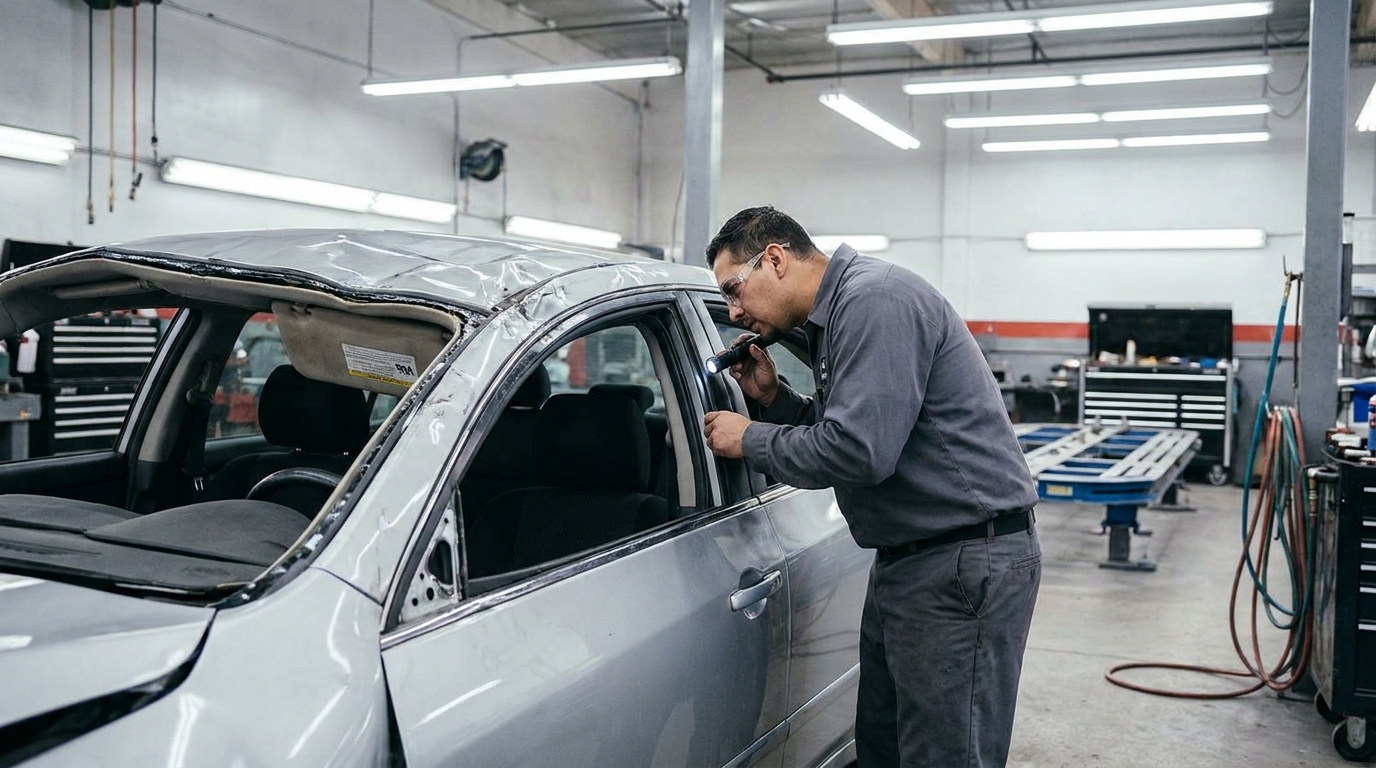
Can a Crushed Car Roof Actually Be Repaired?
Yes, a crushed car roof can be repaired, but whether it should be repaired depends on how far the structure collapsed and what it cost relative to the car’s pre-accident value. A single roof dent with paint intact is a straightforward paintless dent repair job. A rollover that buckled the A- or B-pillars is a structural safety repair that may exceed the vehicle’s worth entirely. The answer lives somewhere on that spectrum, and a thorough inspection by a qualified body shop is the only way to place your car on it.
For crushed car roof repair in Los Angeles, the starting point is understanding which of three repair categories your car falls into, because the cost, timeline, and safety implications of each are completely different.
What Are the Three Repair Categories for a Crushed Roof?
The right repair path depends on the depth of damage, not just how bad it looks. Here is how LA shops categorize roof damage:
- PDR (Paintless Dent Repair), cosmetic only: A single dent, hail strike, or low-impact roof contact where the paint is intact and the structural pillars are unaffected. A technician massages the metal back from below, sometimes after dropping the headliner for access. Cost in LA: $200–$600 per dent.
- Roof skin replacement, moderate damage: The roof skin panel is a welded structural piece. When a dent is too deep for PDR, or the paint is cracked and filler is needed, the full panel is cut away, a new skin is welded in, and the headliner is removed to allow proper access. The panel then goes through masking, primer, base coat, and clear coat for a color match. Cost in LA: $1,500–$4,500 for the skin plus paint.
- Structural rollover / crush repair, severe damage: The vehicle was inverted or the roof took a major impact. The A-, B-, or C-pillars show bending or creasing, the unibody may have shifted, and the crossmembers that tie the pillars together are compromised. This requires a frame rack, sectioning, and welding to factory tolerances. Cost in LA starts around $3,000 and frequently exceeds $10,000, with many vehicles declared total losses before a wrench is turned.
Crushed Car Roof Repair Cost in Los Angeles: Full Breakdown
LA labor rates at I-CAR Gold Class and OEM-certified shops run roughly $75–$145 per hour, which is meaningfully higher than national averages. That range drives multi-panel structural jobs well past what generic national cost guides quote. The table below reflects real LA pricing.
| Damage Type | LA Cost Range | Repairable? | Typical Timeline |
|---|---|---|---|
| Single roof dent, paint intact (PDR) | $200 – $600 | Yes | Half-day to 1 day |
| Dent + full roof repaint | $1,000 – $3,000 | Yes | 2–4 days |
| Welded roof skin replacement + paint | $1,500 – $4,500 | Yes | 3–5 days |
| Minor structural pull (pillar kink, no sectioning) | $2,500 – $5,000 | Often yes | 5–8 days |
| Moderate rollover (multi-pillar, unibody distortion) | $5,000 – $10,000 | Sometimes | 2–4 weeks |
| Severe rollover / full crush | $10,000 – $15,000+ | Often total loss | N/A or 4–6+ weeks |
For context on how structural labor pricing compares across different collision scenarios, the guide on airbag deployment repairs and total-loss decisions in Los Angeles covers similar cost dynamics for another high-severity event.
Is a Rolled Car a Total Loss in California?
California does not use a fixed percentage threshold to declare a vehicle totaled. Instead, it uses the Total Loss Formula (TLF): if the cost of repairs plus the vehicle’s salvage value equals or exceeds the car’s pre-accident actual cash value (ACV), the insurer must declare it a total loss. Because a rolled-over car that needs structural pillar and roof skin work can easily produce a $6,000–$12,000 repair estimate, and because that same damaged car may carry significant salvage value at auction, the formula can trigger a total loss even when repairs are only 50–60% of the car’s ACV.
Practically, this means a 2018 sedan worth $14,000 ACV with a $7,500 repair estimate and $6,500 salvage value hits the formula exactly at the total-loss line. The insurer pays you the ACV (minus your deductible) and keeps the salvage. If you think the ACV is undervalued, you have the right to dispute it with documentation of comparable vehicles in the LA market.
Rollover Damage vs. Total Loss: California Decision Table
| Scenario | Repair Estimate | Likely Outcome |
|---|---|---|
| PDR dent, no pillar damage | $200 – $600 | Repaired, rarely claimed |
| Roof skin + minor pillar kink, high-ACV car | $3,000 – $5,000 | Usually repaired |
| Roof skin + moderate pillar damage, mid-ACV car | $6,000 – $9,000 | Gray zone, depends on ACV and salvage |
| Full rollover, multi-pillar crush, any car | $10,000+ | Total loss in most cases |
| Luxury or EV with rollover, proprietary structure | $12,000 – $20,000+ | Almost always total loss |
Why Is Roof Crush a Safety Repair, Not a Cosmetic One?
The roof, A-pillars, B-pillars, C-pillars, and crossmembers are the primary rollover protection structure of your vehicle. Federal standard FMVSS 216 requires a vehicle roof to withstand roughly 1.5 times the vehicle’s unloaded weight without exceeding approximately 5 inches of intrusion, a standard that was strengthened for model year 2012 and newer vehicles. When that structure is compromised in a crash and then repaired incorrectly, it cannot perform that protective function in a future accident.
Beyond the roof itself, curtain airbags are anchored along the roofline and deploy using signals that travel through the pillar structure. If the B-pillar is bent and not restored to factory geometry, those airbags may not deploy correctly. Any vehicle with ADAS features, including cameras and radar mounted at the windshield base or roof, also requires recalibration after a structural repair, since sensor alignment depends on the precise geometry of the pillars and glass plane. Skipping recalibration is a safety deficiency that most LA insurers will not cover after-the-fact.
Rollovers represent only about 3% of serious crashes but account for roughly 30% of passenger-vehicle fatalities in the United States, which is precisely why roof-structure repairs must follow factory repair procedures and use OEM-spec materials and welding processes.
What Does a Shop Inspect on a Rollover Car Beyond the Roof?
A vehicle that has been inverted or has had its roof crushed has experienced forces that travel through the entire unibody structure. A thorough post-rollover inspection covers more than the visible roof damage:
- A-, B-, and C-pillars: Measured against factory specs on a frame-measuring system. Even a 3mm deviation matters for airbag and door-gap alignment.
- Unibody rails and rocker panels: Rollovers often load the rockers and floor pan in ways not visible from outside. A shop places the car on a frame rack and pulls measurements at multiple points.
- Glass and seals: The windshield and rear glass are bonded structural components in modern vehicles. Rollover forces frequently crack or debond the glass even if it looks intact, compromising roof rigidity.
- Suspension geometry: An inverted car that lands on its roof can bend subframe mounting points, shifting caster and camber values enough to cause handling problems or tire wear.
- Airbag modules and seat belt pretensioners: Side curtain bags and seatbelt pretensioners that fired during the rollover must be replaced, not reset. This alone can add $1,500–$4,000 to the repair bill.
- Headliner, interior, and electrical: Water and debris entry through shattered glass during a rollover frequently damages the headliner, wiring harnesses, and interior panels that must be quoted separately.
What If an Injury Claim Is Also in Play?
If people were hurt in the rollover, your attorney may need the vehicle preserved as evidence before repairs begin. This is not a reason to avoid talking to a body shop, but it is a reason to coordinate the sequence. A reputable shop in LA can photograph, document, and store the vehicle without beginning repairs, keeping the evidence chain intact for a liability or crashworthiness review while the injury claim proceeds. Do not let an insurance adjuster pressure you into a quick teardown or crush authorization before that documentation is complete. Once the car is disassembled or scrapped, the physical evidence is gone.
If you are only dealing with property damage and there are no personal injuries, there is no reason to delay the repair or inspection. Get the car into a qualified structural shop promptly, because deferred damage can allow moisture intrusion and secondary corrosion in bent metal seams.
Common Mistakes to Avoid
- Approving a cosmetic-only estimate on a structural car. If the pillars are bent and the shop only quotes a roof skin and paint, the structural damage is being ignored. Push for a full frame-system measurement before authorizing any work.
- Accepting the insurer’s first ACV without checking comparable sales. In the LA market, a vehicle’s real market value is often higher than what a desk adjuster’s database produces. Pull Craigslist and CarGurus comps for your exact trim, mileage, and zip code.
- Skipping ADAS recalibration. Any camera, radar, or lidar mounted at or near the roofline must be recalibrated after a structural repair. This is not optional and is not included in most base repair quotes.
- Authorizing salvage or crush before documenting the car if any injury claim or lawsuit is pending. Once the car is gone, the evidence is gone.
- Choosing a shop based on price alone for a rollover repair. Structural welding and sectioning on a modern unibody require OEM procedures. An under-equipped shop that uses non-OEM materials or skips post-weld stress relief can compromise the repair’s safety even if it looks correct from the outside.
- Assuming PDR is always faster or cheaper on a roof. On roofs where the headliner is bonded (common on newer European and EV platforms), headliner removal adds labor that can make PDR cost nearly as much as a skin replacement on some vehicles.
Rollover Damage Repair: The LA-Specific Variables
Los Angeles has some factors that make rollover and roof crush repair more expensive than national averages suggest. Shop labor rates on the Westside (Santa Monica, Culver City, West Hollywood) run toward the top of the $75–$145/hr range. I-CAR Gold Class and OEM-certified shops, which are the appropriate choice for any structural pillar repair, command premium rates because the certifications require ongoing training investments and proper equipment including dedicated aluminum welding stations and computerized frame systems.
Luxury and EV vehicles, which are especially common in LA, add another layer of cost. A Tesla, Rivian, or Porsche roof crush repair involves proprietary aluminum or high-strength steel sections that require OEM-approved repair procedures, special welders, and OEM replacement panels that are more expensive than stamped steel equivalents for conventional vehicles. On many of these platforms, even a moderate roof crush is a total loss because replacement panel costs alone exceed ACV thresholds. For related context, see the breakdown of Rivian collision repair costs in Los Angeles, where structural panel pricing follows similar logic.
Permit requirements also vary by LA municipality. Some structural repairs technically require a CHP brake and light inspection or a referee inspection before the vehicle can be re-registered after a salvage-title event, adding cost and time that out-of-state guides never mention.
Paintless Dent Repair vs. Roof Skin Replacement: Which Does Your Roof Need?
The PDR-or-replace decision on a roof comes down to three factors: paint condition, dent depth, and pillar involvement. If the paint is unbroken, the dent has no sharp creases, and the pillars are straight, PDR is the right call and costs far less. If the paint has cracked, the dent has a sharp ridge, or the deformation is within about 6 inches of a pillar seam, a skin replacement is the appropriate repair. Attempting PDR on a crease near a pillar risks work-hardening the metal, making a future skin replacement more difficult and expensive.
For more detail on how LA shops price and decide the PDR path, the post on paintless dent repair costs in Los Angeles covers per-dent pricing and what qualifies across a range of scenarios including roof panels.
Frequently Asked Questions
Can a crushed car roof be safely repaired in Los Angeles?
A roof with cosmetic denting and intact pillars can absolutely be repaired safely using PDR or a welded skin replacement. A roof where the A-, B-, or C-pillars have been bent or crushed requires structural repair to factory tolerances using OEM procedures. When done correctly at a qualified shop with proper frame-measuring equipment, the repair restores the vehicle’s rollover protection structure. When done poorly or incompletely, the structural integrity is not restored even if the car looks fine. Always confirm the shop has a computerized frame-measuring system and follows OEM structural repair procedures.
How much does rollover damage repair cost in Los Angeles?
Minor roof dents via PDR run $200–$600. A welded roof skin replacement with paint runs $1,500–$4,500. Moderate rollover damage involving pillar repair runs $5,000–$10,000. Severe rollovers with full crush start above $10,000 and frequently exceed $15,000, with many vehicles declared total losses before repairs begin. LA labor rates of $75–$145/hr push multi-panel structural jobs above what generic national cost guides quote.
Is a rolled car a total loss in California?
California uses the Total Loss Formula (TLF): if repair cost plus salvage value equals or exceeds the vehicle’s pre-accident actual cash value, the insurer must declare it a total loss. There is no fixed percentage threshold in California. Because rollover repairs on even moderately damaged vehicles can run $6,000–$10,000, and because a damaged car still carries salvage value, the formula triggers a total loss declaration on a large percentage of rollover claims, particularly for older or lower-value vehicles.
What else does a shop check after a rollover beyond the roof?
A thorough post-rollover inspection covers the A-, B-, and C-pillar measurements, rocker panels, unibody rails, floor pan, windshield bonding integrity, suspension geometry, airbag modules, seatbelt pretensioners, and all ADAS sensor alignments. Many of these items add to the repair cost and are not visible in an initial estimate, which is why post-teardown supplements are extremely common on rollover claims.
Should I repair my car before the injury claim resolves?
If people were hurt in the rollover and an injury or liability claim is pending, have the vehicle photographed and documented thoroughly by the shop before authorizing any disassembly or repair. Your attorney may need the vehicle preserved as physical evidence. A good LA body shop can store the car and prepare documentation without beginning repairs. If no injury is involved, there is no reason to delay the repair, and prompt inspection helps prevent secondary damage from moisture in bent metal seams.
0 Comments