

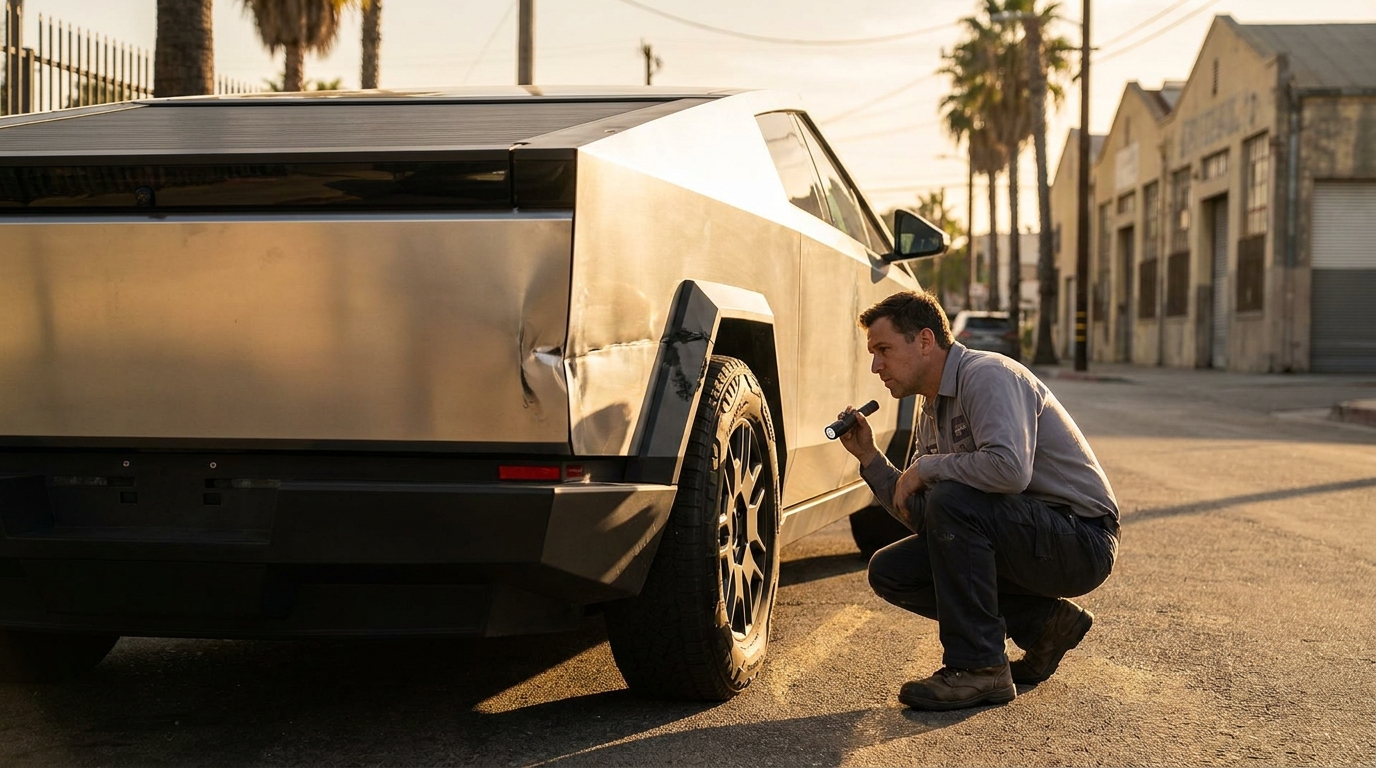
What Does Cybertruck Collision Repair in Los Angeles Actually Cost?
Cybertruck collision repair in Los Angeles ranges from roughly $200 for a minor surface scuff to well over $50,000 for a multi-zone structural hit, and the stainless-steel exoskeleton is the reason that gap is so extreme. Because the outer skin IS the structure, damage that looks modest from ten feet away can involve suspension, drive-unit, and frame components that must all be replaced simultaneously. The table below gives you a realistic working range before you even call a shop.
| Damage Tier | Typical Scenario | Estimated Repair Range |
|---|---|---|
| Minor / cosmetic | Surface scuff, small fender ding, glass chip | $200 – $3,000 |
| Moderate | Single-panel replacement, door, bumper, suspension | $3,000 – $10,000 |
| Major / structural | Multi-zone rear hit, frame, drive unit, bed | $10,000 – $50,000+ |
| Severe (near total-loss) | Rear wheel pushed in, suspension + motor + bed | $50,000 – $58,000+ |
The wide range is not a cop-out. Owner-forum data shows a Cybertruck fender repair for $81 after a minor parking-lot contact, while a well-documented severe case produced a teardown estimate of $57,879.89. Both numbers are real. Where your repair lands depends almost entirely on whether the stainless exoskeleton was bent inward past the panel surface.
Why Is Cybertruck Body Repair So Different From a Normal Truck?
The Cybertruck uses an ultra-hard cold-rolled stainless-steel exoskeleton: the outer panels are structural, not cosmetic shells hanging on a separate frame. That single design choice changes the repair math in three ways.
- No dent-pulling. Conventional steel and aluminum can often be massaged back into shape with PDR or hammer-and-dolly work. Stainless panels at Cybertruck hardness levels crack or spring back instead of reshaping cleanly. A bent panel almost always means a full panel replacement, not a repair. (Learn more about when PDR qualifies and when it does not.)
- Structure hides behind the skin. When the outer panel deforms inward it can transmit force directly into suspension mounts, frame rails, and motor brackets. An impact that looks like a $2,500 bumper job can hide a $9,000+ suspension replacement underneath.
- No aftermarket panels exist. As of 2025 there are no aftermarket stainless body panels for the Cybertruck. Every replacement part is OEM-only, and supply is constrained, which extends both wait times and costs.
One additional myth worth clearing up: those reddish spots you may see on a Cybertruck panel are almost always surface rail-dust contamination settling into microscopic pores in the steel, not the stainless body itself rusting. High-chromium stainless resists true corrosion. A professional decontamination polish usually removes those spots without any structural intervention. This is cosmetic, not a collision repair issue.
What Do Individual Cybertruck Parts Actually Cost?
Tesla’s parts catalog gives us the clearest per-piece picture. These figures come from catalog data that has been widely cited in the automotive press and corroborated by real completed repairs.
| Part | Part Cost (OEM) | Notes |
|---|---|---|
| Left or right fender panel | $550 each | Hand-fitted stainless; labor adds significantly |
| Front trunk fascia | $935 – $936 | Requires exoskeleton realignment |
| Powered front trunk assembly | $1,910 | Includes motorized lift; sensor recalibration required |
| Windshield | ~$1,900 | Shatter-resistant Armor Glass; precision fitment |
| Front steering actuator | ~$3,300 | High-precision rear-wheel-steering component |
| Front door glass | $260 | Tesla Armor Glass proprietary |
| Rear door glass | $225 | |
| Quarter panel glass | $200 | |
| Gigawiper blade | $75 per blade / $165 assembly | Unique single-blade design |
| Rear bumper / fascia (OEM) | $800 – $950 | No aftermarket option; used OEM $400–$700 |
| Rear quarter panel (OEM) | $800 – $1,000 | Professional replacement total: $2,500–$4,000+ |
| EV rear drive unit | ~$3,000 | Often collateral damage in rear-wheel impacts |
| Rear suspension (incl. crossmember) | ~$9,149 | Documented in severe rear-hit estimate |
| Rear bed assembly | ~$8,762 | Includes aluminum rear section ($4,280) and outer panel ($1,595) |
Real-world data point: a Cybertruck owner had a rear quarter panel replaced after a Subaru impact for $2,796 total, including about one day of labor. That aligns with the parts-database estimate of $2,500–$4,000 for that job. Contrast that with the Edmunds long-term-test truck, where a compact sedan struck the driver-side rear wheel/bumper while parked in West Hollywood on December 11, 2024. The teardown inspection alone cost $1,128 and the resulting repair quote reached $57,879.89 against an unblemished value of $86,160, including $16,584 in labor alone. Both outcomes stem from the same truck; the difference is whether the wheel was pushed inward into the suspension.
Where Can You Actually Get a Cybertruck Repaired in the Los Angeles Area?
This is the question no national article answers well, and the answer is uncomfortable: capacity is severely limited.
Only Tesla Service Centers or Tesla-approved body shops that hold Cybertruck-specific certification may legally perform collision repair procedures on the truck. Sending your Cybertruck to an uncertified shop risks a voided warranty and, more seriously, ADAS and safety-system errors that are invisible until they fail. Even some long-established, well-regarded Tesla-approved shops in the LA area explicitly state they do not yet service Cybertruck models, underscoring how new and narrow this certification category is.
When Edmunds searched for a certified shop after their West Hollywood crash, only two qualified facilities existed within a 50-mile radius of Los Angeles, described as “the most Cybertruck-dense population on the planet.” One shop quoted a one-month wait just to produce an estimate, plus roughly six months before repairs could even begin. The second, located in Ontario, California, also quoted a one-month wait for an estimate but said repairs could start immediately after. Edmunds ultimately received a visual estimate two full months after the accident.
What this means for an LA Cybertruck owner today:
- Expect to call multiple certified shops before you find one with near-term capacity.
- Get your truck to a certified shop for teardown before committing to any repair or total-loss decision. The initial visual never captures full damage on an exoskeleton vehicle.
- Budget for rental-car or rideshare costs during what may be a multi-month repair window. Make sure your insurer has activated loss-of-use coverage from day one.
- Do not allow an uncertified shop to touch the vehicle, even for “just” the bumper. ADAS sensors, the rear-wheel-steering actuator, and structural tolerances require calibration procedures only certified technicians can perform correctly. For related context on sensor recalibration costs, see our breakdown of Tesla bumper repair in Los Angeles.
How Does California’s Total-Loss Rule Apply to a Cybertruck?
California uses the Total Loss Formula (TLF) rather than a fixed percentage threshold. The formula is: Cost of Repairs + Salvage Value ≥ Actual Cash Value (ACV) = Total Loss. There is no magic 75% rule in California; an insurer can declare your Cybertruck totaled even if the repair estimate is 60% of ACV if the salvage value is high enough to tip the formula.
For a Cybertruck, this calculation runs differently than for a conventional truck for two reasons:
- High ACV, but high salvage too. A lightly-used Cybertruck carries a high pre-accident value, which creates headroom for expensive repairs. However, Cybertruck salvage values are also elevated because collectors and EV dismantlers compete for the stainless bodies.
- Hidden damage inflates repair estimates. Because the exoskeleton transfers force through the body into mechanical systems, teardown almost always reveals more damage than the visual suggests, pushing repair estimates upward and tilting the TLF toward total loss.
The Edmunds case illustrates this perfectly: $57,879.89 in repairs against an $86,160 ACV is a 67% ratio, which by itself would not automatically trigger total loss in many fixed-threshold states. But once a California insurer added salvage value into the formula, the truck was declared totaled. Our detailed breakdown of when a car is totaled in Los Angeles covers this TLF math in full.
What Does the Insurance Claim Look Like for a Cybertruck in LA?
The claim process for a Cybertruck has several line items that catch owners off-guard.
- Teardown fee: Expect a teardown inspection charge of $1,000 or more before a final estimate is even produced. This is a legitimate, billable step on any exoskeleton vehicle and should be covered under your collision claim.
- OEM-parts requirement: There are no aftermarket Cybertruck body panels. Your policy should specify OEM parts, or the insurer should agree to them in writing before repair authorization. If your insurer tries to apply aftermarket rates to non-existent aftermarket parts, push back. Our guide on Rivian collision repair covers a similar OEM-only EV situation.
- ADAS calibration line items: Any repair touching the bumper, windshield, rear suspension, or camera mounts will require sensor recalibration. This runs $300–$900+ per system and should appear as a separate supplement, not be buried in labor.
- Diminished value: In California, you can pursue a diminished-value claim against the at-fault party’s insurer for the market value your Cybertruck loses simply from having a collision on its record, even after a perfect repair. On a $75,000+ truck, this figure can be substantial. Document everything before repairs begin.
- Loss-of-use / rental: With parts waits measured in weeks and estimate queues measured in months, loss-of-use costs add up fast. Confirm your daily rental allowance with your insurer before assuming it covers a comparable SUV or truck for two-plus months.
- Supplements: Nearly every Cybertruck repair generates a supplement after teardown reveals hidden structural or mechanical damage. This is normal, not a shop overcharging. Plan for at least one supplement before the job is closed.
Repairable vs. Must-Replace: Setting Correct Expectations
Not every Cybertruck damage scenario ends in a five-figure bill. Here is a plain breakdown of what is and is not repairable:
- Surface scratches, swirl marks, contamination spots: Manageable with professional polishing and decontamination. Not a body-shop collision repair at all.
- Very minor fender ding (no crease, no bend through the panel): Potentially repairable at a certified shop in one day, as documented by owners, for under $300. Rare, but it happens.
- Creased or bent panel: Panel replacement is almost always the correct call. Stainless at Cybertruck hardness cannot be reliably straightened without compromising structural integrity or surface finish.
- Any impact that moved a wheel: Treat this as a structural event until proven otherwise. Expect suspension, steering, and potentially drive-unit involvement, which means a repair estimate starting in the $10,000+ range.
- Bed damage: The aluminum-and-steel bed is a multi-section assembly. Even the “outer panel only” line item runs $1,595, and a full rear section is $4,280 in parts alone before labor.
Common Mistakes to Avoid
- Taking it to an uncertified shop. Any shop without Cybertruck-specific Tesla approval should not perform collision repairs on this vehicle. Warranty, ADAS, and structural safety are all at risk.
- Accepting the visual estimate as final. Exoskeleton vehicles virtually always have additional hidden damage that only a teardown reveals. Never authorize repair or settle an insurance claim based on a visual alone.
- Assuming “minor” means cheap. A parked-car strike to the rear corner that appears minor can be a $9,000+ suspension job. Get the teardown done before assuming anything.
- Skipping the loss-of-use conversation. Given multi-month repair timelines at the few certified LA shops, failing to activate rental or rideshare coverage on day one means paying out of pocket during a long wait.
- Letting the insurer skip ADAS calibration line items. Calibration is not optional after a Cybertruck collision. If it is missing from the estimate, ask the shop to add it as a supplement before any work begins.
- Panicking over “rust spots.” Rail-dust contamination on stainless panels is a detailing problem, not a collision-repair problem. Do not let anyone sell you a panel replacement for surface oxidation that professional decontamination would remove.
Frequently Asked Questions
How much does it cost to repair a Cybertruck fender in Los Angeles?
A fender panel itself costs approximately $550 (OEM, part only). With labor and alignment at a certified LA shop, a single fender replacement typically runs $1,500–$3,500 depending on whether adjacent panels or sensors were affected. If the fender impact was truly isolated to the surface with no crease, some owners have reported minor repairs for under $300 at Tesla-certified centers.
Can any auto body shop in Los Angeles repair a Cybertruck?
No. Only Tesla Service Centers or Tesla-approved body shops with Cybertruck-specific certification may perform collision repair procedures. Unauthorized repairs risk voiding the warranty and introducing ADAS safety faults. Capacity is limited, with very few certified facilities serving the entire greater LA area, and even some established Tesla-approved shops have not yet added Cybertruck to their certification scope.
Will my Cybertruck be totaled after a fender bender in California?
Not automatically. California uses the Total Loss Formula: repair cost plus salvage value must meet or exceed the vehicle’s actual cash value (ACV) for a total loss declaration. A high ACV helps Cybertruck owners avoid total-loss outcomes on moderate damage. The risk comes from hidden structural damage that inflates repair estimates during teardown, which can tip the formula toward total loss even on impacts that look minor.
How long will a Cybertruck collision repair take in Los Angeles?
Plan for a minimum of one month just to receive a written estimate at most certified LA-area shops, based on documented real-world wait times. After an estimate, parts lead times and shop scheduling can push the full repair timeline to three to six months for moderate or major damage. A minor cosmetic fix handled by a Tesla Service Center may be faster, but do not count on it without confirming availability first.
Does a Cybertruck repair require ADAS recalibration?
Yes, for virtually any repair beyond pure surface polishing. The Cybertruck’s cameras, radar sensors, and rear-wheel-steering actuator require calibration to factory spec after any collision that affects the bumpers, suspension geometry, windshield, or surrounding panels. Calibration must be performed by a certified technician using Tesla-approved equipment and should appear as a line item on the repair estimate.
0 Comments