

What Does It Cost to Repair a Car After Hitting an Animal in Los Angeles?
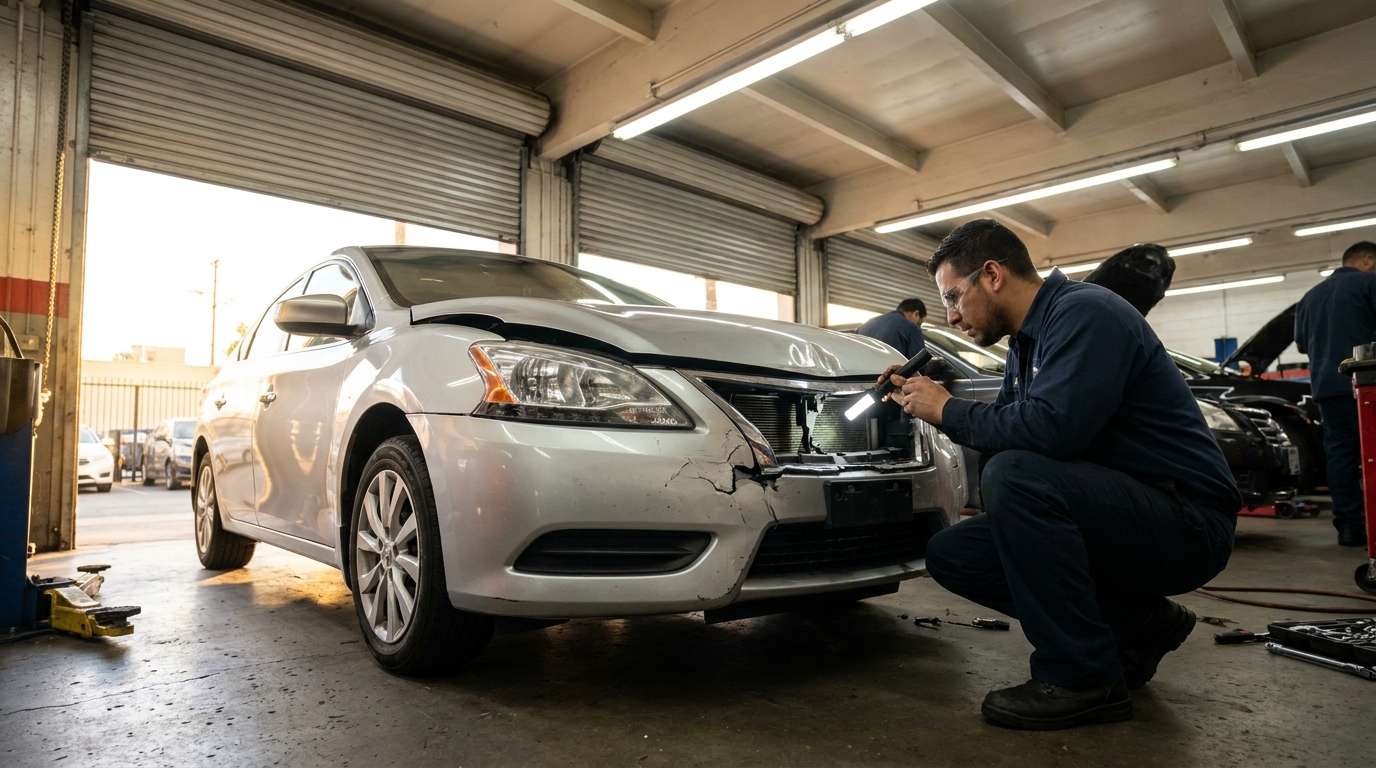
If you hit an animal with your car in Los Angeles, repair costs typically fall between $2,000 and $10,000, with severe front-end impacts sometimes pushing a vehicle into total-loss territory. A low-speed coyote strike that creases the bumper cover and cracks the grille might settle around $1,500 to $2,500. A higher-speed hit that collapses the fascia into the radiator, condenser, and front inner structure lands in the $4,000 to $8,000 range. Add in sensor or camera damage on a modern vehicle and the number climbs fast.
Los Angeles labor rates add real cost here. Shop labor in the LA area ranges roughly from $56 per hour in the Valley to $98 per hour on the Westside, a 75 percent swing that directly affects your estimate. Parts pricing, especially OEM parts on luxury and EV platforms, adds another layer. Budget conservatively and get an independent estimate before accepting whatever the insurer’s preferred shop proposes.
Animal Collision Repair Cost by Damage Severity
| Damage Severity | What Is Typically Hit | Estimated Repair Range |
|---|---|---|
| Minor (low speed) | Bumper cover, grille, fog light | $1,000 – $2,500 |
| Moderate | Hood, headlights, fenders, A/C condenser | $2,500 – $5,500 |
| Severe | Radiator, fan assembly, front inner structure, ADAS sensors | $5,500 – $10,000+ |
| Total loss threshold | Frame rails, EV battery cooling, airbag deployment | Actual cash value payout |
What Does a Shop Actually Find After an Animal Strike?
The bumper cover is never the whole story. A coyote or other mid-size animal hits at bumper height and the energy transfers directly into the components packed behind the fascia. Here is what a thorough teardown typically reveals:
- Bumper cover and reinforcement bar: Almost always damaged; the reinforcement bar is often bent even when the cover looks repairable.
- Hood: On higher-speed impacts, the hood buckles at the leading edge from the energy wave traveling up through the grille structure.
- Grille and grille surround: Usually cracked or shattered; clips and mounting tabs frequently break, requiring full replacement.
- A/C condenser: Sits directly behind the grille opening; even a moderate strike can puncture the fins and cause a refrigerant leak you will not notice until the AC stops working.
- Radiator: One step behind the condenser; a bent fan or penetrating debris can crack the tank or core.
- Fan shroud and fan assembly: Plastic fan blades shatter on contact; the shroud buckles and can contact the radiator.
- Headlights: Outer lenses crack; inner housings fracture from the compression wave even without direct contact.
- Front inner structure (core support): On severe hits, the upper and lower tie bars deform, requiring pulling or replacement.
- Front fenders: Take loading from the hood and bumper; often need realignment or replacement.
- Windshield: Larger animals, coyotes traveling at highway speed, can produce enough mass to crack or spider the base of the windshield.
The category no other local guide mentions: ADAS sensors, cameras, and radar. Most 2018-and-newer vehicles mount a forward-facing camera in or behind the grille, a radar module in the front bumper, and parking sensors around the fascia. Any of these can be damaged or knocked out of calibration by a wildlife strike. A camera that physically survived but shifted two millimeters no longer aims correctly, and the vehicle’s lane-keep assist, automatic emergency braking, and adaptive cruise control will be unreliable until the system is recalibrated. Recalibration alone can add $300 to $1,200 to the repair bill and requires specialized equipment. If your shop does not mention it, ask directly. For more on why this matters, see our post on Tesla bumper repair in Los Angeles, which covers the calibration bill nobody warns you about, the same principle applies to any ADAS-equipped vehicle.
Does Comprehensive Cover Hitting an Animal in California?
Yes. Hitting a wild animal is covered by comprehensive coverage, not collision and not liability. This surprises many drivers because the incident clearly involves a collision, but insurers classify animal strikes as an “other than collision” event, an act of nature outside the driver’s control. You pay your deductible; your insurer covers the rest up to the vehicle’s actual cash value.
A few specifics to know for California:
- Liability-only (minimum coverage) pays nothing toward your own vehicle damage. If that is all you carry, the repair bill is entirely out of pocket.
- Wild animals have no owner, so there is no third party to pursue. Comprehensive is your only recovery path.
- Animal strikes are typically treated as not-at-fault, because wildlife movement is unpredictable and unpreventable. Filing a comprehensive claim usually does not affect your rate the way an at-fault collision claim would, though individual policies vary.
- If the animal died, California drivers can file a report with the California Roadkill Observation System, which the state uses to track collision hotspots.
The Edge Case That Trips Up LA Drivers: Swerve vs. Direct Hit
This is the most misunderstood scenario in the entire animal-collision space, and no other local guide covers it clearly. The coverage that applies depends entirely on whether you physically contacted the animal.
| Scenario | Coverage That Applies | Why |
|---|---|---|
| You hit the coyote directly | Comprehensive | Animal strike = “other than collision” event |
| You swerve to miss the animal, never touch it, and hit a guardrail | Collision | Your vehicle struck an inanimate object |
| You swerve, hit the animal AND then hit a barrier | Both may apply; insurer determines primary | Two separate damage events; document carefully |
| You hit the animal but also deploy airbags and sustain structural damage | Comprehensive (primary); may approach total-loss threshold | If repair cost exceeds California’s total-loss threshold, insurer pays ACV |
This distinction matters because collision deductibles are often higher than comprehensive deductibles, and at-fault collision claims can raise your rate. A swerve-and-crash into a guardrail on Malibu Canyon Road is a collision claim, not a free pass under comprehensive, regardless of what caused you to swerve. Document exactly what happened at the scene. If your car never touched the animal, be accurate with your insurer.
Where in Los Angeles Are Animal Strikes Most Common?
The national guides always frame this as a deer problem. In LA, the real risk is coyotes, and the geography is specific. Coyotes are deeply established throughout the Santa Monica Mountains, San Gabriel foothills, Verdugo Mountains, San Rafael Hills, and the wash networks that cut through residential neighborhoods from Griffith Park to Topanga. The California Department of Fish and Wildlife estimates 250,000 to 750,000 coyotes statewide, with the greater LA basin holding a significant share.
The highest-risk roads are the canyon connectors: Mulholland Drive, Topanga Canyon Boulevard, Las Virgenes Road, Little Tujunga Canyon Road, Angeles Crest Highway, and the surface streets that border the LA River wash system. Coyotes cross at dawn and dusk, exactly the lighting conditions that make them hardest to see. The UC Davis Road Ecology Center recorded nearly 8,000 wildlife-vehicle collisions on California highways and major roads in a single year, and that figure substantially undercounts surface street incidents in urban corridors like these.
Larger animals are not unheard of either. Black bears have been documented on the 101 Freeway in Ventura County, and mountain lions use underpasses across the region. A collision with an animal that size is almost certainly a total-loss or near-total-loss event.
What to Do at the Scene and at the Shop: The Repair-Focused Steps
Most LA guides on this topic steer toward PI attorneys. If you were not injured and your goal is getting the car fixed, here is the practical sequence:
- Move to safety first. Pull completely off the roadway on canyon roads, the shoulder is narrow and oncoming traffic moves fast at night.
- Photograph everything before moving the vehicle if it is safe to do so: the damage, the animal (if visible), the road surface, the debris field, and your GPS location. Insurers use this documentation to confirm the claim type.
- Note whether you made contact with the animal or only swerved. This determines your claim type (comprehensive vs. collision) and should be stated accurately to your insurer.
- Call your insurer to open the claim, but do not commit to a repair shop yet. In California, you have the right to choose your own body shop regardless of which shops your insurer prefers.
- Get an independent estimate from a shop that will do a full teardown inspection, not just a surface-damage review. Hidden damage, condenser, radiator, sensors, is the number the insurer’s quick photo estimate consistently misses.
- Ask about supplements explicitly. If the shop opens the front end and finds condenser or structural damage not visible on the surface, a supplement gets filed with your insurer. A good shop handles this routinely. See our guide on rear-end collision repair costs in Los Angeles for more on how hidden damage and supplements work in practice.
- Confirm ADAS recalibration is in the estimate if your vehicle has front cameras, radar, or parking sensors. Do not accept a completed repair without it.
Animal Strike Repair and EVs: A Special Note for LA Drivers
Los Angeles has one of the highest concentrations of electric vehicles in the country, and an animal strike on an EV carries unique considerations. The front frunk area on many EVs houses the front motor, high-voltage components, and the thermal management plumbing for the battery. A hit severe enough to reach the front inner structure can damage cooling lines or the battery enclosure itself. What looks like a $4,000 front-end repair can escalate dramatically once the frunk liner comes out. Our post on minor accidents that total EVs due to battery damage in Los Angeles covers this in detail. The short version: get the estimate from a shop that has actual EV experience before you assume it is a clean claim.
Common Mistakes to Avoid
- Filing under collision instead of comprehensive. Telling your insurer “I hit something” without specifying it was an animal can cause it to be coded as a collision claim, costing you a higher deductible and potentially affecting your rate.
- Accepting a photo estimate without a teardown. A drive-by or photo-based estimate will miss the condenser, radiator, and sensor damage almost every time. Always get a physical inspection with panels removed.
- Skipping ADAS recalibration. Driving away after a front-end repair without confirmed calibration means your emergency braking and lane-keeping systems may be operating on bad data.
- Assuming the car is fine because it drives. A punctured condenser will not show up until you turn on the AC. A bent core support will not show up until the hood gaps look wrong. Driving untreated structural damage risks further misalignment.
- Using the insurer’s shop without checking their certifications. The preferred-shop network is chosen for cost efficiency, not for brand-specific expertise. California law gives you the right to choose any licensed shop.
- Ignoring total-loss math on older or high-mileage vehicles. If the repair estimate approaches or exceeds the vehicle’s actual cash value, it may be totaled. Push for an independent valuation if you think the insurer’s ACV is low.
Frequently Asked Questions
Does comprehensive insurance cover hitting a coyote in California?
Yes. Hitting any wild animal, coyote, deer, raccoon, or mountain lion, is covered under comprehensive coverage in California, not collision. You pay your deductible and the insurer covers the rest up to the vehicle’s actual cash value. If you do not carry comprehensive, the repair is entirely out of pocket.
Will my insurance rate go up after an animal strike claim?
Animal strikes are generally treated as not-at-fault because wildlife movement is unpredictable. Filing a comprehensive claim for an animal strike typically does not raise your rate the way an at-fault collision would, but individual carrier policies vary. Confirm with your insurer before filing if rate impact is a concern.
What if I swerved to avoid a coyote and hit a guardrail instead?
If you never made contact with the animal, the damage is a collision claim, not comprehensive. Your collision deductible applies, and the at-fault status depends on your insurer’s policies. Document the scene carefully, including any evidence the animal was present, and report exactly what happened. Misrepresenting the incident to get comprehensive treatment instead of collision is insurance fraud.
Do I need ADAS recalibration after hitting a coyote?
If your vehicle has front-facing cameras, radar, or parking sensors, which describes most vehicles built after 2018, then yes, recalibration is required any time those components are displaced or replaced. A camera that survived physically but shifted position will feed incorrect data to your emergency braking and lane-keeping systems. Calibration typically costs $300 to $1,200 and should appear as a line item on your repair estimate.
How long does an animal collision repair take in Los Angeles?
A moderate front-end repair, bumper, grille, hood, condenser, typically takes 5 to 10 business days once parts arrive. Parts availability is the main variable: OEM parts for certain luxury brands or EVs can add one to three weeks. Supplement approvals from the insurer after hidden damage is discovered add two to five days. Rental coverage under your policy’s loss-of-use benefit can offset the wait; confirm your daily rental limit before the car goes in.
0 Comments