

Can a Minor Accident Total Your EV in Los Angeles?
Yes, a minor accident can absolutely total your EV in Los Angeles, and it happens more often than most owners expect. If a low-speed collision, curb strike, or piece of freeway debris compromises the battery pack’s enclosure or mounting structure, the cost to make the car safe again can easily exceed what the insurer is willing to pay. A minor accident totaled EV battery damage in Los Angeles is not a fringe scenario; it is a predictable outcome of how EVs are built and how California’s total-loss math works.
Why Is EV Battery Damage So Expensive After a Crash?
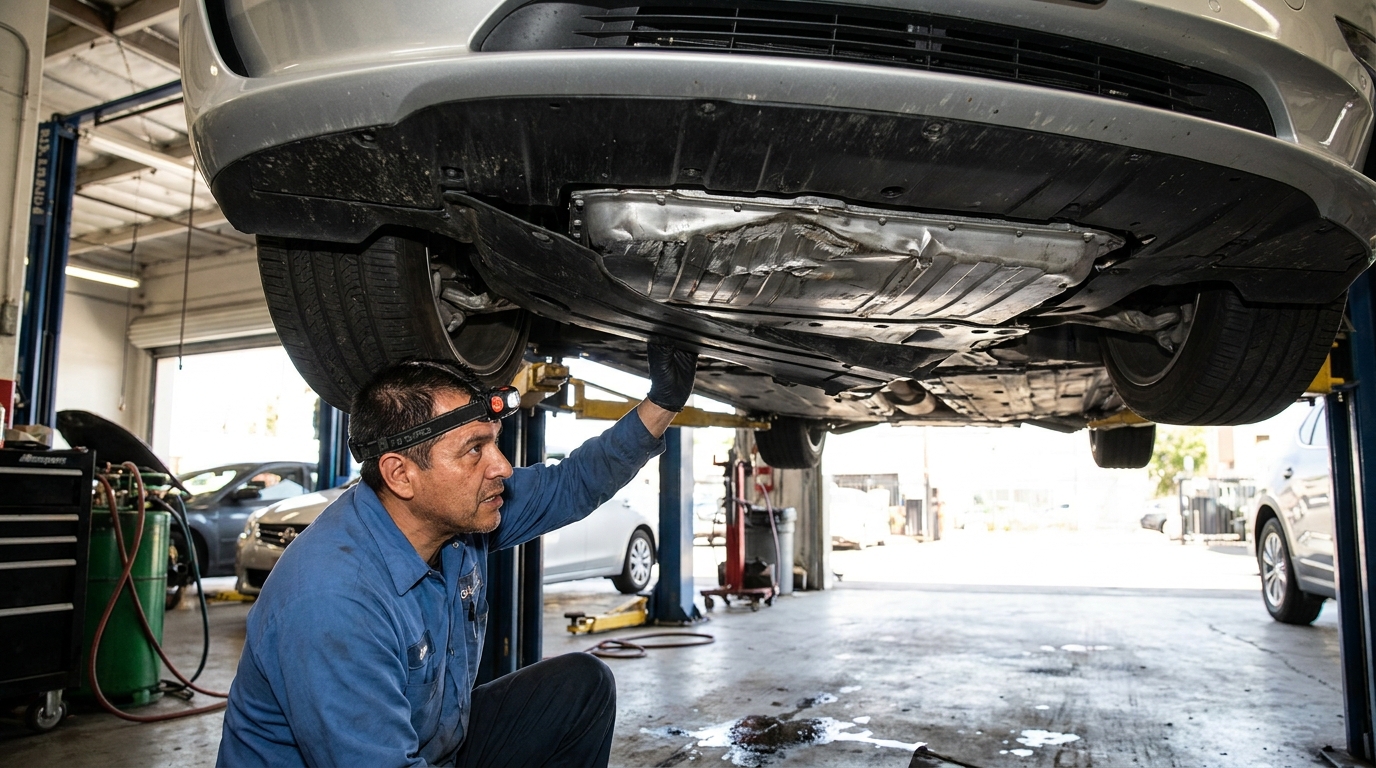
The battery pack in a modern EV is not a replaceable module tucked under the hood. It is a structural floor, bonded and bolted across the full length of the vehicle’s underbody. In a Tesla Model 3, Model Y, or comparable EV, the pack sits between the axles, low to the ground, with only a thin skid plate and the battery enclosure itself standing between the road and the cells inside.
Even a scrape that looks superficial from a street-level walk-around can crack the enclosure, bend mounting brackets, or breach cooling lines. Any of those findings requires a full high-voltage safety inspection before any other work can proceed, and if the casing or structure is compromised, insurers and OEM repair procedures require full pack replacement on safety grounds. Replacement costs for a Tesla Model 3 pack run roughly $11,000 to $18,000 installed in 2025, depending on pack size and whether you use Tesla direct or an independent EV specialist. Add $3,000 to $6,000 in body and structural repairs, and a car with an actual cash value of $30,000 to $40,000 is suddenly past the point of economic repair.
The battery pack alone typically represents 30 to 40 percent of a modern EV’s total vehicle value. That concentration of value in one damageable component is what makes EVs uniquely vulnerable to total-loss declarations after what looks like a minor hit.
How Does California’s Total-Loss Formula Work for EVs?
California does not use a simple fixed-percentage threshold like some states. Instead, it uses a Total Loss Formula (TLF): a vehicle is declared a total loss when the cost of repairs plus the vehicle’s salvage value equals or exceeds its actual cash value (ACV). In practice, most California insurers reach that threshold somewhere in the range of 65 to 75 percent of ACV, depending on how the salvage market values the specific vehicle.
| Scenario | ACV of Vehicle | Battery Replacement | Body/Structural Repair | Total Repair Cost | Total Loss? |
|---|---|---|---|---|---|
| Tesla Model 3 (2022, used) | $32,000 | $14,000 | $4,500 | $18,500 (58%) | Borderline, likely yes with salvage |
| Tesla Model 3 (2020, used) | $24,000 | $13,000 | $3,500 | $16,500 (69%) | Very likely total loss |
| Toyota RAV4 Hybrid (2021) | $30,000 | $8,000 (HV battery) | $4,000 | $12,000 (40%) | Possible, inspect closely |
| Rivian R1T (2022) | $55,000 | $20,000+ | $6,000 | $26,000+ (47%+) | Borderline, supplement risk high |
These figures use real 2025 battery replacement ranges and Mitchell industry labor data. The salvage value assigned by insurers typically runs $4,000 to $8,000 for a damaged mid-range EV, which pushes the formula toward total-loss faster than most owners realize.
What Are the LA-Specific Triggers Nobody Warns You About?
Los Angeles driving conditions create battery-damage scenarios that rarely come up in national consumer guides:
- Tight condo and valet garages: Century City, Koreatown, and Downtown LA parking structures have steep ramps and low curbing. A Model Y or Ioniq 6 with minimal ground clearance can scrape the front battery skirt or rear pack edge hard enough to crack the enclosure, with no visible body damage above the rocker. If valet was involved, see our breakdown of valet car damage in Los Angeles and who pays.
- Speed bumps on residential streets: Silver Lake, Los Feliz, and Mar Vista are loaded with aggressive speed bumps. Low-slung EVs frequently bottom out, and an underbody hit at even 10 mph can bend battery mounting hardware.
- Debris on the 405, 10, and 110: Tire tread, metal strapping, and fallen cargo are common on LA freeways. Running over tire tread at freeway speed can punch the battery skid plate upward into the pack itself.
- Pothole impacts in the Valley and East LA: A hard pothole hit transfers energy through the suspension into the subframe and battery mounts, damage that shows up nowhere on the outside of the car. For pothole claim guidance, see our pothole damage repair in Los Angeles guide.
- Low-speed rear-ends at stoplights: The Westside and Hollywood are rear-end capitals. A 10 to 15 mph tap can damage rear battery mounting brackets even when the bumper cover looks only lightly scuffed.
What Does a Proper Battery Inspection Actually Find?
This is where most drive-by insurance estimates fail EV owners. An adjuster walking around the car at a tow yard sees body damage. What they do not see, without a lift, proper de-energization, and a trained eye, is:
- Cracked or deformed battery enclosure panels. The outer casing keeps moisture, road debris, and crash energy away from the cells. A crack may not leak immediately but creates a safety and warranty failure.
- Bent or sheared battery mounting brackets. The pack is bolted to the underbody at multiple points. A bent bracket means the pack is no longer seated correctly, which affects structural integrity and can cause cell movement under future loads.
- Damaged cooling lines or fittings. EVs use liquid thermal management for the battery. A pinched or cracked cooling line that goes undetected can cause thermal runaway later.
- High-voltage connector stress. The main battery connector runs from the pack to the power electronics. An underbody impact can stress or partially unseat this connection, which is an active electrical hazard.
- Structural gigacasting damage (Tesla-specific). Newer Tesla models use large single-piece cast sections. A crack in a gigacasting typically requires full-section replacement, there is no weld-and-repair option the way there would be with stamped steel.
None of these findings appear in a visual surface estimate. They require the vehicle on a lift, the high-voltage system properly de-energized, and a technician trained in EV high-voltage safety procedures. A shop that skips de-energization before inspecting is creating a fire hazard and will miss the damage that drives the real repair cost.
Mitchell industry data shows EV repairs average nearly double the mechanical labor hours compared to combustion vehicles (3.04 hours vs. 1.66 hours), largely because of HV battery de-energization and removal requirements before any structural work can begin. That labor cost is real, and an insurer’s first estimate almost never accounts for it fully.
Is This Risk Limited to Teslas?
No. This is one of the most important gaps in popular EV crash coverage. Hybrid owners face the same exposure:
| Vehicle | HV Battery Location | Typical HV Battery Replacement Cost | Total-Loss Risk After Underbody Hit |
|---|---|---|---|
| Tesla Model 3 / Model Y | Full underbody floor pack | $11,000 – $18,000 | Very high |
| Toyota RAV4 Hybrid | Under rear cargo floor | $5,000 – $9,000 | Moderate to high |
| Honda CR-V Hybrid | Under rear seat / cargo area | $5,000 – $8,000 | Moderate |
| Hyundai Tucson Hybrid | Under rear floor | $4,500 – $7,500 | Moderate |
| Rivian R1T / R1S | Full underbody skateboard pack | $15,000 – $25,000+ | Very high |
| Ford F-150 Lightning | Full underbody skateboard pack | $15,000 – $25,000+ | Very high |
Any vehicle with a high-voltage pack under the floor or rear cargo area is exposed to the same total-loss math. The difference is that Tesla owners get the most media coverage, RAV4 Hybrid owners in Silver Lake and Tucson Hybrid owners in Pasadena face exactly the same scenario with far less warning.
What Should an LA EV Owner Do Before Accepting a Settlement?
If your EV was in any collision that involved an underbody impact, a rear-end hit, a curb strike, or a low-speed bump, follow these steps before accepting anything from your insurer:
- Get the car to a qualified EV-capable shop for a proper inspection. The insurer’s drive-by estimate at the tow yard is not a complete assessment. A shop that can de-energize the high-voltage system and put the car on a lift will find what the adjuster missed. California law gives you the right to choose your own repair shop, your insurer cannot force you to use a preferred shop.
- Request a written supplement before any settlement is finalized. If hidden battery or structural damage is found after the initial estimate, a supplement documents those additional costs. Do not let the insurer close the claim before the car has been properly inspected on a lift.
- If the insurer declares a total loss, get an independent appraisal. The ACV the insurer assigns determines your payout. If you believe their valuation is low, and in the LA market, used EV values fluctuate significantly, hire an independent appraiser before accepting. California insurance regulations support this right.
- Check your GAP coverage immediately. The insurer pays ACV, not what you paid or what you owe. If you financed a 2022 Model 3 for $48,000 and its current ACV is $32,000, GAP coverage pays the difference. Without it, you owe that gap out of pocket. Check your loan documents or contact your lender now, not after you accept the settlement.
- Understand salvage-title buyback risks before agreeing to keep the car. Some insurers offer a “salvage buyback” where they pay the total-loss settlement and let you keep the car with a salvage title. A salvage-titled EV has severely limited resale value, is difficult to insure for comprehensive coverage, and may not be legally drivable on California roads until it passes a state salvage inspection. This is rarely a good deal for the owner.
- Document diminished value if the car is repairable. If the repair comes in below the total-loss threshold and the insurer opts to fix it, the vehicle’s market value is permanently reduced. California allows diminished-value claims. Get the documentation from your shop before the claim closes. See our guide to diminished value documentation in California for the specifics.
Common Mistakes to Avoid
- Accepting the insurer’s first estimate as final. Drive-by estimates at tow yards routinely miss underbody and battery damage. Always get a proper shop inspection first.
- Assuming no visible body damage means no battery damage. The battery sits below the visible body panels. A car with a clean rocker and quarter panel can have a cracked battery casing from a curb or pothole strike.
- Letting the insurer total the car before supplemental damage is documented. Once you accept a settlement, it is much harder to reopen the claim if additional damage surfaces.
- Ignoring GAP coverage until after accepting the payout. Verify your GAP status the day of the accident, not after you sign paperwork.
- Taking the salvage buyback without researching California salvage title rules. A salvage EV in California requires a Brake and Light inspection and a referee inspection before it can be retitled, and many insurers will only write liability coverage on a salvage vehicle.
- Using a shop that is not trained in EV high-voltage procedures. A shop that does not properly de-energize the HV system before inspection is creating a fire hazard and will produce an incomplete damage assessment.
- Skipping the diminished-value claim if the car is repaired. Battery and structural repairs generate a CARFAX entry and reduce resale value. That loss is documented and claimable in California if you act before the claim closes.
Frequently Asked Questions
Can a minor fender-bender actually total my Tesla or EV in Los Angeles?
Yes. If the impact, even a low-speed one, damages the battery pack’s enclosure, mounting structure, or cooling system, the repair cost can easily reach $15,000 to $20,000+. Combined with body and structural repairs, that total can meet California’s total-loss formula threshold on a vehicle with an ACV of $25,000 to $40,000. The battery pack represents roughly 30 to 40 percent of an EV’s total value, which is why the math changes so fast compared to a combustion vehicle.
How does California’s total-loss formula work, and how is it different from other states?
California uses a Total Loss Formula rather than a fixed percentage: the car is totaled when repair costs plus salvage value equal or exceed the vehicle’s actual cash value. In practice this triggers somewhere around 65 to 75 percent of ACV for most vehicles, depending on the salvage market. The formula means the insurer’s salvage estimate directly affects whether your car gets totaled, a higher salvage value makes total loss easier to declare, which is relevant for EVs because even a damaged EV pack has salvage demand.
My hybrid was rear-ended, is the high-voltage battery at risk too?
Yes. Toyota RAV4 Hybrid, Honda CR-V Hybrid, Hyundai Tucson Hybrid, and similar vehicles carry high-voltage battery packs under the rear floor or rear seat. A rear-end collision at 15 to 25 mph can compromise the pack’s enclosure or cooling system. Repair costs for hybrid battery packs typically run $5,000 to $9,000, and combined with body and structural repairs on a three- to five-year-old hybrid, that can approach the total-loss threshold.
What if the insurer’s ACV offer seems too low?
You can and should dispute it. Request a written breakdown of how ACV was calculated, the comparable vehicles used, mileage adjustments, and condition adjustments. If the comparables are inaccurate or the condition assessment is wrong, provide counter-evidence: dealer listings, private-sale data, and the vehicle’s service history. You also have the right to hire an independent appraiser in California. Do not sign the settlement release until you are confident the ACV reflects real LA-market replacement cost.
What is a salvage-title buyback and why is it risky for EV owners?
After a total loss, the insurer may offer to pay you the ACV settlement and let you keep the car under a salvage title. On an EV, a salvage title means severely reduced resale value, limited comprehensive insurance availability, and the requirement to pass California’s salvage inspection process before the car can be retitled for road use. For an EV with a potentially damaged or unverified battery pack, a salvage buyback carries real ongoing safety risk, the battery inspection required to certify the car as road-safe after a salvage title can itself cost thousands of dollars.
0 Comments