

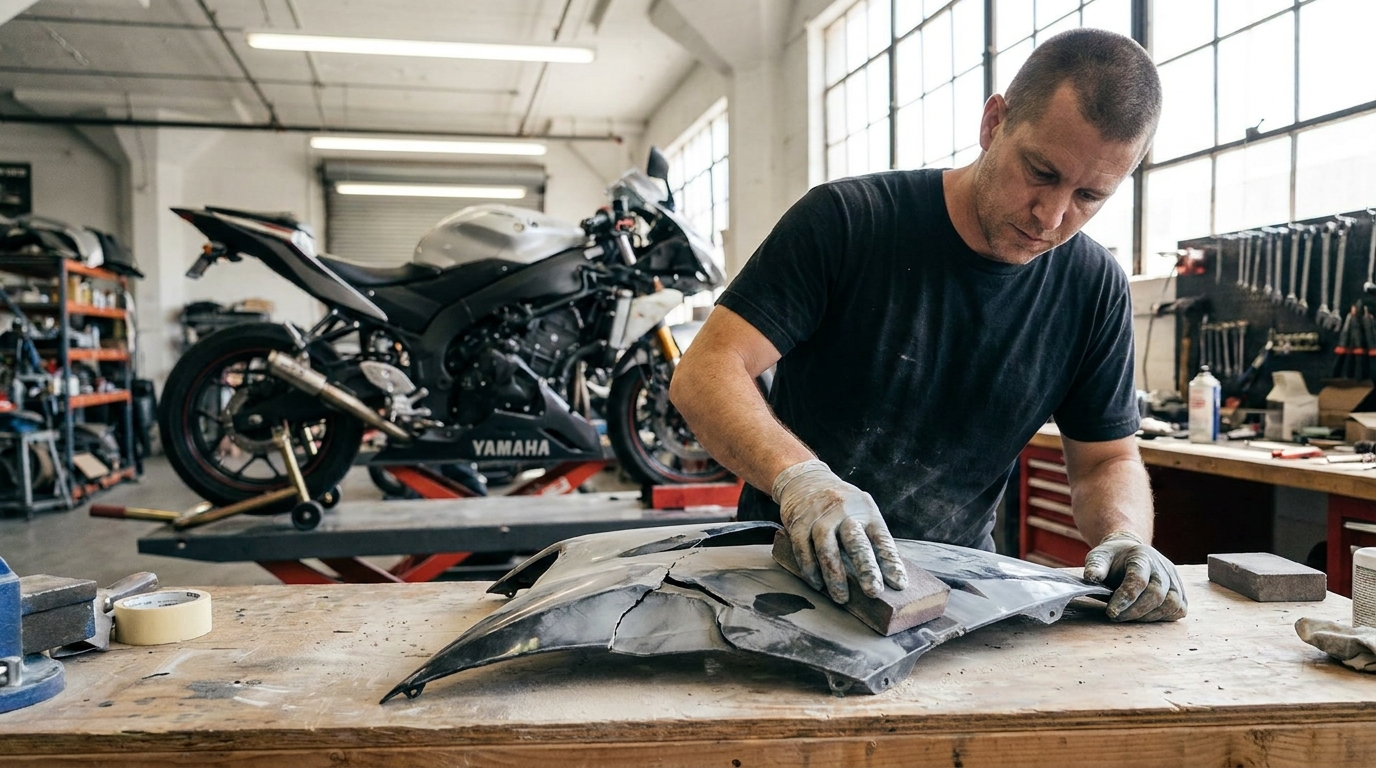
What Does Motorcycle Fairing Repair in Los Angeles Actually Cost?
Professional motorcycle fairing repair in Los Angeles runs higher than the national figures you’ll find on parts-seller blogs, which are written to move replacement kits, not to give you an accurate repair quote. Here is what to expect when you bring a damaged sportbike to a quality LA body shop.
Paint work is the largest variable. A single-color professional refinish on one or two panels runs roughly $300–$600. Two-tone or moderate graphics work lands in the $800–$1,500 range. Full custom airbrushing, candy finishes, or multi-layer pearl coats can reach $2,500 or more. Those figures reflect national shop data; LA overhead, rent, utilities, and licensed labor, pushes local rates toward the top of each band.
Labor for structural repair (plastic welding, fiberglass lamination, filler work, blocking, prime, base coat, clear coat, and cure) takes 8 to 20 shop hours depending on the panel count and damage severity. At LA collision shop rates of roughly $90–$175 per hour, that labor alone can add $800 to $3,000+ before parts. Plan on a one- to two-week turnaround for a proper job, not because shops are slow, but because each stage (primer flash, color cure, clear cure, polish) requires real drying time that cannot be safely compressed.
Repair vs. Replace: Which Makes Sense for Your Fairing?
The honest answer depends on damage type, material, and how many panels are involved, not on what an ecommerce site wants to sell you.
| Damage Scenario | Recommended Path | Why |
|---|---|---|
| Superficial scratches, light scuffs, no structural crack | Professional paint refinish | Panel integrity is intact; refinishing is faster and cheaper than sourcing a matching replacement |
| Single crack or stress fracture (ABS or fiberglass) | Professional plastic weld or fiberglass laminate + refinish | A properly executed repair is structurally sound and costs less than OEM replacement |
| Shattered panel or multiple cracks through a mounting point | Replace the panel | Fairings are sacrificial by design, they shatter to absorb impact. Once structural integrity is gone, a surface patch is unsafe |
| Multiple panels damaged in a tip-over | Consider a full aftermarket set + professional paint | OEM panel-by-panel replacement can exceed $1,500–$2,500+ in parts alone; a full aftermarket ABS kit runs $450–$800 and gives a uniform finish baseline |
| Carbon fiber fairing, any significant damage | Specialist carbon fiber repair or replacement | Carbon fiber requires resin infusion and layup expertise; filler-only repairs mask structural failure |
One tip-over in a parking lot on the congested streets of Silver Lake or DTLA can crack two or three panels simultaneously and generate an OEM parts quote above $1,500 before a single labor hour is charged. That number shocks most riders, and it is exactly where the repair vs. replace math matters most. For carbon fiber panels specifically, see our detailed guide on carbon fiber repair in Los Angeles for what specialist restoration actually involves.
What Material Is Your Fairing? Why It Changes Everything
Most riders know their bike’s model year but not what their panels are made of. Material determines repairability, cost, and the right shop to choose.
| Material | Common On | Repairability | Cost Implication |
|---|---|---|---|
| ABS Plastic | Most production sportbikes (Yamaha, Honda, Kawasaki, Suzuki) | High, welds cleanly, accepts filler well | Lowest repair cost; aftermarket replacement sets widely available at $450–$800 |
| Fiberglass | Older bikes, track-use fairings, some Ducatis | Good, can be laminated and sanded back to shape | Moderate; labor-intensive but parts cheaper than OEM ABS for rare models |
| Carbon Fiber | High-end sportbikes, Ducati Panigale, Aprilia RSV4, BMW M 1000 RR trim | Lower, requires specialist resin repair; filler alone is not structural | Highest; replacement panels often $400–$1,500+ each, specialist labor required |
ABS plastic is the most forgiving material for a body shop with the right plastic-welding equipment. Fiberglass can be rebuilt with mat and resin when a qualified technician handles the layup. Carbon fiber is a different discipline entirely, the fibers need to remain in tension across the repair zone, which requires vacuum bagging or at minimum careful wet layup, not just epoxy filler. Any shop offering a carbon fiber fairing repair should be able to explain their lamination process specifically.
What Does a Professional Fairing Repair Actually Involve?
Understanding the process helps you evaluate an estimate and avoid shops that shortcut the prep. Here is what a correct repair looks like, step by step.
- Disassembly: Fairings are removed from the bike to allow full access to both sides of each panel. Working on-bike leads to poor prep and paint adhesion failures at the edges.
- Damage assessment: The technician checks both sides of each panel for stress cracks invisible from the outside, especially around mounting tabs and grommets.
- Structural repair: Cracks are V-grooved and plastic-welded (ABS) or laminated with fiberglass/carbon mat (fiberglass/CF). This restores structural integrity before any cosmetic work begins.
- Filler and blocking: Body filler is applied to level the repaired surface, then hand-blocked to a flat plane. This stage determines whether the finished panel looks right at arm’s length or only in photographs.
- Primer and sealer: A high-build primer is applied, cured, and wet-sanded to create a sealed, contamination-free surface. Skipping primer is the single most common reason cheap repairs peel.
- Base coat and clear coat: Color is applied in a controlled spray booth to prevent dust contamination. A urethane clear coat is applied over the base for durability against LA’s UV load and heat cycles.
- Cure and polish: Clear coat requires full cure time, often 24–48 hours in a heated booth, before compounding and polishing. Rushing this stage causes solvent pop and micro-cracking in the clear.
- Reassembly and hardware check: Panels are remounted with fresh grommets and clips where needed. A panel that rattles or sits proud of its neighbors is a sign reassembly was not done carefully.
This process genuinely takes 8 to 20 shop hours. A quote that implies a one-day turnaround on structural repair plus paint should raise questions about which steps are being skipped.
How Does Motorcycle Fairing Paint Matching Work in Los Angeles?
Color matching a fairing is harder than matching a car door, and the parts-seller blogs that tell you to order a pre-painted panel in your factory color code are glossing over the real problem.
Paint ages. A 2019 CBR600RR sitting in Van Nuys or Culver City has been exposed to years of Southern California UV, heat cycles, and oxidation. The factory color code produces a color that matched the bike on the showroom floor, not the color the bike is today. Order a pre-painted panel to that code and it will look noticeably different next to the faded originals.
The solution is a spray-booth color blend. A trained painter spectrophotometrically reads the existing paint, adjusts the formula to account for aging, and blends the repaired panel’s color into adjacent surfaces so there is no visible transition line. This is the same process used for invisible automotive color repairs, and it is what separates a professional result from a “close enough” patch. Our post on car color change cost in Los Angeles explains how spray booth blending works for complex finishes.
Paint choice also matters for longevity. Urethane-based automotive coatings bond more durably to plastics than acrylic lacquers or rattlecan enamels, and they resist UV yellowing and California heat far better. The cost difference between a urethane system and a budget rattle-can respray shows up within 18 months of LA sun exposure.
For riders concerned about long-term paint quality, our guide on caring for your vehicle after a fresh paint job covers how to protect a refinished fairing through the cure window and beyond.
DIY Fairing Repair Kits vs. Professional Repair: When Each Makes Sense
DIY fiberglass and filler kits run approximately $20–$50 and are appropriate for one situation: a superficial scratch or hairline scuff on a panel with no structural damage, where you are not concerned about a color-matched result. That is a narrow use case.
DIY kits are not appropriate for any crack that runs through a mounting tab, any impact that flexed the panel enough to fracture the inner surface, or any repair where the finished product needs to match the surrounding panels. A surface patch over a structural crack will re-crack under riding vibration, often within weeks. A mismatched DIY respray on a panel that sits next to undamaged panels looks worse than the crack it replaced.
If your goal is a result you cannot distinguish from undamaged panels, professional repair is the only path.
The LA Insurance Claim Decision: Comprehensive, Collision, or Out of Pocket?
Which coverage applies to your fairing damage, and whether filing is worth it, depends on how the damage happened.
Comprehensive coverage applies when damage results from a non-collision event: a tip-over in a parking lot, vandalism (a common reality on LA streets), theft of the bike or its components, or weather damage. Collision coverage applies when your bike collides with another vehicle or object, regardless of fault.
A slow-speed tip-over in a parking structure in Hollywood or Echo Park, the most common fairing damage scenario for urban sportbike riders, is a comprehensive claim, not collision. That matters because many riders carry different deductibles on each coverage type.
The deductible math is where LA riders get surprised. Because LA riders face higher theft exposure and traffic density, insurers often price deductibles at $500–$1,000 on comprehensive policies. If your fairing repair totals $900, a $750 deductible makes filing nearly pointless: you save $150 on paper, gain a claim on your record, and risk a premium increase at renewal that exceeds that savings within one policy year.
The break-even rule for most LA riders: if the out-of-pocket repair cost is less than 1.5x your deductible, strongly consider self-funding the repair and protecting your rate. If the damage is substantial, multiple panels, structural frame concerns, or a declared total loss scenario, file the claim and work with an independent shop rather than an insurer-preferred one. California law gives you the right to choose your repair facility.
Also note: standard motorcycle policies typically cover only $1,000 in aftermarket accessories and custom equipment by default. If your fairings are custom-painted or carbon fiber upgrades, you may need a separate accessories rider to cover their full replacement value. Check your declarations page before you assume the policy covers the whole repair bill.
For a parallel look at how the claim decision plays out for other LA vehicle damage scenarios, our post on keyed car repair in Los Angeles walks through the same deductible math for paint-only damage.
Common Mistakes to Avoid
- Ordering a pre-painted OEM or aftermarket panel without blending it to the existing finish. Factory color codes do not account for your bike’s aging. The new panel will visibly misatch unless the surrounding panels are blended in a spray booth.
- Surface-patching a structurally cracked fairing. Fairings crack to absorb impact energy. A filler-only repair over a cracked panel restores the look for a few weeks and then re-cracks under vibration. Structural repair must come before cosmetics.
- Buying a budget aftermarket kit and assuming it is plug-and-play. Poorly fitting kits require trimming, re-drilling, and shimming that adds labor time and cost, erasing much of the parts savings. Confirm fitment reviews for your specific model year and sub-variant before ordering.
- Filing a comprehensive claim for a repair that barely exceeds your deductible. In LA’s high-theft, high-density market, deductibles are often $500–$1,000. A small claim nets you minimal reimbursement and can trigger a rate increase.
- Skipping the spray booth because a shop quotes a lower price painting the panel on the bike. Dust contamination and uneven coverage are almost guaranteed. The booth is not optional for a result that lasts.
- Choosing a shop with no plastic-welding or composite experience. A shop that only does automotive steel and aluminum bodywork will default to filler-only fairing repairs. Ask specifically whether they weld ABS or laminate fiberglass before committing.
- Not checking your accessories coverage limit before filing. Most standard policies cover only $1,000 in custom parts and equipment. Carbon fiber or custom-painted fairings can far exceed that cap without a supplemental rider.
Frequently Asked Questions
How much does motorcycle fairing repair cost in Los Angeles?
A professional paint refinish on one or two panels runs $300–$600 for single color. Structural repair (plastic welding or fiberglass lamination plus paint) adds labor at $90–$175 per hour, with most fairing jobs requiring 8–20 shop hours total. A full multi-panel repair with custom matching can reach $1,500–$3,000+ depending on panel count, material, and finish complexity. OEM replacement panels for popular sportbikes run $300–$900 per panel; a full OEM set can exceed $2,500 before labor.
Should I repair or replace cracked motorcycle fairings?
Repair makes sense for single cracks in structurally sound ABS or fiberglass panels, plastic welding or lamination restores integrity before refinishing. Replace when the panel is shattered, when mounting points are destroyed, or when multiple panels are damaged in the same incident. In that scenario, a full aftermarket ABS kit ($450–$800) plus professional paint is often more cost-effective than sourcing individual OEM panels. Carbon fiber panels with significant damage should go to a specialist for a proper structural assessment before any cosmetic work.
Does motorcycle insurance cover fairing damage in California?
It depends on how the damage happened. Tip-overs, vandalism, theft, and weather damage are covered under comprehensive. Collision with another vehicle or object is covered under collision coverage. California does not require either coverage by law, only liability is mandatory, so riders with minimum coverage have no fairing repair benefit. Even with full coverage, LA deductibles of $500–$1,000 often make self-funding a small repair the smarter financial choice.
Why doesn’t a pre-painted replacement fairing match my bike?
Factory color codes match the original finish at time of manufacture. After years of LA sun exposure, heat cycling, and oxidation, your bike’s existing paint has drifted from that code. A new panel sprayed to the original code will look noticeably different next to the aged panels. The fix is a spray-booth blend: the painter adjusts the formula to the current aged shade and blends the color into adjacent panels so there is no visible transition line.
How long does a professional motorcycle fairing repair take?
Allow one to two weeks for a complete structural repair and refinish at a professional shop. The timeline reflects actual chemistry: primer needs flash time, color needs cure time before clear, and clear coat needs full cure before compounding and polish. Shops that quote a two- or three-day turnaround on structural fairing repair plus paint are almost certainly skipping one of those stages.
0 Comments