

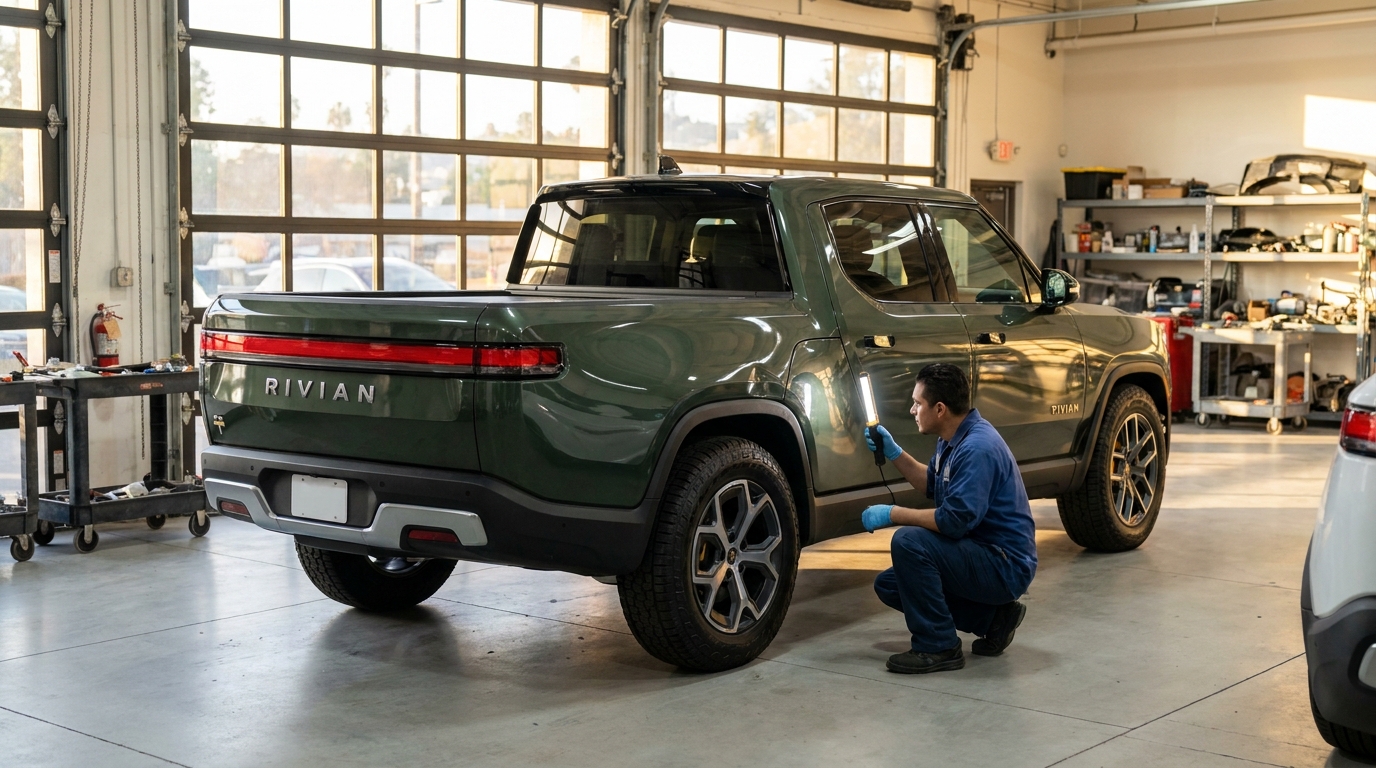
What Does Rivian Collision Repair Cost in Los Angeles?
Rivian collision repair in Los Angeles realistically runs $5,000 to $30,000 or more, depending on which panels are hit, whether structural work is needed, and how many ADAS sensors require recalibration afterward. That range is not a worst-case scare tactic, it reflects what certified shops across the LA metro are actually quoting on R1T and R1S repairs right now. A fender-bender that a conventional truck owner might fix for $1,500 can easily become a five-figure job on a Rivian. Understanding why before you file a claim saves you from a painful gap between what your insurer pays and what a certified shop charges.
Rivian Repair Cost by Damage Tier (LA Estimates)
The table below maps common damage scenarios to realistic LA-area cost ranges at a certified Rivian collision center. These reflect OEM parts pricing, certified labor rates, and mandatory ADAS recalibration where applicable.
| Damage Scenario | Typical LA Certified-Shop Range | Key Cost Driver |
|---|---|---|
| Minor scratch or paint scuff (no panel deformation) | $800 – $2,500 | Aluminum prep, color-match blend |
| Bumper repair or replacement (with sensors) | $2,500 – $6,000 | Sensor removal, reinstall, Driver+ recalibration |
| Single panel dent (door, fender, bed side) | $5,000 – $12,000 | Aluminum repair complexity, OEM panel cost |
| Rear corner / quarter panel damage | $12,000 – $25,000 | Unipanel integration, sublet calibration, hidden damage |
| Structural / frame involvement | $18,000 – $35,000+ | Frame straightening, battery inspection, full ADAS reset |
| Major multi-panel collision (real-world cases) | $42,000 – $50,000+ | Compounding sublet ops, ceramic coating replacement, tow fees |
The upper end of that table is not hypothetical. A widely documented R1T rear-corner collision produced a final bill of over $42,000, with line items that included roughly $10,000 in sublet operations performed outside the primary shop, a tow to another city for sensor recalibration, and replacement of an aftermarket ceramic coating. A separate incident involving a rear-quarter-panel dent, first estimated at $1,700 by the at-fault insurer, ended up at $22,000 after hidden structural damage was discovered seven weeks into the repair. For LA owners driving in high-density neighborhoods like Silver Lake, Koreatown, Venice, or DTLA, where parking-lot and low-speed freeway hits are a daily reality, these numbers matter.
Why Is Rivian Repair So Expensive? The Plain-English Explanation
Three structural facts drive every large Rivian repair bill: the unipanel body design, the high-strength aluminum construction, and the mandatory ADAS recalibration after virtually any significant impact.
The Unipanel Problem
The R1T’s body uses a large integrated panel construction, similar in concept to the Tesla Model 3/Y approach, where the rear sides of the truck form a single structural piece that physically connects to panels running toward the front doors. A dent in the rear bed corner is not just a dent in one bolt-on panel; it is damage to a large, integrated piece that a certified tech must either carefully cut, rework with new material, or replace in full. One documented repair involved exactly this: the shop confirmed they cut the panel and reworked it with a new rear half, a job that consumed 94-plus hours of labor billed at rates of $120 to $195 per hour.
Aluminum Construction
Rivian vehicles use high-strength aluminum alloys and some carbon fiber in their construction. Aluminum does not flex and spring back the way mild steel does, it work-hardens when deformed, meaning any crumple zone in a aluminum panel is essentially a one-use component. Straightening aluminum requires different tools, different welding equipment, and technicians trained specifically for the material. Most general body shops in Los Angeles do not have the dedicated aluminum repair infrastructure that Rivian requires, which is why the certified-shop network is so small and why independent shops charge a premium when they do take the work. For a deeper look at how aluminum body repair differs from conventional steel work, see our guide to paintless dent repair Los Angeles cost, including which scenarios qualify and which don’t on harder metals.
ADAS Recalibration (The Bill Nobody Warns You About)
The Rivian Driver+ suite comprises multiple cameras and radar components. After any collision that touches a bumper cover, a corner panel, a windshield, or any sensor housing, the full ADAS system must be recalibrated to Rivian specs before the vehicle is safe to drive. Rivian operates separate Calibration and Diagnostic Centers for this work, which means your truck may need to leave the collision center entirely and travel to a calibration facility, adding a tow, a labor session, and waiting time to the bill. That is what the “sublet operations” line item represents on a Rivian repair estimate. It is not padding; it is a real third-party operation your primary shop cannot perform in-house. Our post on Tesla bumper repair Los Angeles covers the same calibration dynamic on another popular EV, the parallels are direct.
Why Most PDR Shops Refuse Rivians, and When PDR Is Actually Viable
Paintless dent repair (PDR) works by flexing a panel back to its original shape using rods and pressure, a technique that depends on the metal having enough elasticity to move without cracking. Steel panels handle this well. High-strength aluminum is far less forgiving: it work-hardens at the dent point and can crack or crease further under PDR tools if the technician is not specifically trained for aluminum. Most independent PDR shops in Hollywood, Burbank, and the San Fernando Valley will flat-out refuse a Rivian because the liability risk is not worth it. Certified Rivian shops do list PDR as a service option, but it is limited to very shallow dings with no crease, no paint fracture, and no proximity to a sensor housing. If you are hoping to fix a parking-lot ding with a $200 PDR appointment, the honest answer on a Rivian is: probably not.
Certified vs. Non-Certified: What the Difference Actually Costs You
Taking your R1T or R1S to a non-certified shop is legally your right in California, you can choose any shop you want. But the practical consequences are significant:
- OEM parts access: Certified collision centers receive direct support from Rivian and access to all required OEM parts. Non-certified shops source parts independently, which often means longer waits or non-OEM substitutes that your insurer may use to deny coverage supplements later.
- Warranty protection: Rivian’s collision repair warranty applies only to work performed by certified centers using approved procedures and parts.
- ADAS sign-off: Insurance companies increasingly require documented ADAS recalibration by a certified facility as a condition of closing a claim. A non-certified shop cannot provide that sign-off.
- Insurer disputes: If the repair is later found to be substandard, a non-certified repair record can complicate both warranty claims and future insurance disputes.
| Factor | Rivian Certified Center | Non-Certified Body Shop |
|---|---|---|
| OEM parts access | Direct from Rivian | Third-party sourcing, variable lead time |
| ADAS recalibration | Required, documented, covered in estimate | Often skipped or outsourced without documentation |
| Repair warranty | Rivian-backed | Shop-only warranty, no OEM backing |
| Insurance supplement support | Established process with major carriers | Higher dispute risk on labor rate disputes |
| Aluminum / unipanel tooling | Mandatory per certification | Varies widely, often absent |
| Typical repair timeline | 5 – 28 days depending on damage tier | Unpredictable; parts sourcing can stall indefinitely |
How to Find and Verify a Rivian Certified Collision Center in Los Angeles
Rivian maintains a center-finder tool at rivian.com/support where you enter your ZIP code to pull the nearest certified locations. The network in LA proper is small. Certified shops serving the greater LA area include locations in the Miracle Mile / La Brea corridor and in the South Bay (Hermosa Beach, El Segundo). There is also a Rivian Certified Collision Center in Silver Lake (ZIP 90026), which is notably convenient for drivers coming from DTLA, Echo Park, Los Feliz, and East Hollywood. For West LA, Culver City, and Santa Monica owners, South Bay shops are typically the closest certified option.
When you use Rivian’s center-finder, verify each shop independently: confirm they hold active certification (not just past certification), ask whether they have the dedicated aluminum repair bay and the ADAS calibration equipment on-site or if they sublet calibration, and ask how many Rivian repairs they have completed in the past 12 months. Certification requirements include up-to-date training and specialty tooling, but shops can lapse, so verify directly.
Typical certified-shop timelines by damage tier:
- Minor cosmetic (no sensor impact): 3 – 5 days
- Bumper replacement with sensor recalibration: 5 – 10 days
- Single panel replacement: 7 – 14 days (parts-dependent)
- Structural or multi-panel repair: 2 – 4 weeks or longer
Parts availability remains a real constraint. Rivian’s production volume is still a fraction of mainstream brands, and some panels carry multi-week lead times. Build wait time into your rental car coverage planning, California requires insurers to cover a rental for the duration of a covered repair, but you may need to push for it explicitly.
When Does a Rivian Become a Total Loss in California?
California uses a total-loss threshold: if the cost to repair the vehicle exceeds its actual cash value (ACV), the insurer can declare it a total loss. On a Rivian, this threshold is hit more often than owners expect, because repair costs are high and Rivian’s market values are subject to meaningful depreciation.
Consider a scenario: an R1S with a market value of $55,000 sustains rear-corner structural damage. The certified shop estimates $38,000 to repair. At roughly 70% of ACV, many California insurers will push for a total-loss declaration rather than authorize the repair. The owner then faces the ACV payout, which may be less than what they owe on a loan, rather than a repaired vehicle. If you believe the insurer’s ACV figure is low, you can challenge it with a independent appraisal and documented comparable sales. For a detailed walkthrough of how California’s total-loss rules work on EVs specifically, see our post on minor accident totaled EV battery damage in Los Angeles.
The Insurance Fight: Shortfalls, Supplements, and Your California Rights
The most financially painful part of a Rivian collision is not the damage, it is the gap between what your insurer initially authorizes and what the certified shop actually charges. Here is how that gap forms and what to do about it.
The Initial Estimate Is Almost Always Too Low
In documented real-world cases, at-fault insurers have opened with estimates as low as $1,600 to $1,700 for damage that ultimately cost $22,000 to repair. The insurer’s field adjuster bases the initial estimate on standard labor rates and database parts prices, neither of which reflects Rivian certified-shop rates or the true scope of integrated-panel repair. Do not accept the first offer as final.
What a Supplement Is and How to Get One
A supplement is a revised, higher estimate submitted by the repair shop when the teardown reveals damage not visible in the initial inspection. On Rivians, supplements are nearly guaranteed on any rear-corner or structural hit, hidden deformation behind the unipanel is routine. Your shop submits the supplement directly to the insurer with photo documentation, and the insurer is required to respond. California law does not allow an insurer to force you to use their preferred shop, and they must pay the prevailing labor rate at the shop you select if it is reasonable for the area. For a line-by-line explanation of how to read a supplement and push back on insurer denials, our post on rear-end collision repair cost in Los Angeles covers the process in detail.
Labor Rate Disputes
One documented Rivian case saw an insurer initially agree to pay only $13,000 of a $22,000 bill, calling the certified shop’s labor rates “excessive”, leaving roughly $9,000 out of pocket for the owner. In California, you have the right to choose your shop, and if a certified Rivian center is the only shop that can properly repair the vehicle, that shop’s labor rate is the market rate. Document this argument in writing when you dispute the insurer’s position.
Diminished Value in California
After a collision repair, a Rivian that carries a CARFAX accident history is worth less on the resale market than an identical unrepaired vehicle, that loss is called diminished value (DV). California allows you to claim DV from the at-fault party’s insurer. To pursue it effectively, you need a professional independent appraisal (not the insurer’s 17c formula calculation, which produces artificially low figures). Some Rivian owners have recovered $25,000 or more in DV settlements after significant repairs. File the DV claim after repairs are complete, and do not cash any insurer check without reading whether it includes a release of further claims. California’s statute of limitations for property damage claims is three years from the date of the accident.
Common Mistakes to Avoid
- Accepting the first insurer estimate as the repair budget. Initial estimates on Rivians routinely undercount labor, parts, and calibration. Always get a full certified-shop teardown estimate before agreeing to anything.
- Taking your Rivian to a general PDR shop. Most independent PDR technicians will refuse the vehicle or, worse, attempt a repair on aluminum they are not trained for and cause additional panel damage.
- Skipping the ADAS recalibration to save money. Uncalibrated Driver+ systems are a safety liability and will create an insurance problem if you are in a subsequent incident. No certified shop should release the vehicle without documented recalibration.
- Not verifying active certification before dropping off the truck. Shops can let certifications lapse. Confirm current status via Rivian’s online center-finder and ask for the certification documentation directly.
- Missing the diminished value window. Many owners repair the car and move on without claiming DV. On a Rivian, where repair costs are high and resale impact is real, leaving DV on the table is a significant financial mistake.
- Not requesting a rental car in writing. California requires insurers to cover loss-of-use for the repair duration on a covered claim. Rivian repairs take weeks, get rental coverage confirmed in writing before your truck goes into the shop.
- Assuming the repair is complete when the car is returned. Ask for the documented supplement history, all ADAS calibration reports, and the OEM parts invoices before you sign off. These documents protect you in any future warranty or resale dispute.
Frequently Asked Questions
How much does Rivian collision repair cost in Los Angeles?
LA certified-shop estimates for Rivian collision repair range from roughly $2,500 for a bumper replacement with sensor recalibration up to $30,000 or more for panel replacement and structural work. Real-world cases with multi-panel damage and sublet calibration operations have reached $42,000 to $50,000. The cost depends on which panels are involved, whether the unipanel structure is compromised, and how many ADAS components need recalibration.
Does my regular insurance cover Rivian certified-shop labor rates?
Your insurer is required to pay a reasonable labor rate for your area, but “reasonable” is often interpreted by adjusters using databases that undercount certified EV shop rates. Expect a dispute. Document the certified shop’s rate, explain in writing that it is the only authorized facility for proper Rivian repair in your area, and be prepared to file a supplement. California law does not allow your insurer to force you to use their preferred shop.
Can any body shop repair a Rivian in Los Angeles?
Legally, yes. Practically, most cannot do the work correctly. Rivian’s aluminum and unipanel construction requires specialized tooling, training, and OEM parts access that non-certified shops lack. Taking your Rivian to an uncertified shop risks improper repairs, voided warranty coverage, and ADAS systems that are not recalibrated to spec.
Why do Rivian repairs take so long?
Three factors extend timelines: limited parts availability (Rivian’s production volume is small, and some panels have multi-week lead times), the small certified-shop network in LA (meaning shops can be backed up), and the mandatory ADAS recalibration step, which may require the vehicle to travel to a separate calibration facility. Structural repairs routinely take two to four weeks or longer. Plan your rental car coverage accordingly.
Can I claim diminished value on my Rivian after a collision repair in California?
Yes. California allows diminished value claims against the at-fault party’s insurer. You need a professional independent appraisal, not the insurer’s formula, to support the claim. File after repairs are complete, and do not cash any settlement check that includes release language without reviewing it with a legal professional first. The state’s statute of limitations is three years from the accident date.
0 Comments