

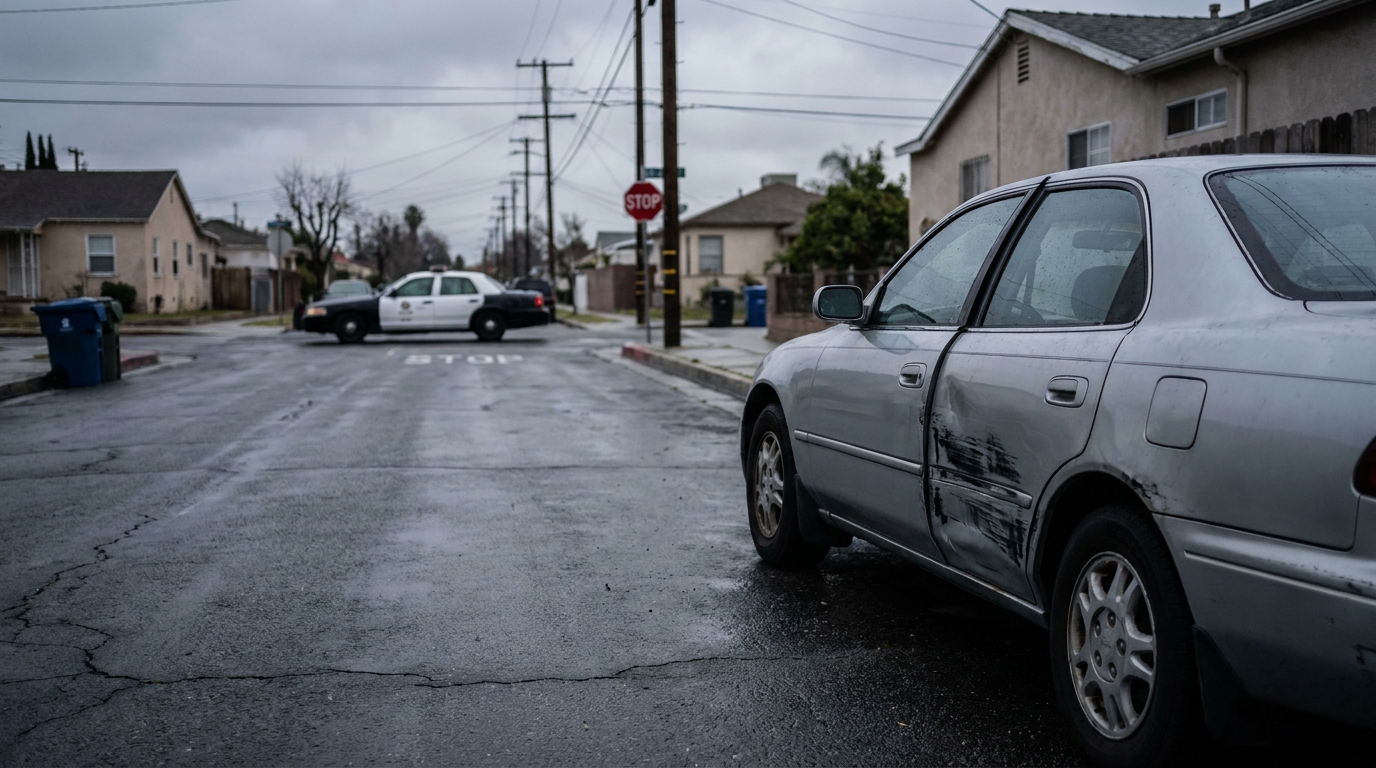
What Happens to Your Car at a Street Takeover?
If your parked car or moving vehicle was hit at a sideshow, street takeover car damage repair in Los Angeles starts with understanding exactly what hit it, because the damage profile is different from a typical fender bender. The damage almost always comes from one or more of four sources: a spinning stunt car that clips or T-bones you, tire-burnout rubber transfer and chemical residue baked onto your paint, debris thrown from spinning wheels, or fire and heat from vehicles set alight nearby.
Takeovers cluster in South LA (the Harbor Gateway intersection at South Figueroa and West Alondra Boulevard is a documented hotspot), the San Fernando Valley (Northridge and Westmont), and downtown intersections. If your car was parked on an adjacent street or you were caught moving through the area, the damage range spans from superficial paint contamination to structural collision damage.
What Does Street Takeover Damage Actually Look Like?
A body shop sees five distinct damage types from these incidents, and each requires a different repair path:
- Burnout rubber transfer: Black, smeared tire-rubber baked onto clear coat by heat. Often looks like a stain but chemically bonds at high temperature.
- Debris impact dents: Rock chips and larger projectiles thrown by spinning tires at speed. Can range from small chips across a panel to deep dents that break through primer.
- Sideswipe or impact damage: A stunt car loses control and strikes your vehicle, leaving crumpled panels, broken glass, torn bumper covers, or bent structural components.
- Undercarriage and wheel damage: If your car was dragged or pushed, or if you drove over debris in the intersection, expect wheel, tire, control arm, or suspension damage.
- Heat and soot damage: Vehicles set on fire at takeovers, documented in South LA and downtown intersections, can heat-blister paint on adjacent cars and deposit soot that etches clear coat over time.
What Does the Repair Actually Involve?
Not every type of damage polishes out. Here is what a shop actually does for each scenario:
Burnout Rubber and Burnt-Residue Paint Contamination
Fresh rubber transfer that has not deeply bonded can often be lifted with a clay bar, iron remover, and machine polish. If the rubber was deposited while the tire was spinning hot, the heat accelerates chemical bonding into the clear coat, and polishing alone will leave haze or surface irregularities. At that point, the affected panels need a wet sand and respray with a clear coat blend into the adjacent panel to avoid a visible color-match line. The decision process is similar to graffiti paint repair: a skilled detailer evaluates depth with a paint-depth gauge before committing to bodywork.
Debris Dents
Small-to-medium dents without paint damage are candidates for paintless dent repair (PDR), which keeps the factory finish intact and costs significantly less than conventional body work. PDR works when the metal has not creased, the paint has not cracked or chipped, and the dent is accessible from behind the panel. Impact dents from large debris, anything that breaks paint or creases a panel, require conventional repair: fill, prime, color match, and clear coat blend. For multi-panel debris patterns, a shop may need to blend paint into two or three adjacent panels to achieve an invisible match under LA sunlight.
Sideswipe and Structural Collision Damage
When a spinning stunt car tags your vehicle at speed, the structural consequences go beyond what shows on the surface. A shop should perform a full frame and unibody measurement before any cosmetic work starts. Bent structural rails require frame straightening on a computerized bench. Any collision that displaces a door, fender, or bumper enough to shift panel gaps may also affect ADAS sensors: cameras, radar units, and parking sensors embedded in bumpers all require recalibration after structural repair and bumper replacement. Skipping recalibration is a safety risk and a liability issue if something goes wrong afterward.
Bumper Damage
Bumper covers hit by a glancing stunt car often crack or tear in a way that cannot be safely fused. A replacement bumper cover is typically the right call when the damage involves cracking near a mounting tab, a tear longer than a few inches, or any deformation that prevents proper fitment. For luxury and newer vehicles, make sure the shop uses OEM or OEM-equivalent covers, since aftermarket bumper covers on modern cars frequently cause sensor alignment failures at recalibration.
Heat and Soot Damage
If your car was near a vehicle fire at the takeover, see our detailed breakdown in car fire damage repair in Los Angeles for the full scope. Briefly: soot that sits on paint etches the clear coat within days in LA heat. If a professional wash and clay bar do not fully restore the finish, the affected panels need a machine polish or respray. Heat that actually blistered or bubbled paint requires sanding to bare metal and a full respray of those panels.
Repair Cost Comparison Table
| Damage Type | Repair Method | Typical Cost Range (LA) |
|---|---|---|
| Rubber transfer, polish out | Clay bar + machine polish | $150–$400 |
| Rubber transfer, respray needed | Sand, respray, clear coat blend | $600–$1,500 per panel |
| Small debris dents (no paint break) | PDR | $75–$300 per dent |
| Debris dents with paint damage | Fill, prime, paint, blend | $400–$1,200 per panel |
| Sideswipe, 1–2 panels | Panel repair or replace + paint | $1,200–$4,000 |
| Structural/frame damage | Frame straightening + repair | $2,000–$8,000+ |
| Bumper cover replacement | Replace + paint + ADAS recal | $900–$2,500 |
| Soot / heat paint damage | Polish or respray | $150–$2,000 per panel |
Who Pays? Which Coverage Applies to Street Takeover Damage in California?
This is the question most online guides ignore for this scenario. The answer depends on who caused the damage and whether that person can be identified. Here is the breakdown for California drivers:
The Stunt Driver Flees (Hit-and-Run)
This is the most common outcome. Until recently, most takeover participants and spectators would scatter when police arrive. If no driver is identified, your two options are uninsured motorist property damage (UMPD) coverage or your own collision coverage. California requires insurers to offer UMPD, though not all drivers carry it. UMPD applies specifically to damage caused by an uninsured or unidentified driver, a hit-and-run sideshow spinner qualifies. A police report is required for a UMPD claim; without one, insurers routinely deny the claim. UMPD carries a deductible (typically $250–$500 in California), and if the at-fault driver is later identified and prosecuted, your insurer may recover it for you. Collision coverage is the fallback if you do not carry UMPD, and it comes with your policy’s collision deductible.
Vandalism or Malicious Debris (No Direct Impact)
If your car was not struck by a vehicle but was damaged by thrown debris, tire rubber, or fire from the event, that is a comprehensive claim in California. Comprehensive covers non-collision events including vandalism, fire, and falling objects. Comprehensive deductibles are typically lower than collision deductibles ($100–$500 is common). If you can document that the damage occurred at or near a street takeover, a police report, photos with a timestamp, or witness accounts, your comprehensive claim is well-supported.
The At-Fault Driver Is Caught
If LAPD arrests the driver (Operation Street Sweeper-style enforcement is making this increasingly realistic), you can pursue a third-party claim against their liability policy. The reality is that many stunt-car drivers carry minimum-limits policies or none at all, so even with an identified driver, your own UMPD or collision coverage may still be the practical recovery path.
Coverage Comparison Table for Sideshow Damage Claims in California
| Scenario | Applicable Coverage | Police Report Required? | Deductible Applies? |
|---|---|---|---|
| Stunt car hits your car, driver flees | UMPD or Collision | Yes (UMPD) | Yes |
| Debris thrown by spinning tires damages paint | Comprehensive | Strongly recommended | Yes |
| Nearby vehicle fire damages your paint | Comprehensive | Strongly recommended | Yes |
| At-fault driver identified and insured | Third-party liability claim | Yes | No (via their insurer) |
| At-fault driver identified but uninsured | UMPD or Collision | Yes | Yes |
What Should You Do Immediately After a Street Takeover Damages Your Car?
A takeover scene is chaotic. No one exchanges insurance information. Here is the documentation sequence that protects your claim:
- Call 911 and wait for LAPD. Do not leave the scene before filing a report. A police report number is the single most important document for a UMPD or hit-and-run claim in California. LAPD’s Street Racing Task Force uses intelligence gathering and drone technology to track takeover locations, so officers may already be en route.
- Photograph everything before moving the car. Wide shots placing your car in context, close-ups of every damage point, and screenshots of your location and the timestamp are all critical. If there is rubber transfer on your paint, photograph it before it cools and bonds further.
- Get witness information. Bystanders who saw what happened to your car are valuable, even if they cannot identify the at-fault driver.
- Notify your insurer that day. Report the incident as a hit-and-run or vandalism claim within 24 hours. Delay gives insurers grounds to question the timeline.
- Get a written repair estimate from a licensed body shop. Do not let the insurer steer you to a shop without evaluating it yourself. An independent estimate protects you if a supplement is needed later.
- Ask the shop about diminished value. California allows owners to claim diminished value after documented collision damage. For newer or luxury vehicles, this is a real dollar figure that can be documented at the shop level.
The 2025 California Sideshow Law Package and Why It Matters for Victims
On September 23, 2024, Governor Newsom signed AB 1978, AB 2186, AB 2807, and AB 3085, a bipartisan package addressing sideshows and street takeovers, all effective January 1, 2025. For innocent victims, the practical takeaway is that enforcement has teeth that did not exist before:
- AB 1978 authorizes law enforcement to impound a vehicle without taking the driver into custody for obstructing or placing a barricade upon a highway, or an off-street parking facility for the purpose of facilitating or aiding a speed contest or exhibition of speed.
- AB 2186 authorizes law enforcement to remove a motor vehicle used in an exhibition of speed in an off-street parking facility for no more than 30 days.
- AB 2807 clarifies that vehicle sideshows are also known as “street takeovers,” standardizing the terminology statewide so that your police report and insurance claim use consistent language.
- AB 3085 empowers law enforcement to impound cars used in street racing, even if the vehicle in question is found later away from the sideshow.
AB 2807 also states that as of July 1, 2025, the state can suspend the license of anyone who takes part in a sideshow. More impounds and prosecutions increase the odds that an identified stunt driver can be traced, which is relevant if you want to pursue diminished value or a third-party claim.
The scale of these events is not abstract. LAPD’s “Operation Street Sweeper” resulted in over 60 arrests, 570 citations, and the impounding of 200 vehicles at a single Harbor Gateway takeover. The operation culminated in a massive scene at the intersection of South Figueroa Street and West Alondra Boulevard, where over 700 people were gathered for an illegal street takeover. These events generate real property damage to innocent nearby vehicles.
Common Mistakes to Avoid
- Leaving the scene before the police arrive. Without a police report, a UMPD or hit-and-run claim has almost no chance of approval in California.
- Filing only a comprehensive claim when a vehicle actually struck yours. Comprehensive does not cover a vehicle impact. Filing under the wrong coverage creates a denial and delays your repair.
- Attempting to wipe or wash off burnout rubber yourself. Household cleaners can smear rubber residue deeper into clear coat or strip the clear coat entirely on newer paint. Have a shop assess it first.
- Skipping ADAS recalibration after bumper or structural repair. Sensors that are not recalibrated after replacement can produce false alerts or fail to detect obstacles, creating a safety hazard.
- Accepting the insurer’s first estimate without a supplement process. Takeover damage is frequently multi-layered. A shop may find structural issues only visible after disassembly. A supplement is a normal part of the process for complex damage.
- Ignoring diminished value. If your car is under five years old or a luxury model, the collision history created by a sideshow impact reduces resale value. Document it while the car is still at the shop.
Frequently Asked Questions
Does comprehensive or collision insurance cover street takeover damage in California?
It depends on how your car was damaged. If a vehicle directly struck yours and the driver fled, that is a hit-and-run claim under uninsured motorist property damage (UMPD) or collision coverage. If your car was damaged by thrown debris, rubber transfer, or a nearby fire without a direct vehicle impact, that is a comprehensive claim. Many takeover incidents involve both types of damage on the same car, so the shop’s written estimate should break out the damage clearly for the insurer.
Can I file a claim if no one gave me their insurance information?
Yes. That is exactly the scenario UMPD and collision coverage are designed for. File the claim as a hit-and-run, provide the police report number, your photos, and any witness contact information. California insurers cannot deny a UMPD claim solely because the at-fault driver was not identified, as long as there is independent corroborating evidence such as a police report or witness account.
Will burnout rubber transfer on my paint polish out or does it need a respray?
Fresh, lightly deposited rubber can be removed with a clay bar and machine polish without affecting the clear coat. Rubber deposited by a hot, spinning tire bonds chemically and may require wet sanding and a panel respray. A paint depth gauge reading before any work starts tells the technician which path is safe. Attempting to scrub it off at home risks permanently damaging the clear coat.
How do I document damage at a chaotic scene with no at-fault driver present?
Call 911 and wait for a police report before moving the car. While you wait, photograph the damage from multiple angles with timestamps active, capture wide shots showing your car’s location at the intersection, and ask any bystanders for their contact information. If there is rubber transfer or debris on the road around your car, photograph that too. The more context you create, the stronger your UMPD or comprehensive claim will be.
Can I claim diminished value after sideshow damage in California?
Yes. California allows first-party diminished value claims, meaning you can pursue the difference between your car’s pre-damage market value and its post-repair value from your own insurer or the at-fault party’s insurer. This matters most for vehicles under five or six years old and for luxury or collector vehicles. A body shop can document the repair scope and costs, which forms the foundation of a diminished value claim. Ask about this before the car leaves the shop.
0 Comments