

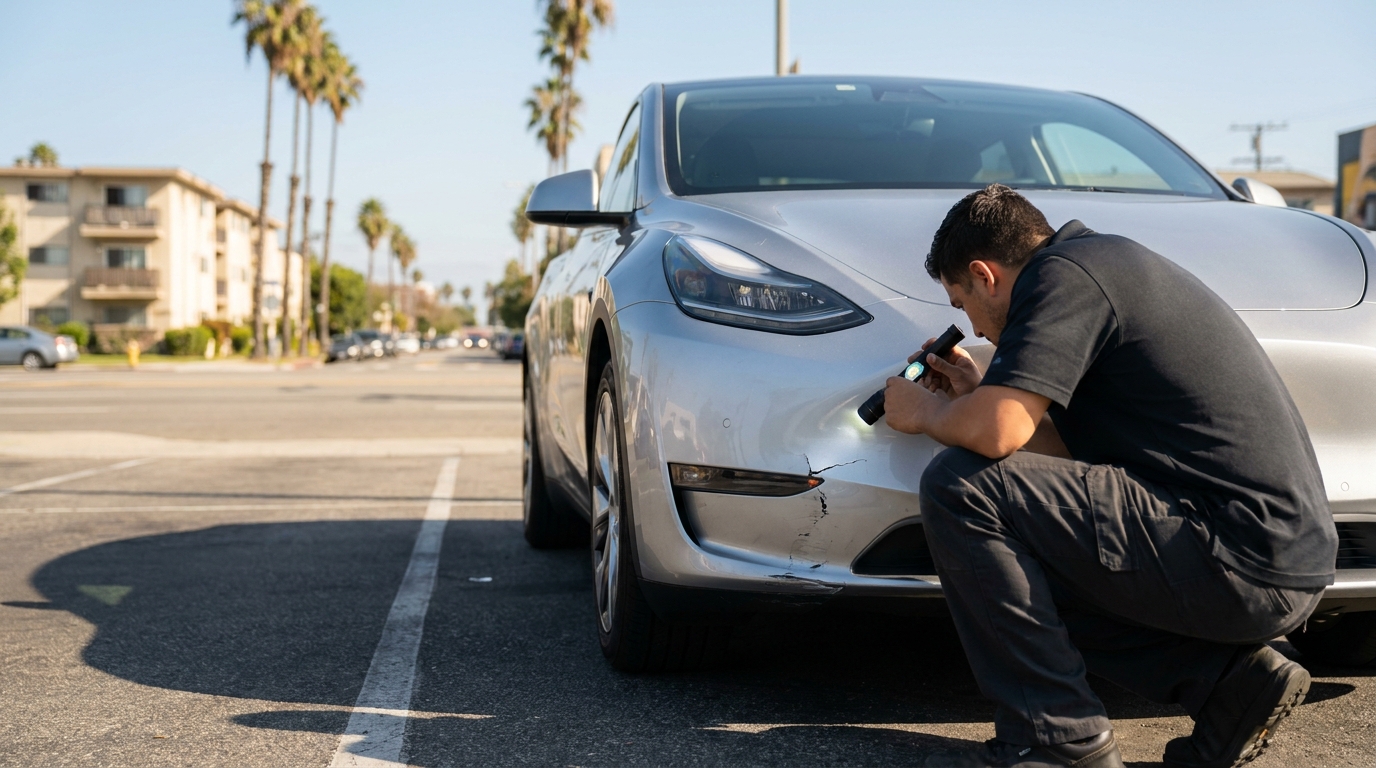
How Much Does Tesla Bumper Repair Cost in Los Angeles?
Tesla bumper repair los angeles runs $750 to $6,500 or more in 2026, and the single biggest variable is whether your bumper’s sensors and cameras need to come out and be recalibrated. A surface scuff on a Model 3 can land at $750–$1,200. A full OEM front-bumper replacement on a Model X with ADAS recalibration can push past $6,500. The ranges below reflect what LA shops are actually quoting this year, not national averages.
Model-by-Model LA Price Table
| Model | Cosmetic Repair | Full Replacement (incl. paint) | With ADAS Calibration |
|---|---|---|---|
| Model 3 | $750–$1,500 | $1,200–$3,500 | Add $300–$900 |
| Model Y | $900–$1,800 | $1,500–$4,500 | Add $400–$1,000 |
| Model S | $1,000–$2,200 | $2,000–$5,500 | Add $500–$1,200 |
| Model X | $1,200–$2,500 | $2,500–$6,500+ | Add $600–$1,500 |
Model 3 sits at the lower end because it has a simpler sensor layout and a smaller paint blend area. Model X is the most complex repair in the lineup due to its size, high sensor density, and reinforced mounting structures. Model Y sits in between but its larger fascia means a bigger paint blend, which adds labor and material cost versus the Model 3.
A genuine Tesla Model Y front bumper cover runs roughly $2,000 in parts alone, compared to $300–$500 for a typical non-Tesla bumper. That gap comes from Tesla’s tightly controlled parts supply chain, and it’s a major reason why full replacements feel expensive before labor is even factored in.
What Makes a Tesla Bumper Job More Expensive Than a Standard Car?
Tesla bumpers are not passive plastic covers. They house ultrasonic sensors, forward-facing cameras, radar hardware, and the brackets that tie those systems to Autopilot and automatic emergency braking. Even a low-speed parking impact can shift sensor alignment with zero visible exterior damage. That means a shop cannot simply pop a new cover on, blend the paint, and call it done.
- OEM parts cost: Tesla controls its parts supply more tightly than traditional automakers. A Model 3 front bumper cover costs $800–$1,200 versus $300–$500 for most sedans.
- Specialized labor: Technicians need Tesla-specific diagnostic software to read sensor fault codes before and after removal.
- Paint complexity: Tesla’s proprietary colors, especially multi-coat whites and reds, require precise mixing and blending to neighboring panels to avoid visible color shifts.
- LA labor rates: Shop rates in Los Angeles run higher than national averages, typically $75–$125 per flat-rate hour for collision work.
For more on what makes EV body work structurally different from a standard collision job, see our guide on OEM Certified Collision Center Los Angeles: How to Find and Verify One for Your Brand.
What Is the Calibration Cost That Shops Don’t Warn You About?
ADAS recalibration is almost always required after any bumper removal or replacement on a Tesla, and it is frequently quoted as a separate line item after teardown, not in the initial estimate. Budget $300–$1,500 specifically for this step, depending on which sensors are disturbed and the calibration method required (static, dynamic, or both).
| Calibration Type | When Required | Typical LA Cost |
|---|---|---|
| Static only | Camera or radar removed, minimal structural shift | $300–$600 |
| Dynamic only | Sensor realigned, requires road test at speed | $400–$700 |
| Static + Dynamic | Full bumper replacement, multiple sensors disturbed | $700–$1,500 |
A shop without Tesla-specific diagnostic equipment cannot complete this step properly. Skipping calibration or using generic scan tools leaves Autopilot, automatic emergency braking, and lane departure systems operating on misaligned baselines, which is a direct safety risk. Our post on Minor Accident Totaled EV Battery Damage Los Angeles covers a related scenario where a seemingly minor hit carried expensive hidden consequences.
Should You Repair or Replace Your Tesla Bumper?
Repair is the right call for localized cosmetic damage. Replacement is mandatory when structure or sensors are compromised. Use this decision rule:
- Repair: Scuffs, surface scratches, small cracks under 3–4 inches that do not reach mounting tabs or sensor pockets. No fault codes on pre-scan. Estimated repair cost is clearly less than a new cover plus labor to install it.
- Replace: Cracks that extend to mounting points, torn or deformed sensor brackets, any fault codes triggered on a pre-repair diagnostic scan, or when the labor to plastic-weld and finish the repair approaches the cost of a new OEM cover.
- Never: Body filler (Bondo) on a Tesla bumper. Filler does not flex with the thermoplastic cover, will crack again within months, and cannot restore proper sensor bracket geometry. Forum quotes for $325 Bondo fixes are real, and so are the repeat repairs and safety risks that follow.
The catch in LA specifically: tight condo garages, valet lots, and compact street parking generate a high volume of low-speed impacts that look cosmetic but are hiding bracket damage found only when the cover comes off at teardown. Expect the shop to call you mid-repair if the initial estimate was based on exterior inspection alone.
Should You File an Insurance Claim or Pay Out of Pocket?
The right answer depends on your deductible and the repair total, not a general rule about always filing or never filing.
- Pay out of pocket when the total repair cost, including calibration, is at or near your deductible. Filing a claim for $1,400 on a $1,000 deductible nets you $400 while triggering a rate review at renewal.
- File a claim when sensor damage or a full replacement pushes the total well above your deductible. A Model Y front bumper replacement with calibration at $3,500–$5,000 typically clears even a $1,500 deductible by a meaningful margin.
- Consider diminished value if the other driver was at fault. California allows diminished value claims, and a documented repair on a Tesla can reduce resale value even after a perfect fix. See our post on Diminished Value in California: What a Body Shop Can Document for specifics.
If someone else hit your parked car and left, the calculus shifts to their liability coverage, not your collision deductible. Non-certified shops are often excluded under Tesla’s repair standards, which can become an issue when an insurer tries to steer you to a preferred network facility.
Common Mistakes to Avoid
- Accepting an estimate based only on photos. Tesla bumper damage regularly reveals hidden bracket and sensor issues at teardown. A reputable shop will pre-scan the vehicle before quoting a final price.
- Choosing a shop that skips the pre-repair diagnostic scan. Without a scan, nobody knows which sensor fault codes already exist. Post-repair calibration cannot fix a sensor that was damaged before the bumper came off.
- Using aftermarket bumper covers on a Model Y or Model X. Aftermarket covers frequently misalign sensor pockets by several millimeters, making proper calibration impossible and voiding Tesla’s sensor warranty.
- Skipping calibration to save money. A bumper job that omits ADAS recalibration is an incomplete repair. It leaves safety systems unreliable and creates liability if those systems fail in a future incident.
- Filing a small claim reflexively. If the total is close to your deductible, paying out of pocket preserves your claims history and can save more in premiums than the insurer would have covered.
- Using body filler on cracked thermoplastic. Bondo does not bond permanently to flexible bumper plastic. It will crack again, and the re-repair will cost more than doing it right the first time.
Frequently Asked Questions
How long does a Tesla bumper repair take in Los Angeles?
A cosmetic scuff repair typically takes 2–4 business days. A full OEM bumper replacement with paint and ADAS calibration runs 5–10 business days in most LA shops, with parts availability being the most common source of delay. Tesla OEM parts do not have the same aftermarket supply depth as legacy automakers.
Can any body shop repair a Tesla bumper, or does it need to be Tesla-approved?
Any licensed body shop can attempt the work, but only shops with Tesla-approved or Tesla-certified status have access to official repair procedures, OEM parts at standard lead times, and the calibration software required for ADAS systems. Using a non-certified shop for sensor-involved repairs can void Tesla’s ADAS warranty and produce an uncalibratable result.
Is a Tesla Model 3 or Model Y bumper repair cheaper?
Model 3 bumper repairs generally run $200–$600 less than comparable Model Y work. The Model 3 has a smaller fascia, a smaller paint blend area, and slightly lower sensor density at the front. Model Y’s larger cover increases both parts cost and labor hours for removal, refinish, and reinstall.
What is a Tesla bumper sensor calibration, and why does it cost so much?
Tesla’s bumper-mounted sensors connect directly to Autopilot, automatic emergency braking, and parking detection. After any bumper removal, the shop must use Tesla-specific diagnostic equipment to realign sensor aim angles and verify system function. The process requires dedicated calibration targets, sometimes a road-speed dynamic verification run, and post-calibration documentation. That process, equipment overhead, and technician time account for the $300–$1,500 add-on cost.
Does a Tesla bumper repair show up on CARFAX and affect resale value?
Minor cosmetic repairs that do not involve a written insurance claim typically do not appear on CARFAX. However, insurer-paid repairs are reported and will appear in the vehicle history. Even a disclosed, properly completed bumper repair can reduce resale value on a Tesla, particularly on Model S and Model X, where buyers are more sensitive to any reported damage. Documenting the OEM parts used and the calibration completion can partially offset that discount.
0 Comments