

Who Pays When a Tow Truck Damages Your Car in Los Angeles?
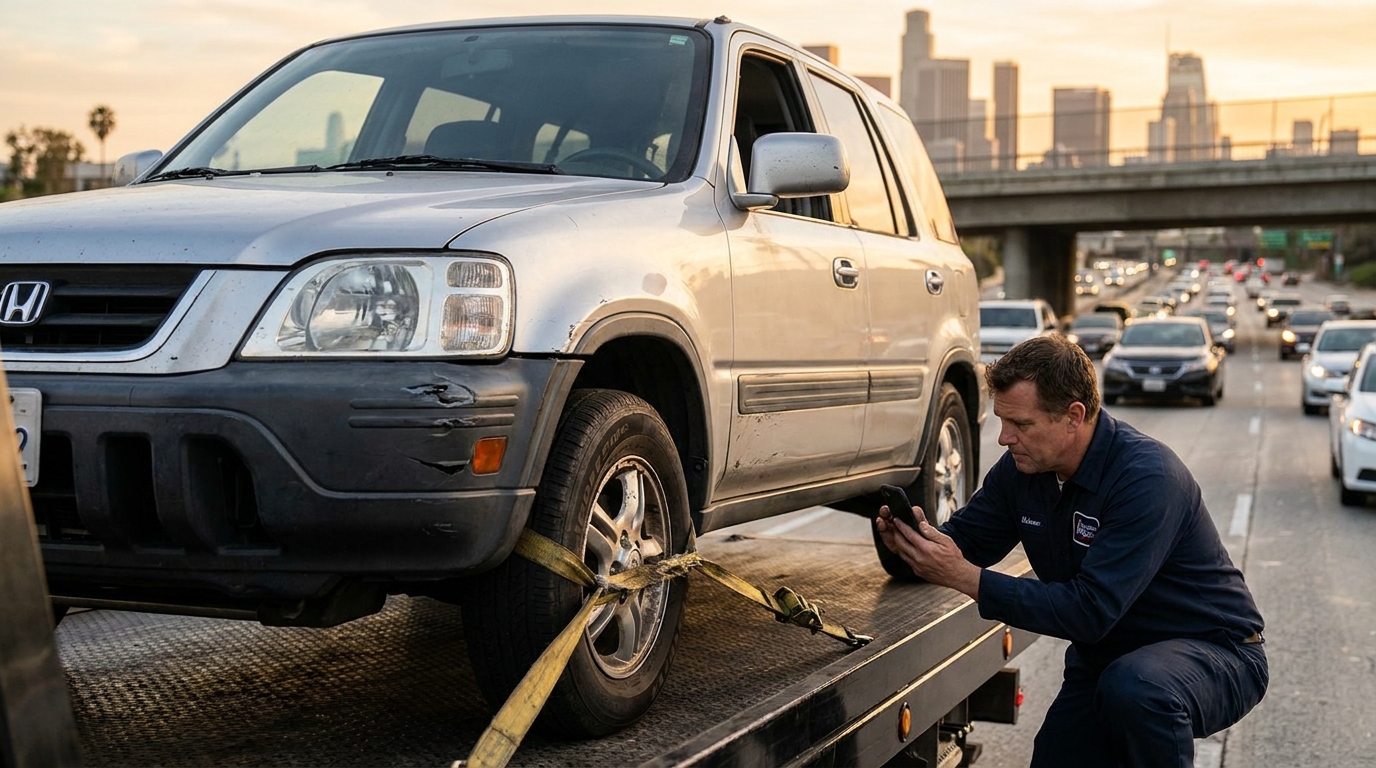
The tow company is liable. Under California tort law, a tow company owes every vehicle owner a duty of due care at every stage of the tow: hooking up, transporting, and handling the car at the yard. If they breach that duty and your car is scratched, cracked, or structurally damaged, they owe you the repair cost. This is the core legal principle that governs tow truck damaged my car in Los Angeles situations, and it doesn’t change whether the tow was private, LAPD-ordered, or dispatched through the CHP’s rotation program.
That said, collecting from the tow company isn’t always instant. Here is exactly what your payment options look like, in order of preference:
- Tow company’s on-hook or garagekeepers insurance: California tow operators must carry on-hook towing coverage specifically for damage that occurs during transport. File directly with their insurer once you have the company’s carrier information.
- Your own collision or comprehensive coverage: Your insurer can pay the repair minus your deductible, then subrogate, meaning they pursue the tow company’s insurer for reimbursement and return your deductible once they recover it.
- California small claims court: If the tow company refuses to cooperate or won’t disclose their carrier, you can sue for up to $12,500 in small claims. A written shop estimate and timestamped before/after photos are your evidence.
One critical warning: Do not accept a quick cash settlement directly from the tow company without looping in your insurer. Accepting that payment can interfere with your insurer’s subrogation rights, potentially leaving your deductible unreimbursed and complicating any claim for hidden damage found later.
The LA-Specific Tow Context: CHP Rotation, LAPD Dispatch, and Your Right to Decline
Los Angeles has two overlapping tow systems, and knowing which one applies changes how you handle a damage dispute.
On freeways, the CHP dispatches tow companies from an approved rotation list. These operators sign the CHP’s Tow Service Agreement (TSA), which sets conduct standards, insurance minimums, and fee caps. Critically, even after a CHP rotation truck arrives on scene, you have the right to decline and choose your own tow company, and you will not be charged a cancellation fee if you do so before the hook-up is complete. If the CHP-dispatched truck damages your car, the company’s TSA-required insurance covers it, and the CHP’s area commander can take disciplinary action against the operator, up to and including removal from the rotation program.
On surface streets, LAPD contracts with Official Police Garages (OPGs) to handle ordered tows. The same liability principle applies: damage caused during an OPG tow is the company’s responsibility. Any tow truck driver operating in the City of Los Angeles must be registered with the Police Board of Commissioners, which creates an additional layer of accountability and a formal complaint channel.
The practical takeaway: document the damage at the scene, before the truck leaves. Once the car is in a tow yard, separating yard-handling damage from transport damage becomes much harder.
What Does Tow Damage Actually Look Like? A Shop’s Damage Map
Legal pages tell you to “get photos.” A body shop tells you exactly where to look and what you’re photographing. Here are the most common tow-damage patterns, by hook-up method:
- J-hook and chain scrapes: Chains dragged under the frame leave gouges along the frame rails and subframe. On lower-slung vehicles and EVs, these marks can reach the battery tray or undercarriage skid plates.
- Flatbed approach-angle cracks: When a flatbed’s loading angle is too steep for a low-clearance vehicle, sports cars, lowered trucks, or long-wheelbase SUVs, the front valance, lower bumper cover, and even the front diffuser contact the ramp and crack or split.
- Winch and strap marks: Nylon straps cinched too tight across painted panels leave compression bruising, paint transfer, and sometimes structural deformation in the door sills or bumper reinforcement bars.
- Wheel and rim tie-down damage: Wheel nets and axle straps can scratch alloy rims and, if improperly routed, bend brake dust shields or stress wheel hubs.
- AWD and EV drivetrain damage from flat-towing: Flatbed is the correct method for most modern vehicles. If a truck with a wheeled-lift or J-hook drags an AWD vehicle with one or two axles on the ground, the differential or transmission can be damaged. For EVs, dragging can also stress the half-shafts and, in a worst case, damage the battery management system connections.
- Tow-yard handling damage: Scrapes from cars being shuffled around a crowded lot are common, and harder to prove. Photograph the car at drop-off if you can.
Photograph every panel, the undercarriage, all four wheels, and the bumpers front and rear. Shoot with timestamps enabled. If the damage is a fresh scrape in a panel that had clean paint before the tow, that visual contrast is your most powerful evidence.
What Does Tow Damage Repair Cost in Los Angeles? Real 2026 Shop Ranges
Los Angeles body shop rates run higher than the national average, and repair pricing varies 60–100% between shops depending on labor rate, parts strategy, and equipment. The ranges below reflect realistic LA shop pricing in 2026.
| Damage Type | Typical LA Repair Cost | Notes |
|---|---|---|
| Light scuffs and paint scratches | $150–$500 | Polish or spot respray; depends on panel size and depth |
| Cracked bumper cover (repairable) | $300–$1,000 | Plastic weld + refinish; works on clean cracks without sensor damage |
| Painted bumper cover replacement | $700–$2,000 | OEM vs. aftermarket part choice drives most of the variance |
| Bumper with ADAS sensor damage | $1,500–$4,000 | Includes radar/camera replacement and recalibration |
| ADAS recalibration alone | $150–$600 | Required any time a sensor is disturbed or a bumper is replaced |
| Rim and wheel repair | $150–$500 per wheel | Curb rash from tie-downs; structural cracks require replacement |
| Frame rail / undercarriage repair | $1,000–$4,000+ | Chain-drag gouges; straightening vs. section replacement depends on depth |
| Transmission damage from flat-towing | $1,500–$6,000+ | Mechanical scope; must be documented separately from body damage |
| EV undercarriage / battery tray inspection | $300–$1,500+ | Scan plus physical inspection; replacement costs are vehicle-specific |
Total tow-related repair bills commonly run $1,500–$5,000 for cosmetic damage, and well above that when sensors, drivetrain, or structural components are involved. Getting a written, itemized estimate from a licensed shop is the essential first step, not an optional one.
The ADAS and EV Angle Nobody Warns You About
Modern vehicles, especially EVs and vehicles with active safety systems, carry a hidden cost multiplier in tow damage scenarios. Flatbed loading at a steep angle is the most common culprit: the front bumper cover contacts the ramp, and even a minor flex can unseat the radar sensor, forward camera bracket, or parking sensor harness behind the cover. The cover may look only lightly scratched, but the sensor behind it can require full replacement and static or dynamic recalibration before the lane-keeping, automatic emergency braking, and adaptive cruise systems function correctly again.
ADAS recalibration alone commonly adds $150–$600 to a modern bumper repair. If the shop skips it, your safety systems may pass a visual check but fail in real-world use. For Tesla and other EV owners, the same flatbed loading event that cracks the front valance can also gouge the undercarriage skid plate, requiring a thorough inspection of the battery tray and high-voltage connections before the vehicle is safe to drive.
See our detailed guide to Tesla bumper repair in Los Angeles for a full breakdown of what’s behind that front cover and why calibration is non-negotiable.
How a Body Shop Documents Tow Damage to Win the Claim
This is the section no legal page covers, and it’s the part that actually determines whether the tow company’s insurer writes a check. The shop’s written estimate does two jobs simultaneously: it scopes the repair for the technicians and it serves as the formal evidentiary record for the liability claim.
Here is what a thorough tow-damage estimate includes:
- Damage isolation by cause: The estimator notes which damage is consistent with tow-connection contact (chain marks, hook points, strap impressions) versus which wear was clearly pre-existing. Tow company insurers only owe for damage they caused; separating new from old is the single biggest factor in whether a claim pays out in full.
- Panel-by-panel photo documentation: Stamped, numbered photos tied to each line item on the estimate. This makes it impossible for the insurer to argue a scratch was there before.
- Supplement flagging: Hidden damage, cracked bumper reinforcement bars, bent sensor brackets, frame-rail deformation, only becomes visible once the bumper cover is removed. A reputable shop will flag the potential for a supplement and explain the process to you before work begins. You can read more about how supplements work in our guide to What Is a Supplement in Collision Repair.
- OEM vs. aftermarket parts notation: The estimate specifies part quality. California law does not require you to accept aftermarket parts on a third-party liability claim; you can request OEM, and the insurer must disclose any cost difference.
- ADAS calibration line items: Every sensor disturbed, removed, or replaced should appear as a separate line, with the calibration labor and equipment cost itemized. This prevents the insurer from treating calibration as a “gratuity” rather than a required repair step.
You are not required to use the tow company’s preferred shop or the shop their insurer recommends. Under California law, you have the right to choose any licensed repair facility. That choice matters because a shop with no stake in the tow company relationship has every reason to write a complete, accurate estimate rather than a minimal one.
Step-by-Step: How the Tow Damage Claim Actually Works
- Document at the scene. Photograph every panel, the undercarriage, all four wheels, and the bumpers with timestamps. Note the tow company’s name, truck number, driver’s name, and license plate.
- Get the tow company’s insurer information. Ask the driver and the tow yard directly. If they refuse, note that refusal in writing via text or email so you have a record.
- Bring the car to a licensed body shop for a written estimate. Do this before agreeing to any cash offer. The estimate creates the official damage record.
- File with the tow company’s liability or on-hook insurer. Provide the estimate, your photos, and the tow receipt. The insurer has a duty to respond.
- File with your own insurer if the tow company stalls. Your collision or comprehensive coverage can pay first; your insurer then subrogates to recover from the tow company. You get your deductible back when they recover it.
- Authorize repairs. Once a payment source is confirmed, the shop orders parts, begins the repair, and supplements the estimate if hidden damage is found during disassembly.
- Post-repair safety check. Confirm that all ADAS functions and, for EVs, all battery management indicators are verified before you accept delivery.
- Small claims court as a last resort. If the tow company refuses to pay and you’re below $12,500 in damages, California small claims is accessible without an attorney. Bring your estimate, photos, the tow receipt, and any written communication with the company.
Tow Damage vs. Pre-Existing Damage: The Comparison That Decides the Claim
The table below shows how a shop distinguishes damage caused during towing from wear and damage that was already present. Tow company insurers use this same framework to approve or deny payment on specific line items.
| Damage Characteristic | Likely Tow-Caused | Likely Pre-Existing |
|---|---|---|
| Scratch depth and direction | Deep, linear, consistent with hook/chain path | Random direction, varied depth, weathered edges |
| Paint condition at damage edge | Fresh bare metal or raw plastic; no oxidation | Oxidized, yellowed, or rust-stained edges |
| Location on vehicle | Frame rails, lower bumper, rocker panels, wheel faces | Door edges, hood chips, random door-ding dents |
| Pattern consistency | Bilateral or mirror-image (both sides, same height) | Isolated, asymmetric, inconsistent |
| Surface transfer material | Metal filings, rubber, or strap nylon embedded in paint | Road grime, old paint transfer from prior incidents |
This distinction is exactly why a professional estimate, not a phone photo and a verbal quote, is the only document that holds up in an insurance claim or small claims filing.
Common Mistakes to Avoid
- Accepting a direct cash offer before getting an estimate. You have no way to know the full scope of damage, including what’s hidden behind the bumper cover, until a shop inspects it. A quick cash offer almost always covers only what’s visible.
- Skipping the scene photos. Once the car is at a tow yard, proving that damage happened during transport (versus yard handling) becomes your word against theirs.
- Using the tow company’s recommended shop without question. You are not obligated to do so. A shop chosen by the party that damaged your car has an inherent conflict of interest.
- Ignoring ADAS calibration on a modern vehicle. A bumper repair without sensor verification leaves your safety systems in an unknown state. This is both a safety issue and a future liability issue if you’re in a collision and the system failed to activate.
- Waiting too long to file. California’s statute of limitations for property damage claims against private parties is generally three years, but memories fade, witnesses disappear, and the tow company’s coverage details become harder to retrieve. Act within days, not months.
- Assuming comprehensive coverage doesn’t apply. Comprehensive can cover damage not caused by a collision, which may include improper towing. Check your policy or call your agent before assuming you’re on your own.
- Settling without accounting for diminished value. Even after a perfect repair, a vehicle with a tow-damage claim on its history can lose resale value. California allows diminished value claims on third-party liability claims. Discuss this with the shop when they write your estimate.
Frequently Asked Questions
Is the tow company liable if my car was scratched during a CHP-ordered tow in Los Angeles?
Yes. CHP rotation tow companies must comply with the CHP’s Tow Service Agreement and carry on-hook and garagekeepers liability insurance. If the driver damages your car during a rotation tow, the company’s insurance covers it, and the CHP can take disciplinary action against the operator. You can decline the CHP rotation tow before hook-up and use your own tow company without penalty.
Can my insurer pay for tow truck damage even if the tow company was at fault?
Yes. Your collision coverage can pay the repair minus your deductible. Your insurer then subrogates, pursues the tow company’s insurer for reimbursement, and returns your deductible once they recover it. Collision or comprehensive coverage paying first is often faster than waiting for the tow company’s insurer to accept liability.
What if the tow company refuses to give me their insurance information?
Document the refusal in writing (text or email). Then file with your own insurer and reference the tow company’s non-cooperation. As a fallback, California small claims court handles property damage cases up to $12,500 without requiring an attorney. Your written shop estimate and timestamped photos are the core of that case.
Does a tow truck damaging my bumper require ADAS recalibration?
Almost always on vehicles built after 2018. Even minor flex of the bumper cover during loading or transport can displace radar sensors, forward cameras, or parking sensor harnesses. ADAS recalibration adds $150–$600 to a typical bumper repair and is required before lane-keeping, automatic emergency braking, and adaptive cruise systems will function accurately. Skipping it is a safety risk and voids the repair warranty on those systems at most reputable shops.
Do I have to use the tow company’s preferred body shop?
No. Under California law, you have the right to choose any licensed collision repair facility regardless of what the tow company or their insurer recommends. The shop you choose will write the estimate, document the damage, and represent your interests, not the tow company’s.
0 Comments