

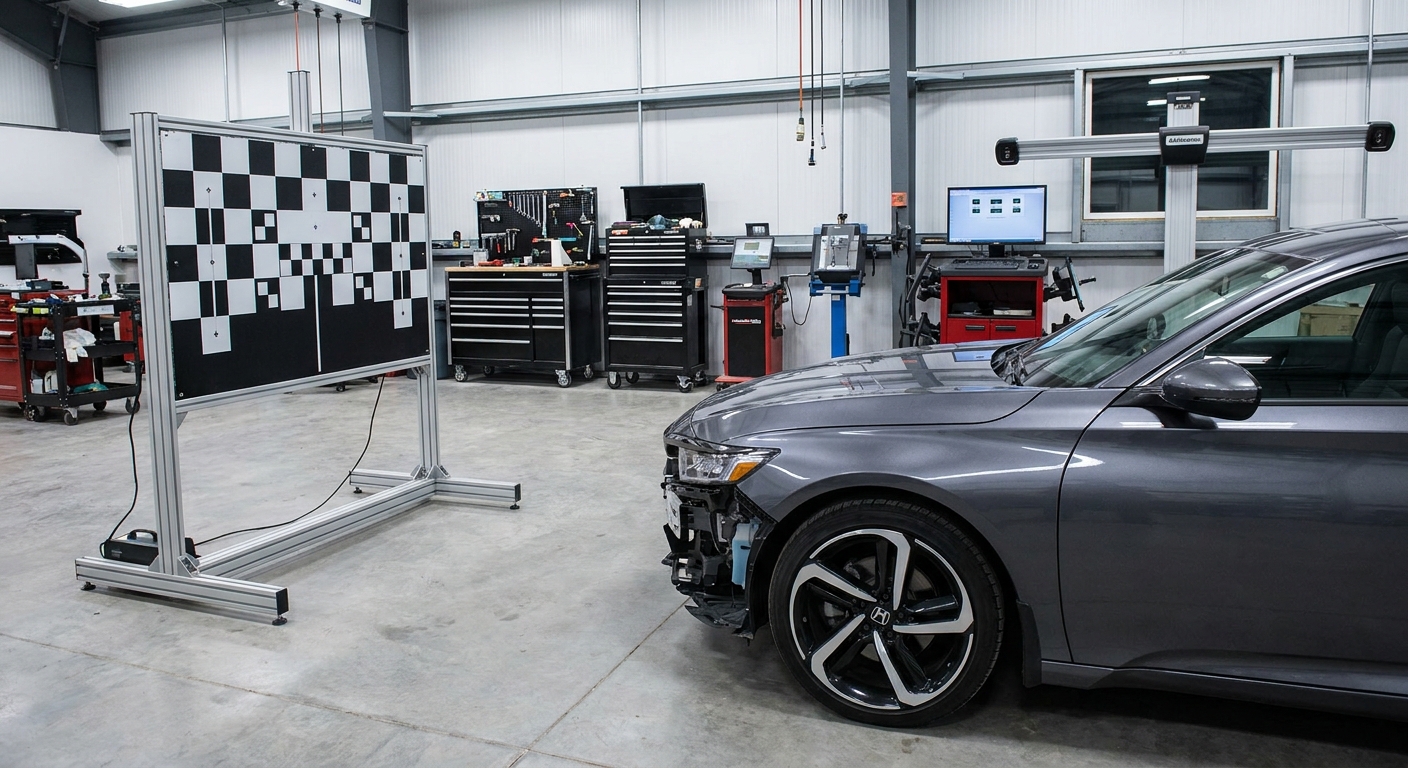
If your car was built in the last several years, it almost certainly has cameras and sensors that need recalibration after a collision repair, and skipping that step can leave safety features quietly miscalibrated. ADAS calibration after collision repair is not an upsell; it is often a required, manufacturer-specified procedure. Here is what it is, when it is needed, and why it matters for your safety.
What is ADAS, and why does it need calibration?
ADAS stands for Advanced Driver Assistance Systems, features like automatic emergency braking, lane-keep assist, adaptive cruise control, and blind-spot monitoring. They rely on cameras, radar, and sensors aimed with great precision. Even small changes during a repair, a new windshield, a bumper R&R, a realigned panel, can shift a sensor’s aim enough to make it read the road incorrectly. Calibration re-aims these systems to factory specification.
When is calibration required after a repair?
| Repair | Calibration often needed |
|---|---|
| Windshield replacement | Forward-facing camera recalibration |
| Front bumper / grille R&R | Front radar (adaptive cruise, AEB) |
| Rear bumper / quarter panel | Blind-spot / rear radar sensors |
| Suspension or alignment work | Camera/radar aim can shift |
| Mirror or side sensor work | Blind-spot / lane systems |
The manufacturer’s repair procedures specify exactly when calibration is required, which is why shops check OEM guidance rather than guessing.
Static vs. dynamic calibration
There are two main types. Static calibration happens in the shop using precise targets, specific distances, and level floors. Dynamic calibration is done by driving the car at set speeds on marked roads while the system relearns. Many vehicles need one or both. Both require the right equipment, space, and scan tools, which is why not every shop performs them in-house.
Why skipping calibration is dangerous
A miscalibrated system can brake late, warn incorrectly, or fail to see a hazard, while the dashboard shows no warning light. The car looks fixed and drives normally until the moment a safety feature is supposed to act. Proper calibration is what ensures the systems you rely on actually work after the repair.
How to make sure it gets done
- Ask whether your repair requires ADAS calibration per the manufacturer.
- Confirm the shop performs calibration in-house or through a qualified partner.
- Look for pre- and post-repair scans on your estimate.
- Get documentation that calibration was completed and passed.
Does insurance pay for calibration?
Generally yes, when it is a required part of the repair it is a legitimate, documentable operation that belongs on the estimate. A good shop lists scans and calibration as line items and provides the proof, so the insurer can approve it as part of a complete, safe repair.
Frequently asked questions
Does a windshield replacement really need calibration?
On most newer cars, yes, the forward camera mounted at the windshield must be recalibrated after replacement.
Will a warning light tell me if calibration was skipped?
Not always. A system can be misaimed without triggering a light, which is why documented calibration matters.
How long does calibration add to a repair?
Often part of a day, depending on static vs dynamic requirements and whether it is done in-house.
The bottom line
On modern vehicles, ADAS calibration is a required, safety-critical step after many collision repairs, not an optional extra. Make sure your Los Angeles shop checks the manufacturer’s procedures, performs the right static or dynamic calibration, and documents that your safety systems were restored to spec before you drive away.
0 Comments