

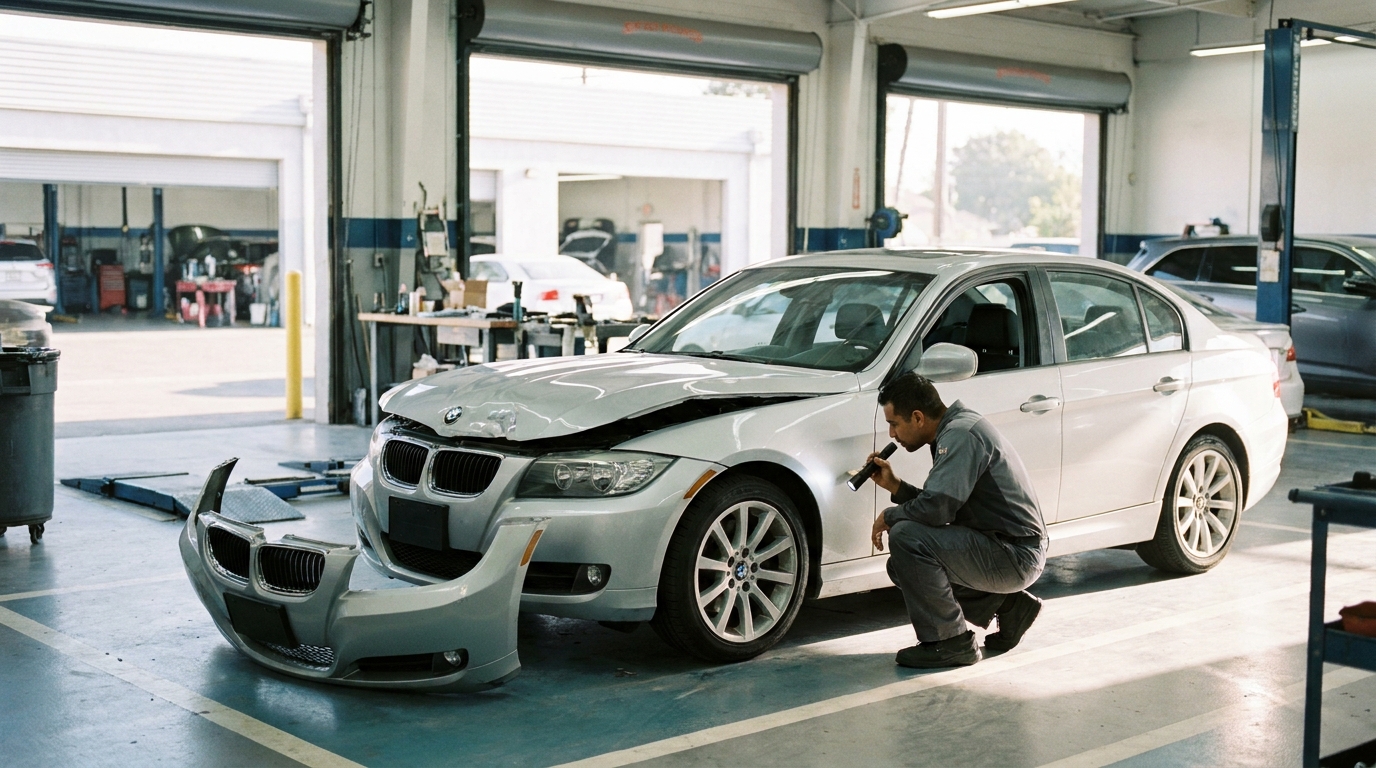
What Does an Auto Body Shop in Glendale Actually Cost?
Glendale repair costs vary more than most directories let on. The right number depends on the job type, your vehicle’s make and model, and whether OEM or aftermarket parts are used. The table below gives you a realistic range for the most common repairs, based on current 2024 local cost data for the Glendale 91205 ZIP and surrounding corridors along San Fernando Road.
| Repair Type | Glendale Cost Range | Typical Time |
|---|---|---|
| Minor cosmetic (scratch, scuff, small ding) | $150 – $500 | 1 – 3 business days |
| Paintless dent removal (per dent) | $75 – $500 | 1 – 3 business days |
| Bumper repair or replacement | $500 – $1,500 | 2 – 4 business days |
| Fender repair or replacement | $750 – $2,500 | 3 – 5 business days |
| Full collision repair (panel + refinishing) | $2,000 – $6,000 | 5 – 10 business days |
| Frame straightening | $750 – $1,500 | 3 – 5 business days |
| Full respray / paint job | $1,000 – $4,500 | 5 – 10 business days |
| Hail damage repair | $100 – $3,500 | 1 – 5 business days |
| Major structural repair (frame + airbags + multiple panels) | $10,000+ | 2 – 4 weeks |
One local cost-profile database pegs Glendale automotive damage repair at roughly $390 on average, with a fair range of $268 to $609 and shop labor rates around $104 per hour. Full collision center work, which includes frame and structural repair, skews the average considerably higher, with a fair range closer to $1,825 to $3,042 based on hundreds of local cost profiles. The wide spread exists because a single-panel repaint on a Honda Civic and a structural repair on a Mercedes-Benz GLE are both called “collision repair.”
Glendale drivers tend to see parking-lot dings and curb scrapes frequently given the dense residential streets and busy commercial corridors near Brand Boulevard, the Americana, and the Galleria. Many of those jobs qualify for paintless dent repair, which is significantly cheaper than repainting. See the PDR section below for the decision logic. For a broader look at how fender benders are priced across the LA area, our fender bender repair cost Los Angeles guide breaks down what a shop actually finds when the bumper comes off.
PDR or Conventional Repair: Which Is Right for Your Glendale Dent?
Paintless dent repair (PDR) is the right call for most Glendale parking-lot dings and minor hail hits. Conventional repair with filler, primer, and paint is necessary when the metal is creased, the paint has cracked, or the panel needs replacement. Here is how to decide:
| Scenario | Best Method | Why |
|---|---|---|
| Smooth round dent, paint intact | PDR | Preserves factory finish, lowest cost ($75 – $500 per dent) |
| Sharp crease or fold in metal | Conventional repair | Metal cannot be massaged back to factory geometry |
| Paint cracked, chipped, or peeling at the dent | Conventional repair | Surface must be primed and refinished regardless |
| Hail damage across hood/roof (small, uniform dents) | PDR (if paint intact) | Multiple dents repaired efficiently without respray |
| Panel too thin (aluminum body, Tesla Model 3/Y door) | Specialist PDR or replace | Aluminum work-hardens; standard PDR risks tearing |
| Luxury vehicle, dent near body line or character line | Case-by-case evaluation | Body lines make full massage impossible; partial fill may be needed |
PDR keeps the factory finish intact and costs a fraction of repainting, with jobs commonly completed in one to three days. For Glendale’s occasional foothill hailstorm, PDR is almost always the right starting point, provided the paint surface held up. Our deeper breakdown of paintless dent repair Los Angeles costs explains per-dent pricing in detail and covers which vehicle types qualify.
OEM vs. Aftermarket Parts: What Glendale’s Luxury and EV Mix Changes
Glendale has a notably high concentration of German luxury vehicles (BMW, Mercedes-Benz, Porsche) and EVs (Tesla Model 3, Model Y, Lucid Air). The OEM vs. aftermarket decision matters more for these vehicles than for a standard domestic sedan.
What California law requires: California Insurance Code Section 758.5 requires insurers to disclose when non-OEM parts are specified in a repair estimate. Under California Insurance Code Section 1874.87, insurers must use OEM parts on vehicles that are three model years old or newer unless you consent in writing to alternatives. Insurers can use aftermarket parts on older vehicles, but those parts must be of like kind and quality, come with a written warranty, and be explicitly identified in the estimate.
When to insist on OEM:
- Your vehicle is under factory warranty, aftermarket parts create ambiguity, and OEM eliminates that risk entirely.
- The repair involves structural components, ADAS sensors, or any safety system. For structural or crash parts, aftermarket carries more risk and OEM is the better choice.
- You drive a luxury or specialty vehicle. Aftermarket panels on a BMW or Mercedes often show panel gap inconsistencies that immediately signal prior accident damage, which cuts resale value. Industry data suggests luxury vehicles repaired with aftermarket parts lose 5 to 12 percent more resale value than those repaired with OEM.
- You drive a Tesla or other EV with proprietary body panels or high-voltage system proximity. Tesla-certified or EV-specialist shops follow manufacturer procedures that require OEM parts.
When aftermarket is acceptable: Older vehicles (beyond the three-year OEM threshold), low-value cosmetic panels on non-luxury makes, and budget-conscious repairs where CAPA-certified aftermarket parts provide a meaningful cost savings without safety implications. Aftermarket parts typically run 20 to 50 percent less than OEM equivalents. If your insurer specifies aftermarket and you want OEM, ask your shop to advocate during the supplement process, a good shop does this routinely. For Tesla-specific collision work near Glendale, see our Tesla bumper repair Los Angeles guide for calibration costs and certification details.
Do I Have to Use My Insurance Company’s Recommended Shop in Glendale?
No. Under California Insurance Code Section 758.5, your insurer can recommend a shop but cannot require you to use one, cannot intimidate you into using one, and cannot pay less because you picked a different shop. This is one of the most misunderstood rights Glendale drivers have, because insurers routinely use language designed to steer you toward their Direct Repair Program (DRP) partners without technically lying.
The California Auto Body Repair Consumer Bill of Rights, codified at California Insurance Code Section 1874.87, gives you six specific protections after a collision. The first is the right to select the auto body repair shop that repairs your vehicle. If your insurer pushes back, the response is straightforward: state that you are aware of California Insurance Code Section 758.5, that you have chosen your shop, and that you are proceeding. Your claim is just as eligible for coverage at your chosen shop as it is at any DRP partner. You can report violations of this code to the California Department of Insurance at 1-800-927-4357.
What to say to your adjuster: “I’d like to use [shop name] for my repairs. I’m aware of California Insurance Code Section 758.5 and that is my legal right.” That is all that is required.
California deductible context: Typical California collision deductibles run $500 to $1,000. Many Glendale shops bill the insurer directly, handle the supplement process on your behalf, and offer free estimates with no commitment required. Getting two to three written estimates is standard practice when the damage is severe or the insurer’s initial payment seems low.
How to Vet an Auto Body Shop in Glendale
Glendale’s shop corridor is concentrated along San Fernando Road, with additional shops scattered through the Brand Boulevard, Verdugo Road, and Fletcher Drive areas. With dozens of options, the following checklist separates shops worth using from the rest:
- I-CAR Gold Class certification: This is the industry’s most recognized training standard. Gold Class shops require ongoing technician training, not just a one-time credential. Ask to see the current certificate.
- OEM certification for your brand: BMW, Mercedes-Benz, Volkswagen, GM, Subaru, Ford/Lincoln, Kia, Hyundai, Genesis, and Lucid all maintain certification networks in the Glendale area. OEM-certified shops follow manufacturer repair procedures, use approved equipment, and must pass audits. For luxury and EV owners, this is non-negotiable.
- Written warranty: Any reputable Glendale shop offers a written warranty on workmanship. Lifetime warranties are common among established shops and should cover paint, body work, and structural repairs for as long as you own the vehicle.
- Direct insurance billing: Shops experienced in insurance work handle the supplement process, handle communication with adjusters, and reduce the burden on you. Confirm this before authorizing any work.
- Free written estimate before any work starts: California law requires a written estimate before repairs begin. Any shop that starts work without one is not operating legally.
- License through the California Bureau of Automotive Repair (BAR): All California auto body shops must be BAR-licensed. Verify at bar.ca.gov.
Documenting your damage with clear photos before you drop the car off, and again when you pick it up, protects you if any post-repair dispute arises. This simple step costs nothing and matters a great deal if a supplement or quality issue surfaces later. For a broader look at what a good shop checks before returning your vehicle, see our OEM certified collision center Los Angeles guide.
Common Mistakes to Avoid
- Letting your insurer book the shop for you without asking questions. You have the legal right to choose. Letting the adjuster default-select a DRP shop means the shop’s primary accountability runs to the insurer, not to you.
- Accepting the first estimate as final. An initial insurance estimate often misses hidden damage. Reputable shops open a supplement file when additional damage is found, expect this on any moderate-to-severe collision.
- Approving aftermarket parts on a newer luxury or EV without reading the estimate line-by-line. Insurers are required to disclose non-OEM parts, but that disclosure can be easy to miss in a dense estimate document.
- Skipping the PDR evaluation on a dented panel. Jumping to conventional repair when PDR is viable costs hundreds of dollars more and replaces the factory finish unnecessarily.
- Choosing a shop based on price alone. The cheapest estimate often reflects cheaper parts, skipped procedures, or unqualified technicians. For luxury, EV, or structurally complex repairs, the cost difference between a certified and uncertified shop is small compared to the difference in outcome.
- Not photographing your car before and after drop-off. This protects you if a dispute arises about pre-existing damage or new damage caused during the repair process.
Frequently Asked Questions
Do I have to use my insurer’s recommended shop in Glendale, California?
No. California Insurance Code Section 758.5 explicitly prohibits your insurer from requiring you to use a specific repair facility. Your insurer can recommend a shop but cannot mandate it, cannot threaten reduced payment because you chose elsewhere, and cannot deny your claim based on your shop choice. Simply tell your adjuster which shop you have chosen and that you are aware of your rights under CIC 758.5.
Is PDR or conventional paint repair better for my Glendale parking-lot dent?
PDR is better when the paint is intact and the dent is smooth with no sharp creases. It costs $75 to $500 per dent, preserves your factory finish, and typically completes in one to three days. If the paint has cracked, the metal is creased, or the dent sits on a body line, conventional repair with filler and refinishing is necessary. A quick in-person inspection at any qualified shop will tell you which applies in about five minutes.
Where do I get Tesla or luxury vehicle collision repair near Glendale?
Several shops along Glendale’s San Fernando Road corridor and in neighboring Burbank and North Hollywood hold OEM certifications for BMW, Mercedes-Benz, Tesla, and other premium brands. For Tesla and EV work specifically, look for a Tesla-approved or EV-specialist shop that uses OEM parts and performs ADAS calibration after any sensor-adjacent repair. Using a non-certified shop on a Tesla or late-model German vehicle risks improper structural repair and skipped calibration, which can disable safety systems.
How long does collision repair take at a Glendale auto body shop?
Minor cosmetic work and PDR typically take one to three business days. Single-panel repairs and bumper replacements run two to five business days. Full collision repair involving panel replacement and refinishing takes five to ten business days. Major structural work with frame straightening, airbag deployment, or multiple panel replacements can take two to four weeks, particularly if OEM parts require a dealer order. Parts availability, not shop labor time, is usually the main variable.
What is the difference between OEM and aftermarket parts for my insurance claim?
OEM parts come directly from your vehicle’s manufacturer and are guaranteed to fit and perform identically to what was originally installed. Aftermarket parts come from third-party manufacturers and typically cost 20 to 50 percent less, which is why insurers default to specifying them. California law requires insurers to disclose when aftermarket parts are used, and vehicles three model years old or newer are entitled to OEM parts unless you consent otherwise in writing. For structural components, ADAS-adjacent parts, and any luxury or EV repair, insist on OEM.
0 Comments