

What Does Sideswipe Repair Actually Cost in Los Angeles?
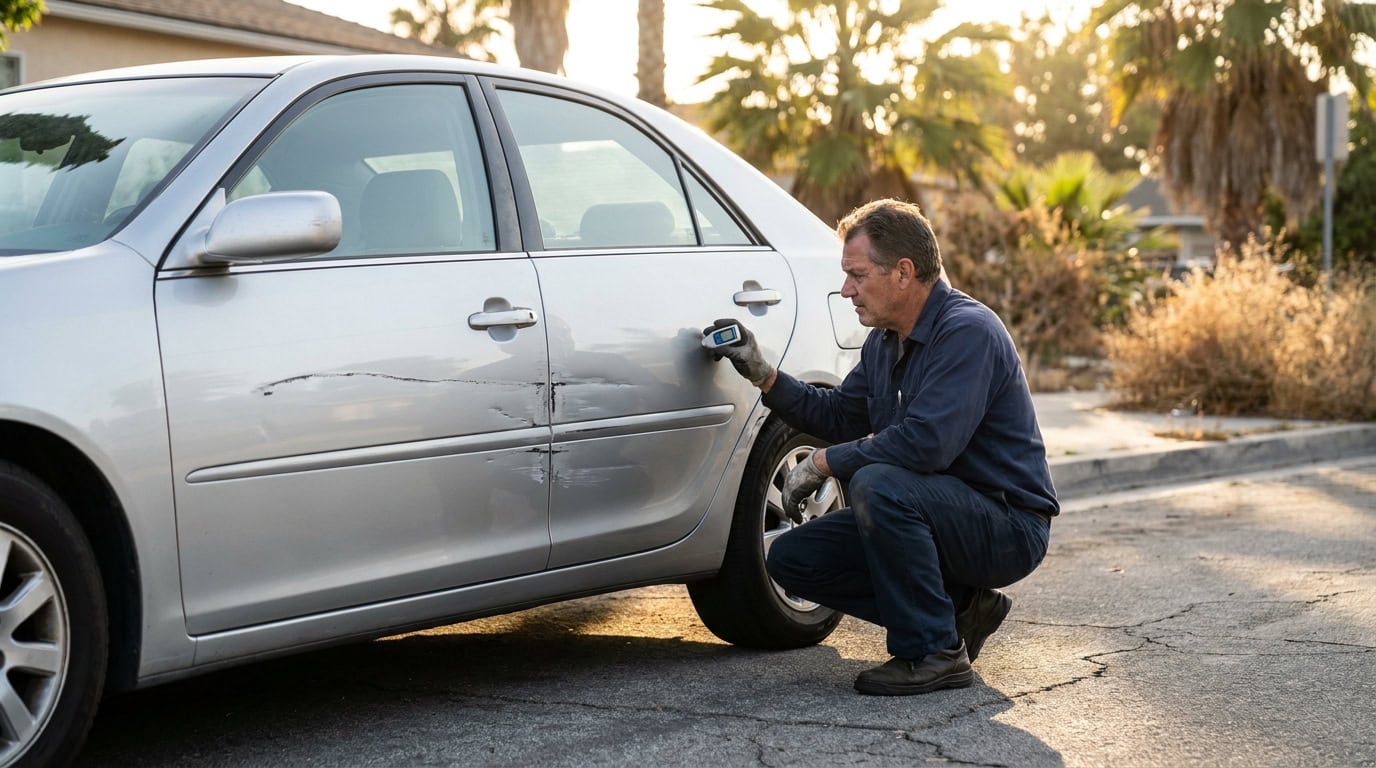
A sideswipe in LA can cost anywhere from $200 for a surface paint scuff to $6,000 or more when the damage crosses multiple panels, requires door replacement, or involves rocker and pillar components. The wide range comes down to one fact: a sideswipe spreads impact energy across a long stretch of the vehicle, often touching the front door, rear door, quarter panel, and rocker in a single pass. That means the repair is almost never a single-panel job, even when it looks minor from the curb.
Los Angeles adds a real cost premium on top of national averages. Body shop labor rates across the LA metro vary sharply by neighborhood, and even a medium-severity repair climbs fast when shop rates and premium paint finishes are factored in. The breakdown below uses four severity tiers so you can find your situation quickly.
Sideswipe Repair Cost Tiers: From Paint Scuff to Structural Damage
Use this table to locate your damage level, then read the section for each tier. Costs reflect current LA metro pricing and assume a standard solid or metallic factory finish.
| Damage Tier | What It Looks Like | Typical LA Cost Range | Repair Time |
|---|---|---|---|
| Tier 1: Surface Paint Scuff | Transfer marks, light clear-coat scratches, no dent, no exposed primer | $200–$500 | 1–2 days |
| Tier 2: Single Dented Panel | One panel creased or dented, paint broken or primer exposed on one surface | $500–$1,200 | 2–4 days |
| Tier 3: Multi-Panel Damage | Two or more panels affected (front door + rear door, or door + quarter panel), paint blending required across adjacent panels | $1,200–$3,000 | 5–10 days |
| Tier 4: Door/Panel Replacement + Structural | Panel too distorted to repair, door alignment compromised, rocker panel or B-pillar involved, possible ADAS sensor damage | $3,000–$6,000+ | 10–20+ days |
Tier 1 is a machine-polish and spot clear-coat job. If no metal moved and no primer shows, a skilled technician may not need to spray anything. Tier 2 is where paintless dent repair (PDR) might apply if the dent is accessible and the paint is unbroken, see our Paintless Dent Repair vs. Conventional Repair guide for when PDR is and isn’t the right call. Tiers 3 and 4 always involve spray work, blending, and a full door-function check.
Real-world data points back these ranges: a light single-door scrape exposing primer runs about $450 with a two-day turnaround; a creased multi-dent quarter-panel job lands between $1,400 and $2,000; an EV or truck sideswipe requiring a rear door replacement at a certified center can reach $9,000 or more.
How Do LA Labor Rates Affect Sideswipe Repair Cost?
Los Angeles is not a single market. Body shop labor rates vary considerably by neighborhood, and that gap translates directly into your final bill. West-side and coastal shops typically charge more than San Fernando Valley locations for identical work. For a multi-panel sideswipe repair that runs eight to twelve labor hours, a $30–$40 per-hour rate difference adds $240–$480 to your total before parts or paint materials are counted.
Premium paint finishes compound this further. Solid basecoat is the least expensive to match and spray. Metallic and pearl finishes require more steps and material. Tri-coat and specialty finishes, common on luxury vehicles and newer EVs, are the hardest to color-match and cost the most in both labor and materials. Shops commonly charge $250–$600 per panel for paint work, and a premium booth and high-end clear coat can add $500 or more to a multi-panel job. If your vehicle has a special-order or factory-exclusive color, expect to be at the top of that range.
For a deeper look at why color matching matters so much on multi-panel sideswipe repairs, see our post on paint color matching and blending in auto body repair.
Why Does a Sideswipe Involve So Many Panels?
A freeway sideswipe or a parking-structure scrape both create what technicians call linear damage: the contact point moves along the side of the vehicle rather than concentrating force at one spot. The result is that a single event typically damages the front door, rear door, and often the rocker panel or quarter panel in a connected strip. Each affected panel must be repaired or replaced, and every adjacent unaffected panel that borders the repaired area needs paint blending so the repair disappears into the factory finish.
Paint blending across adjacent panels is standard repair practice for multi-panel sideswipes, not an upsell. Without it, the color boundary between a freshly painted door and an unrepaired quarter panel will be visible in certain lighting. Any estimate for a two-panel or larger sideswipe that does not list blending charges should be questioned.
What Does a Proper Sideswipe Repair Process Look Like?
A well-run shop works through a consistent sequence for sideswipe damage. Here is exactly what should happen:
- Written teardown estimate: The estimator notes every damaged panel, the method for each (buff, PDR, fill-and-paint, or replace), and any sublet operations like alignment or ADAS calibration. Ask for this before authorizing any work.
- Panel disassembly: Doors, trim, weatherstripping, and mirrors are removed. Hidden damage, including hinge wear, striker misalignment, and rocker deformation, is only visible after teardown. Initial estimates frequently increase at this stage.
- Metal work: Technicians pull, shrink, or fill damaged panels. Severely creased panels or those with torn metal are replaced rather than repaired, because trying to save a destroyed panel adds labor that exceeds the cost of a used OEM door.
- Door alignment check: This is the step most shops skip on sideswipe repairs and most owners never think to request. A sideswipe frequently distorts door hinges or the striker plate, causing the door to bind, sit off-gap, or fail to seal against the weatherstrip. Left uncorrected, the result is wind noise at freeway speeds and water intrusion at the door sill, expensive secondary damage months later.
- Paint preparation and spraying: Panels are primed, blocked, and matched to the factory color code. Adjacent panels receive blend coats so the transition is invisible. The vehicle goes through a controlled spray booth and a heated curing cycle.
- ADAS scan and recalibration: Any sideswipe that reaches the B-pillar, mirror housing, or rocker area may affect blind-spot monitoring sensors, side-curtain airbag wiring, or door-mounted cameras. Scanning and recalibration adds roughly $150–$300 and is not optional on vehicles with these systems. See our ADAS calibration guide for a full explanation of why this matters.
- Final assembly and quality check: Doors are adjusted for gap and flush, weatherstrips are reseated, and a test drive confirms no wind noise or water leaks at the repaired seams.
Single Panel vs. Multi-Panel Sideswipe: How the Decision Gets Made
The repair-versus-replace decision for each individual panel comes down to the extent of deformation, the paint condition, and the cost math. Use this table to understand how shops evaluate each panel in a sideswipe repair.
| Panel Condition | Likely Repair Path | Why |
|---|---|---|
| Surface transfer marks only, no metal movement | Machine polish / spot clear | No structural change; fastest and cheapest |
| Shallow dent, paint intact | PDR (paintless dent repair) | No need to spray if paint is unbroken and panel is accessible |
| Dent with broken paint or exposed primer | Fill, prime, and paint | Metal must be smoothed; bare metal must be sealed before paint |
| Deep crease, multiple dents along one panel | Repair or replace depending on labor hours | If repair labor exceeds 60–70% of replacement cost, replace is smarter |
| Torn metal, buckled door skin, or kinked frame rail | Replace panel or door | Structural integrity cannot be restored by filling |
| Quarter panel with rocker involvement | Repair + structural measurement system | Rocker panels are semi-structural; shops use bench measurement to confirm no frame deflection |
When a door replacement is necessary, shops source either a used OEM door in the factory color (faster, lower parts cost but may need refinishing to match current fade) or a new OEM shell that requires full paint. The right call depends on vehicle age, paint condition, and whether a color-matched used door is available. For a detailed breakdown of how parts sourcing affects cost, see our guide on OEM vs. aftermarket vs. reconditioned parts.
Who Pays for a Sideswipe in California? The Two LA Scenarios
California is an at-fault state. Who pays for repairs depends on which of these two situations you are in.
Scenario 1: Another Driver Sideswiped You (Freeway Lane Change, Merging)
If a driver changed lanes into you, drifted across lane markings, or merged without checking mirrors, their liability insurance should cover your repair costs. California uses a pure comparative negligence system, meaning fault is divided by percentage, not assigned entirely to one party. If the adjuster argues you contributed to the collision, your payout is reduced by your share of fault. A police report, dashcam footage, or witness statements matter here, they are the difference between a 0% fault assignment and a 25% reduction on a $2,500 repair bill.
Document everything before moving the vehicle if it is safe to do so: photograph both cars, the lane markings, skid marks, and any road signage. File a police report even if the other driver wants to handle it privately. In LA’s dense freeway and surface-street traffic, disputes about who crossed whose lane line are common, and evidence wins those disputes.
Scenario 2: You Sideswiped a Pillar, Wall, or Gate (Garage or Parking Structure)
Clipping a parking structure pillar or gate while pulling into a tight LA garage or alley is a self-inflicted collision. No other insured party is involved, so the cost falls to your own collision coverage (minus your deductible) or to you directly if you choose to pay out of pocket. The insurance claim decision here is purely financial: compare your deductible against the repair estimate, factor in any potential premium increase, and decide. For a scrape that costs $800 to fix with a $1,000 deductible, paying out of pocket and skipping the claim usually makes sense. For a $3,500 multi-panel job with a $500 deductible, filing is almost always worth it.
Hidden Costs That Can Expand a Sideswipe Estimate
These line items appear after teardown and are legitimate, not padding. Know them in advance so a supplement does not catch you off guard.
- Door alignment and weatherstrip replacement: Hinge adjustment and new weatherstripping run $100–$300 and are almost always needed after a door-panel sideswipe. A shop that omits this is delivering an incomplete repair.
- ADAS sensor recalibration: Blind-spot sensors in the doors or mirrors, forward cameras, and side-curtain airbag systems must be scanned after any side-impact repair. Budget $150–$300.
- Rocker panel replacement: Rockers sit at the bottom of the door opening and take direct hits in low-angle sideswipes. A replaced rocker also requires careful blending with the adjacent door and quarter panel.
- Tri-coat or specialty paint premium: White Pearl, certain reds, and luxury-brand special-order colors require three separate spray stages and exact tinting. This adds both material cost and spray time.
- Supplement after teardown: If hidden damage is found once the shop disassembles the panels, a written supplement is issued. This is a normal and expected part of sideswipe repair, initial estimates are based on visible damage only. Our post on what a collision repair supplement is explains the process clearly.
How to Read a Sideswipe Estimate and Spot What’s Missing
A complete sideswipe estimate should list every panel separately with its repair method, a blending charge for each adjacent panel, a door alignment or hinge check line item, an ADAS scan if applicable, and a clear note about whether parts are new OEM, used OEM, or aftermarket. If the estimate is a single line reading “repair driver side” with one dollar amount, it is not itemized and you cannot evaluate it accurately.
Specifically look for these lines: Blend, adjacent panel, R&I door trim (remove and install), Door align/adjust, and Sublet, ADAS calibration. Their presence means the shop is accounting for the full scope of a sideswipe. Their absence is a red flag.
Common Mistakes to Avoid
- Accepting a verbal estimate only. A written, itemized estimate protects you. Verbal quotes almost always change, and without a written document you have no basis to dispute a surprise bill.
- Skipping the door alignment check. Asking specifically whether door gap, flush, and weatherstrip seal will be verified is not nitpicking, it is a functional safety and water-intrusion issue.
- Assuming a “minor” scrape needs no ADAS scan. Modern door panels, mirrors, and B-pillars house sensors. Even a Tier 1 scuff that required no metal work should prompt a scan if the vehicle has side blind-zone alerts.
- Filing an insurance claim on a small self-inflicted scrape without doing the math. A claim below or near your deductible is money lost, and a claim on record can affect future premiums.
- Accepting the first adjuster estimate as final. Adjusters often miss blend panels and alignment checks. A qualified shop will submit a supplement; do not settle before the teardown is complete.
- Choosing a shop based on price alone. In LA, the cheapest estimate often omits blending, uses non-OEM parts without disclosure, or skips the post-repair alignment check. The lowest number frequently becomes the highest final cost.
Frequently Asked Questions
What is the average sideswipe repair cost in Los Angeles?
Most sideswipe repairs in the LA metro fall between $800 and $3,000, with the midpoint around $1,500 for a typical two-panel damage scenario involving a door and quarter panel. Surface-only scuffs can be resolved for $200–$500, while structural or door-replacement cases exceed $3,000. LA’s higher labor rates and the prevalence of metallic and pearl paint finishes push costs toward the upper end of national ranges.
Is paint blending across adjacent panels an upsell or a legitimate cost?
Paint blending is a legitimate and necessary part of any multi-panel sideswipe repair. Without blend coats on adjacent panels, the color boundary between a freshly painted door and an original quarter panel will be noticeable in direct light. Any estimate covering two or more repaired panels that does not include blend charges is incomplete.
Who pays for a sideswipe in California when both drivers share fault?
California uses pure comparative negligence. Each driver’s repair recovery is reduced by their percentage of fault. If you are found 20% at fault for a $2,000 repair, you collect $1,600 from the other driver’s insurer. A police report, dashcam footage, and photographs of lane positions significantly affect how fault is assigned.
How long does a sideswipe repair take at a Los Angeles body shop?
A single-panel scrape with paint work takes two to four business days. A multi-panel sideswipe crossing two to three panels with blending typically runs five to ten business days. Repairs involving door replacement, structural measurement, or ADAS recalibration can extend to two to three weeks, particularly if parts need to be ordered.
Can I drive my car after a sideswipe while waiting for the repair appointment?
If the damage is cosmetic only, no metal is deformed into moving parts, all doors open and close fully, and no warning lights are active, the vehicle is generally drivable. However, if a door does not seal properly, if the vehicle pulls to one side, or if any ADAS warning light is on, have the car inspected before driving it further. A sideswipe that contacts the rocker or B-pillar may affect structural integrity in ways that are not obvious from outside the vehicle.
0 Comments