

What Does a Car Color Change Cost in Los Angeles?
A quality full car color change cost in Los Angeles runs between $3,500 and $10,000 for most passenger vehicles, with premium finishes and exotic cars reaching $15,000 or more. That range is wider than most cost pages admit because it collapses three very different things, a budget respray, a professional full color change, and a show-quality custom finish, into one vague number. The tier you need, the size of your vehicle, the finish type, and the shop’s LA neighborhood all move the final invoice by thousands of dollars.
The short version: if a quote sounds low, it almost certainly skips the work that makes a color change look right. The sections below break down exactly what drives each cost, what should be included at each tier, and what the cheapest quotes omit.
Why Does a Color Change Cost More Than a Same-Color Respray?
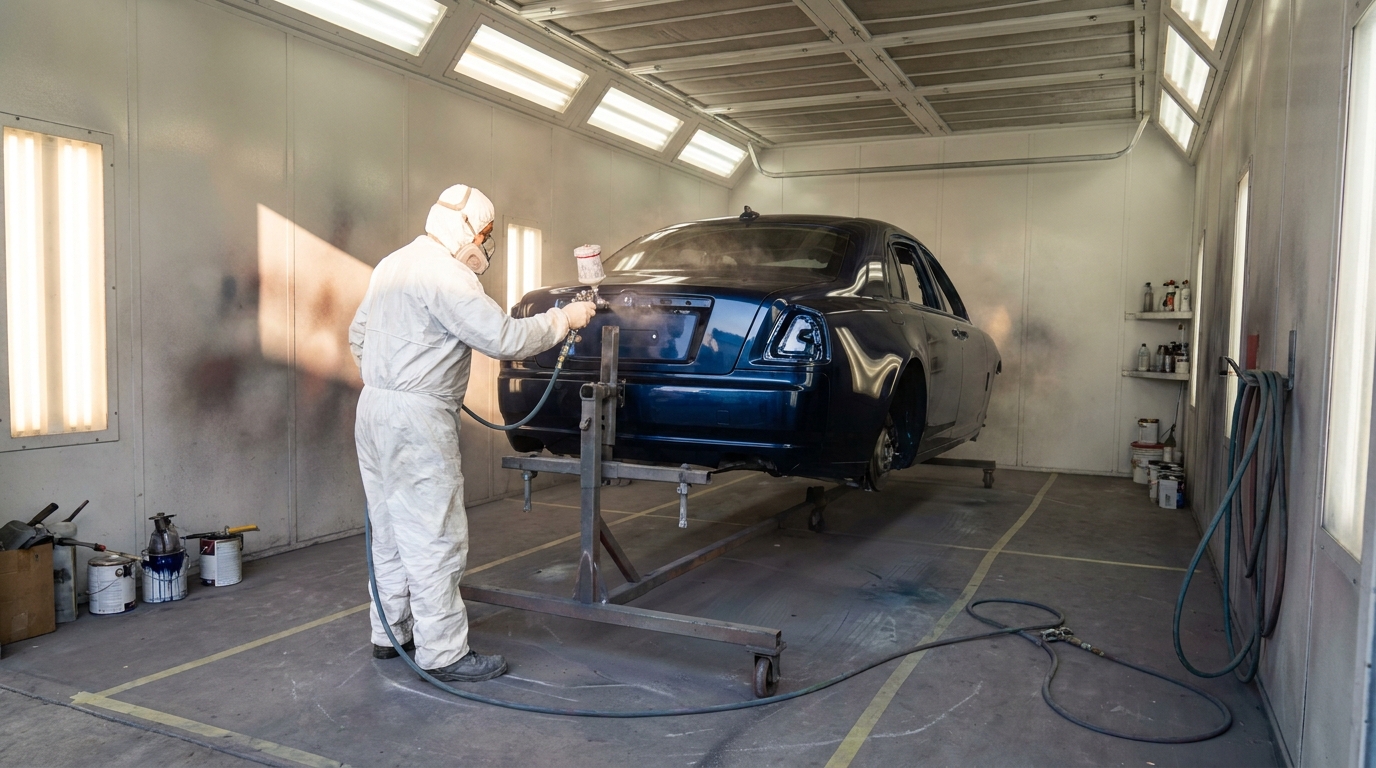
This is the question most cost pages skip, and it matters. When a shop resprays a car in its original color, a technician can tape off door jambs, trunk edges, and engine-bay seams because those hidden areas already match. Change the color, and every surface the eye can reach, including door jambs, trunk cavity, fuel-door recess, under the hood lip, and all four door edges, must be painted to the new color. Anything left in the original color looks immediately wrong when a door swings open.
- Trim removal vs. taping: A true color change requires pulling mirrors, door handles, badges, and trim pieces rather than masking them. Removal adds labor hours but produces a factory-correct result; taping leaves visible lines.
- Hidden surfaces: Jambs, trunk cavity, engine bay lip, and door edges all must be painted. On a full-size SUV, that alone can add four to eight labor hours over a same-color job.
- Prep time: Scuffs, existing rock chips, and prior repairs must all be corrected before spraying, any flaw in the base becomes amplified under a new color, especially darker or metallic shades.
- Clear coat and correction: After color coats cure, a shop must cut and polish to remove any orange peel, then inspect in good light. Rushing this step is exactly what separates a $1,500 TikTok-advertised respray from professional work.
Bottom line: a same-color quality respray on a midsize sedan might run $2,000 to $3,500 in Los Angeles. Add a genuine color change and that figure climbs by $800 to $2,500 depending on vehicle size and how thorough the hidden-surface work is. Understanding why paint color matching and blending matter in auto body repair helps clarify what skilled paint work actually requires.
LA Color Change Cost by Job Tier and Vehicle Size
The table below reflects real Los Angeles market pricing. LA body shop labor rates vary considerably by neighborhood, from roughly $56/hr in Van Nuys to $98/hr in West Hollywood, so these ranges account for that spread. National averages do not apply here.
| Job Tier | What’s Included | Sedan / Coupe | SUV / Truck | Exotic / Luxury |
|---|---|---|---|---|
| Budget / Single-Stage | Exterior panels only, taped jambs, solid color, minimal prep | $1,200 – $2,500 | $1,800 – $3,200 | Not recommended |
| Professional Color Change | Full jambs, trunk, door edges, trim removed, 2-stage base/clear, color sanding | $3,500 – $6,000 | $5,000 – $8,500 | $7,000 – $12,000 |
| Premium / Custom | All above + metallic/pearl/candy/color-shift finish, engine bay, multi-stage correction, show prep | $6,000 – $10,000 | $8,500 – $14,000 | $12,000 – $20,000+ |
Premium finish types add meaningful cost on their own. A metallic or pearl finish typically adds $500 to $1,000 over a solid color at the same tier. Candy, chameleon, or color-shift paints can add $2,000 to $4,000 because they require multiple translucent layers with exact thickness control across every panel.
How Does the Finish Type Affect the Final Price?
The paint itself is a significant line item in any respray quote. Here is a quick comparison of the most common finish categories:
| Finish Type | Typical Material Cost Premium | Difficulty to Spray | Best For |
|---|---|---|---|
| Solid (single color) | Baseline | Low | Daily drivers, budget builds |
| Metallic / Pearl | +$400 – $1,000 | Medium (flake orientation matters) | Most OEM-look color changes |
| Matte / Satin | +$300 – $800 | Medium (no cutting/polishing) | Stealth look; harder to maintain |
| Candy / Translucent | +$1,500 – $3,500 | High (layered, depth-sensitive) | Show cars, custom builds |
| Color-Shift / Chameleon | +$2,000 – $5,000 | Very high | Exotic and prestige vehicles |
What a Proper Color Change Process Actually Includes
A shop doing the job correctly follows a specific sequence. Understanding it lets you evaluate any quote you receive.
- Disassembly: Mirrors, door handles, trim strips, emblems, and sometimes bumper covers are removed. Nothing that moves gets taped around.
- Surface prep: Panel surfaces are cleaned, degreased, and sanded to an appropriate profile. Rust, chips, and prior bondo work are addressed before any new material goes down.
- Primer and sealer: A color-matched or neutral sealer coat is applied across all exterior and jamb surfaces. This is the foundation; skipping it causes adhesion failures.
- Color coats: Multiple base-coat passes are applied until coverage is uniform. Metallic and pearl finishes require an additional “orientation pass” to align flake direction consistently across panels.
- Clear coat: Two or more clear coats are sprayed and allowed to flash between coats. The vehicle then enters a heated cure cycle, typically 140°F for 30 to 60 minutes per bake.
- Color sanding and polish: After full cure, color sanding removes orange peel and booth fallout. Polishing brings the surface to a mirror finish. This stage alone takes four to eight hours on a full respray.
- Reassembly and inspection: All trim is reinstalled and the vehicle is inspected in natural and artificial light for mismatched flake, runs, or missed areas.
Turnaround for this full sequence at a quality LA shop is typically seven to twelve business days, accounting for booth time, cure, and correction. A shop quoting three days for a full color change is almost certainly skipping steps three through six.
The California DMV Step Most Shops Forget to Mention
Here is something almost no competitor cost page covers: after a true color change in California, your vehicle’s registered color on file with the DMV will no longer match the car. That mismatch matters when you report the vehicle stolen, when an officer runs your plates, or when you sell the car. Changing your vehicle’s color in California requires notifying the DMV to update your registration. You should also inform your insurance company about the color change to avoid any coverage issues.
The process is straightforward: you can change basic information on your registration, including the color of your vehicle, by contacting your local DMV, and notifying them is generally enough to have the color change noted on your registration. You will need your current certificate of title and the completed REG 156 form with the new color details. The DMV will issue an updated registration card reflecting the change. Do this promptly after pickup, it is an easy step that most owners overlook entirely.
Color is not used to determine your insurance rates, but it is still a good idea to let your auto insurance company know of the change so the vehicle description on the policy is accurate in case you have to make a claim. A policy that does not match what shows up in an accident report or police report could cause headaches later.
Will Auto Insurance Pay for a Color Change?
No. Auto insurance covers paint work that results directly from a covered collision or comprehensive claim, hail, a crash, a hit-and-run. An elective color change is a cosmetic modification you choose to make, not damage caused by an incident. No standard comprehensive or collision policy will fund it, and submitting it as part of a claim is considered fraud. If collision damage happens to a vehicle you recently resprayed, the insurer pays to restore the car to the color recorded on your policy at the time of loss, which is another reason to update both your DMV record and your insurance policy after a color change.
This stands in contrast to collision-funded paint work, where the insurer pays a body shop to return damaged panels to pre-accident condition using the original factory color and paint code. That work is reimbursable. A new color is not. If you are dealing with a recent incident alongside a planned color change, discuss the timing with your shop, but never conflate the two in a claim.
Color Change vs. Vinyl Wrap: Which Makes More Sense?
A full vinyl color-change wrap in Los Angeles starts around $1,900 for a sedan and tops out around $5,000 to $7,000 for a full-size SUV in a premium film. That is a meaningful savings over a professional respray, and the wrap is reversible, pull it off and you are back to the factory color, which matters for resale and for leased vehicles. For anyone who wants a non-factory color but is not committed to it permanently, a wrap deserves serious consideration.
Paint wins when you want a permanent result, a custom finish (candy, multi-stage) that film cannot fully replicate, or if the vehicle’s existing paint is damaged enough that it needs to be addressed anyway. A wrap applied over peeling clear coat or sun-damaged paint will fail prematurely. If your car already needs paint work, the incremental cost to change color at the same time is much lower than doing them separately. You can read a full side-by-side analysis in our post on car wrap vs. paint in Los Angeles.
One more resale consideration: a non-factory color can affect your vehicle’s appeal to future buyers and in some cases its appraised value. A reversible wrap avoids this entirely. If resale is a priority, see how paint modifications interact with long-term value in our guide to diminished value in California.
How to Read and Compare Color Change Quotes
Every quote you receive should be itemized. Here is what to look for and what to ask about when an item is missing.
- Disassembly line item: If it is not listed, ask whether trim is being removed or taped. Taped trim means a visible line at every edge after the color change.
- Jambs, trunk, and door edges: These should appear explicitly. “Full color change” means nothing unless these surfaces are named. A quote that says “exterior panels only” is a respray, not a color change.
- Primer and sealer: Should be listed with product type (epoxy primer, urethane sealer). If absent, ask, bare-metal or scuffed surfaces sprayed without sealer will show adhesion failure within a year.
- Paint brand and product line: PPG, BASF Glasurit, Axalta, and Sherwin-Williams are the primary professional brands used by quality LA shops. Consumer-grade or off-brand paints cut material cost but reduce durability.
- Clear coat type: Standard 2K urethane clear vs. a high-solids premium clear affects gloss depth, UV resistance, and how well the finish polishes. Ask which product is being used.
- Labor hours: A full color change on a midsize sedan should carry at least 35 to 50 billable hours across prep, spray, cure, and correction. If the math on the quote does not add up to that, something is being compressed.
- Warranty: A shop confident in their work offers a written warranty. Ask for it in writing, not verbally.
Common Mistakes to Avoid
- Choosing based on the lowest quote alone. A $1,300 to $1,500 quote for a “full color change” almost certainly covers exterior panels only, uses budget materials, and skips jambs, door edges, and proper prep. You will see it within weeks.
- Skipping the DMV update. Driving with a mismatched registration color after a paint change creates problems during traffic stops and insurance claims. Update it promptly.
- Not notifying your insurer. If your car is stolen or involved in a collision after a color change, a policy that still lists the original color can complicate a claim.
- Wrapping over damaged paint. Vinyl applied over peeling clear coat or significant sun damage will fail at the adhesion points. Address the paint first, or commit to a full respray. See our guide on sun-damaged and peeling clear coat repair in Los Angeles if your car is already showing wear.
- Rushing turnaround. Picking up a car before clear coat has fully cured damages the finish. A proper color change needs at least seven to ten days in the shop. Pushing a shop to finish faster produces a soft, swirl-prone surface.
- Not asking for a written warranty. Verbal promises are worthless if the clear coat peels or color fades. Get the warranty terms on paper before you authorize the job.
- Ignoring post-paint care. Fresh paint needs specific care in the first 30 days, no automatic car washes, no wax, limited sun exposure. Learn exactly what to do in our guide to caring for your car after a fresh paint job.
Frequently Asked Questions
How much does a full car color change cost in Los Angeles?
A professional full color change in Los Angeles, including jambs, door edges, trunk, trim removal, and proper prep, runs $3,500 to $6,000 for a sedan and $5,000 to $8,500 for an SUV or truck. Premium and custom finishes (metallic, pearl, candy) add $500 to $4,000 depending on the paint system. Budget quotes under $2,000 almost always skip hidden surfaces and cut prep time.
Is a color change more expensive than a same-color respray?
Yes, materially so. A same-color respray allows the shop to tape jambs and hidden edges because those areas already match. A color change requires painting every surface a customer might see, jambs, trunk cavity, door edges, fuel door recess, which adds significant disassembly and labor. Expect to pay $800 to $2,500 more for a true color change over a same-color refresh at comparable quality.
Do I have to update my DMV registration after changing my car’s color?
Yes, and it is a step most shops fail to mention. In California, your vehicle’s registered color should match the actual color on the car. After a color change, update your registration using form REG 156 at your local DMV office or by mail. You should also notify your auto insurance company so the vehicle description on your policy stays accurate.
Will my auto insurance pay for a color change?
No. Auto insurance covers paint work caused by a covered collision or comprehensive event. An elective color change is a cosmetic modification you choose to make and is not reimbursable under any standard policy. If collision damage occurs to a recently resprayed vehicle, the insurer pays to restore the car to the color documented on your policy at the time of loss.
How long does a professional color change take at an LA body shop?
A proper color change takes seven to twelve business days at a quality Los Angeles shop. That window covers disassembly, surface prep, primer, color coats, clear coat curing (including bake cycles), color sanding, polishing, and final reassembly inspection. A shop quoting three to four days is compressing the cure or skipping correction steps, both of which show up quickly in the finished surface.
0 Comments