

What Does a Classic Car Paint Job Actually Cost in Los Angeles?
A classic car paint job cost in Los Angeles falls into three distinct tiers: roughly $5,000–$12,000 for driver-quality, $12,000–$25,000 for high-end show quality, and $25,000–$60,000 or more for a concours bare-metal restoration. Those figures are meaningfully higher than national average guides imply, and the gap is not padding, it reflects real LA variables that most cost guides ignore entirely.
National respray guides quote US-wide averages of $1,000–$5,000 for a standard repaint. Classic and muscle car work is its own market. A 1965 Mustang or 1969 Camaro carries 50-plus years of dent repair, body filler over rust, panel mismatches from prior collisions, and three to five layers of old paint. Stripping and correcting all of that before a single drop of new paint goes on is where most of the money lives, and where most cheap quotes quietly skip the work.
How Do LA Labor Rates and Local Rules Affect the Price?
Los Angeles body shops bill $120–$125 per hour for restoration-grade labor at dedicated classic shops, and collision shops across the region charge $75–$125 per hour depending on neighborhood. That is significantly above the national mid-range. A respray that costs $2,000 in a midsize Midwestern city runs $3,000–$3,500 or more for comparable quality in Los Angeles, and classic work carries even steeper differentials because it demands hand-blocking, period color matching, and multi-stage prep that production shops cannot offer.
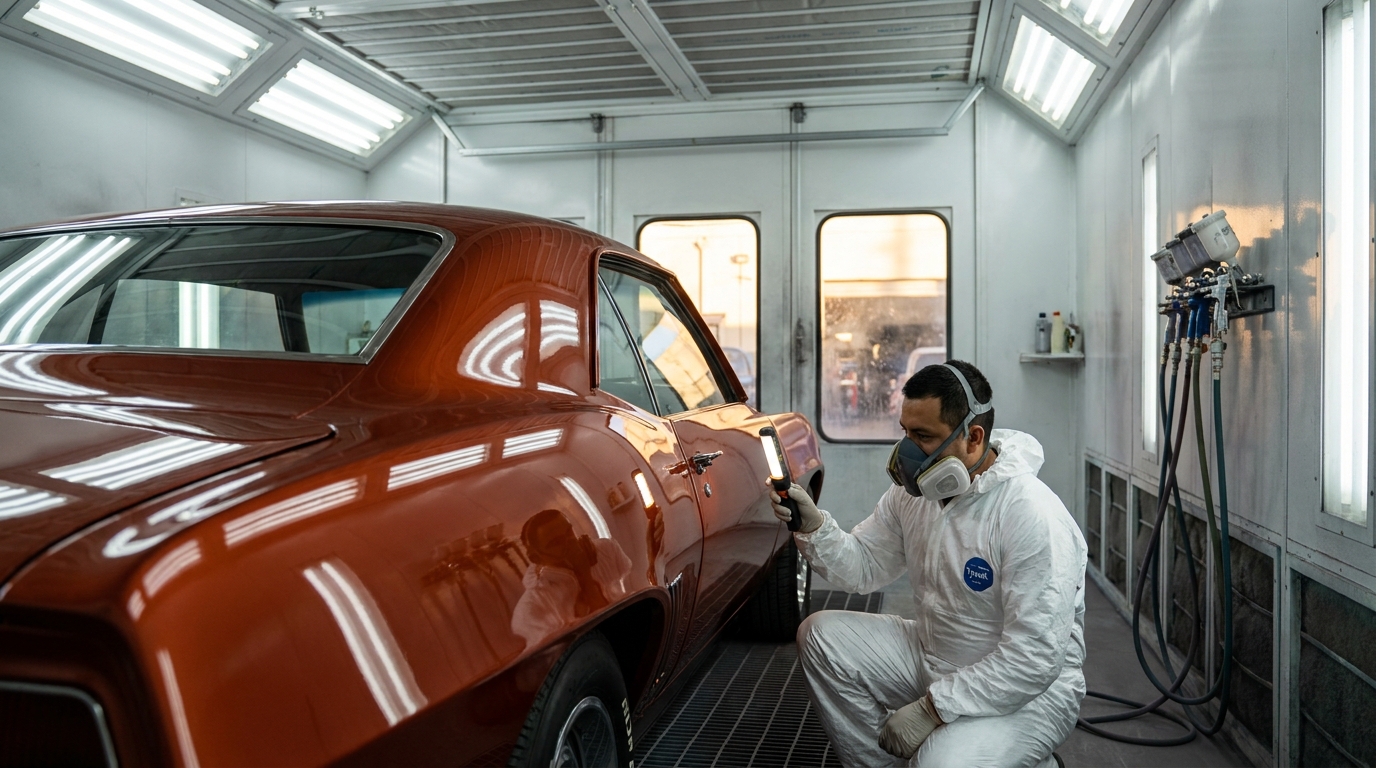
There is also an environmental layer unique to LA. Every shop that sprays paint in Los Angeles operates under the South Coast Air Quality Management District (SCAQMD), the strictest air-quality regulator in the country. SCAQMD Rule 1151 sets VOC content limits on every coating category, primers, basecoats, clearcoats, single-stage topcoats, and mandates high-transfer-efficiency application equipment such as HVLP spray guns. Shops must operate permitted, enclosed spray booths and maintain documentation available for inspection at any time. Permitted AQMD spray booths are increasingly scarce and expensive in older LA industrial buildings, which means shops that have them carry real overhead. If a shop cannot show you a compliant spray booth and their AQMD permit, walk away, especially on a classic where you are paying for a long-lasting finish.
Add the waitlist reality: established LA restoration shops openly work one car at a time and cite waitlists of up to two years. That timeline is not a sales tactic, it reflects the labor hours involved. Show-quality work requires 300–500 labor hours on a typical American muscle body. A complex concours job can exceed 1,000 hours. If a shop promises your 1970 Chevelle back in three weeks at show quality, the math does not work.
What Are the Three Quality Tiers and Which One Do You Need?
The tier you choose should map to how you actually use the car, not to an abstract number. Here is how to decide.
Driver-Quality Respray ($5,000–$12,000)
This tier covers a thorough panel prep, light blocking of surface imperfections, modern base/clear or period-correct single-stage urethane, and color-sanding with a polish. It will look excellent at ten feet and hold up to regular driving. It is not show-ready under inspection lights, and it does not involve bare-metal stripping. Choose this tier if the car is a weekend driver or a daily-used classic that you want to look fresh rather than compete. A quote under about $4,000 on a classic body is a yellow flag, it almost certainly means prep is being compressed or the shop is unfamiliar with classic-specific work.
High-End Show Quality ($12,000–$25,000)
This tier involves significantly more bodywork, addressing filler pockets, repairing or replacing rusted panels, full block sanding to block-flat, and multiple sealer coats before color. Paint material cost at this level runs $800–$2,000 even with professional-grade products; the cost is overwhelmingly labor. A show-quality job on a typical muscle car body runs 300–500 labor hours. This is the correct tier for a car you intend to show locally, sell at a notable price, or insure at an agreed value that reflects the investment. Metallic and pearl finishes add 20–40% to both labor and material costs at this tier.
Concours Bare-Metal Restoration ($25,000–$60,000+)
Frame-off, bare-metal, every surface stripped, straightened, leaded where the factory originally used lead, and finished to a depth that holds up to concours judging at arm’s length. Complex bodies, think a 1970 Hemi Cuda with a multi-layer candy color history or a 1958 Corvette in fiberglass, can exceed 1,000 labor hours and push well past $60,000. This tier is appropriate only when the car’s collector value justifies it. Applying concours prep to a common model that will never auction above $40,000 is not a financial investment, it is a passion spend, and there is nothing wrong with knowing that going in.
Driver-Quality vs Show vs Concours: Quick Comparison
| Tier | Typical LA Cost | Labor Hours | Bare-Metal Strip | Best For |
|---|---|---|---|---|
| Driver-Quality | $5,000–$12,000 | 60–120 hrs | No | Weekend driver, daily classic, budget-conscious refresh |
| Show Quality | $12,000–$25,000 | 300–500 hrs | Partial | Local shows, higher resale, agreed-value insurance |
| Concours | $25,000–$60,000+ | 500–1,000+ hrs | Full | National shows, auction sales, rare/high-value cars |
Single-Stage vs Base/Clear: Does Authenticity Matter on Your Car?
Pre-1980s classics left the factory with single-stage lacquer or enamel, one coat, no separate clear layer. Modern shops default to base/clear urethane because it is more durable, easier to repair spot-damage on, and produces a deep gloss. But for period-correct show cars and concours entries, the finish type matters to judges. Period-correct single-stage urethane (such as PPG Concept) runs $600–$1,500 in materials; modern base/clear urethane runs $800–$2,000. The single-stage look is slightly flatter in gloss, which is exactly correct for a 1960s muscle car but wrong for a car that left the factory with a different finish.
For a driver-quality or show car that will not be judged for factory correctness, modern base/clear is the better practical choice: it holds up to California UV better, polishes more easily, and can be spot-repaired if a parking lot puts a scratch through the clear. For a serious concours build, discuss paint type with your shop before any work begins, it affects prep, product selection, and ultimately the judging sheet.
Paint Type and Finish Cost Adders: LA Comparison
| Finish Type | Material Adder | Labor Adder | Notes |
|---|---|---|---|
| Solid (single color) | Baseline | Baseline | Easiest color match, fastest booth time |
| Metallic / Pearl | +$200–$500 | +20–40% labor | Flake orientation requires multiple passes |
| Matte / Satin | +$200–$400 | +$500–$1,200 total | Cannot be machine-polished; any correction requires respray |
| Candy / Color-Shift | +$800–$2,000 | Significant (translucent layers) | Highest skill demand; most sensitive to repair mismatches |
| Period Single-Stage Urethane | $600–$1,500 | Comparable to base/clear | Correct for pre-1980 concours entries |
Why Is a Cheap Classic Quote a Red Flag?
Paint material, even professional-grade product, costs $1,000–$2,500 at the show tier. The overwhelming driver of classic respray cost is labor. When a shop quotes $3,500 for a full respray on a 1967 Pontiac GTO, the math requires either razor-thin labor hours or a technician being paid almost nothing. Neither produces a result that holds up.
The hidden-labor reality of a classic body: decades of previous repairs mean layers of filler over rust, uneven panel gaps, and surface geometry that has shifted from original spec. A legitimate shop will identify these during the initial inspection and quote the bodywork separately before any paint discussion. A shop that quotes paint without discussing what is underneath the existing finish has not looked, or does not want you to know what is there. Either way, you will pay later, usually in peeling paint over bubbling rust within two to three California winters.
A partial respray, repainting only specific panels that are faded or damaged while leaving sound panels in place, can make sense for a driver-quality car with original paint in decent condition elsewhere. Expect $1,500–$4,000 for a targeted partial job. The tradeoff is color-match: blending new paint to decades-old original finish requires real skill, and if the match is off even slightly, the repair is visible. If your goal is a consistent full-car color, a full respray is almost always worth the incremental cost over a partial.
If you are dealing with collision damage on panels that also need a refresh, a combined approach can be efficient. See how we break down sideswipe repair cost in Los Angeles for panel-level pricing that may overlap with a partial respray scope.
How Do LA Waitlists Affect Your Planning and Budget?
Established LA restoration shops that do show-quality and concours work typically run waitlists of one to two years. That timeline is a direct function of labor hours: a 400-hour show job at a one-technician classic shop, working 40-hour weeks, takes ten weeks of focused time, and shops run multiple cars, handle discovery work that changes scope, and schedule around parts availability. Plan your restoration timeline before your driving season, not after.
Waitlist length also affects your budget planning. If you are financing the work, a two-year waitlist gives you time to save. If you need the car for a specific show date, confirm the shop’s current schedule at the deposit stage, not after the car is in their lot. Get the timeline in writing alongside the scope and the price.
What Happens to Insurance and Appraisal After a Major Respray?
Most classic and collector car policies, Hagerty, American Modern, Grundy, and similar agreed-value insurers, base the covered value on a recent appraisal. After a major paint job, get an updated written appraisal from a qualified appraiser, typically costing $200–$500, and submit it to your insurer with photos and the shop invoice. Without that update, a total-loss settlement pays the pre-paint value even if you put $20,000 into the finish.
On resale, a quality paint job on a notable classic typically returns 60–100% of its cost in added value. On a less collectible car, a $15,000 paint job may return only $8,000–$11,000 in resale value, which is not necessarily a reason to skip it, but it is useful to know before you commit. Paint your classic because you want to enjoy the result, not because you expect to profit from it, unless the car is rare enough that finish quality genuinely moves the auction price. Understanding car color change cost in Los Angeles can also clarify how finish choices interact with valuation when the new color differs from the original.
How Do You Vet a Classic Car Paint Shop in Los Angeles?
Ask these specific questions before signing anything:
- Can I see current work in progress? A legitimate shop will show you cars in various stages. If they cannot or will not, move on.
- What is your booth situation? Confirm an AQMD-permitted, enclosed spray booth. Classic work requires consistent temperature, humidity control, and zero contamination, an open-air spray is not acceptable at any price tier.
- Do you do your own bodywork? Some shops subcontract prep. That is not automatically disqualifying, but you need to know who is actually doing the metal work and what their standard is.
- What paint system do you use? PPG, BASF Glasurit, Axalta, and Sherwin-Williams are the primary professional brands used by quality LA shops. Consumer-grade or unbranded paint cuts material cost but reduces durability and color accuracy.
- Can you show finished work at the same tier I’m asking for? A shop that does excellent collision repairs may not have experience with a bare-metal classic restoration. Request references or photos at the specific quality level you need.
- What is your written warranty? A shop confident in their work offers a written finish warranty. Get it in writing, not verbally.
- What does the quote itemize? A legitimate high-end quote breaks out labor hours, materials, bodywork scope, and paint. A single lump number with no breakdown is a reason to ask more questions before signing.
On the question of collision damage discovered during prep, it is worth understanding how supplemental repairs get added to a scope mid-project. Our breakdown of rear-end collision repair cost in Los Angeles covers how hidden damage changes a repair estimate, the same dynamic applies when a classic respray reveals rust or structural issues that were buried under old filler.
Common Mistakes to Avoid
- Choosing the lowest quote without asking why it is lower. On a classic body, a quote 40% below competitors almost always means prep is being compressed, the work you cannot see.
- Skipping the bodywork inspection before approving paint. Agree on the full scope of metal repair before work begins; avoid surprises mid-project by asking the shop to document all discovered issues before any panels are painted.
- Not updating your insurance appraisal after the job. A $20,000 paint job that is not reflected in your agreed-value policy is uninsured improvement. Get the appraisal, submit it to your insurer, and update the covered value.
- Expecting a show finish on a driver-quality timeline. If a shop says show-quality in four weeks, ask for the labor-hour breakdown. The math rarely holds.
- Assuming a national chain can handle classic-specific work. Production collision shops are optimized for speed and insurance-rate repairs, not for the hand-blocking and period-color matching that a 50-year-old muscle car requires.
- Choosing a matte or candy finish without understanding the maintenance commitment. Matte finishes cannot be machine-polished and any panel damage typically requires a full-panel respray to correct.
- Not visiting the shop in person before committing. Photos and reviews are not substitutes for seeing a car in their booth and speaking with the technician who will do your work.
Frequently Asked Questions
What is the minimum realistic budget for a classic car paint job in Los Angeles?
Plan on at least $5,000 for a legitimate driver-quality respray on a small-to-mid-size classic body like a 1965 Mustang or 1969 Camaro. Quotes under $4,000 on a classic are a yellow flag, at that price point, either prep is being skipped or the shop lacks experience with classic-specific work. LA labor rates and SCAQMD-compliant booth requirements make sub-$4,000 classic work essentially impossible to do properly.
How long will a classic car respray take at a Los Angeles shop?
A driver-quality respray at a capable shop typically takes 4–8 weeks from drop-off to pickup, accounting for bodywork discovery, paint, cure time, and polish. Show-quality work runs 3–6 months at minimum. Concours restorations at dedicated LA shops routinely take 12–24 months, and the best shops carry waitlists of 1–2 years before they can even start. Build this timeline into your planning well before any show or sale target date.
Should I choose single-stage or base/clear paint for a vintage muscle car?
For a show car being judged on factory correctness, single-stage period-correct urethane (such as PPG Concept) is appropriate for pre-1980 cars. For a driver-quality or non-judged show car, modern base/clear urethane is the better practical choice, it holds up to California UV better, can be spot-repaired more easily, and polishes to a deeper gloss. Discuss finish type with your shop before any work starts, since it affects product selection and prep.
Does a new paint job affect my classic car’s insurance value?
Yes, significantly. Most collector car policies are agreed-value policies based on a current appraisal. After a major respray, get an updated written appraisal ($200–$500) and submit it to your insurer with photos and the shop invoice. Without it, a total-loss claim pays the pre-paint value, meaning a $20,000 restoration you paid for is effectively uninsured. On a notable classic, a show-quality paint job typically adds 60–100% of its cost to the appraised value.
What is the difference between a partial respray and a full respray, and when does partial make sense?
A partial respray repaints specific panels, typically those that are heavily faded, damaged, or freshly repaired, while leaving sound surrounding panels. It costs roughly $1,500–$4,000 depending on panel count and condition, and it makes sense for a driver-quality car with good original paint elsewhere. The main risk is color mismatch: blending new paint to decades-old original finish requires skill, and if the blend is off, the repair is visible. For a car going to shows or getting a major investment in quality, a full respray ensures a consistent result.
0 Comments