

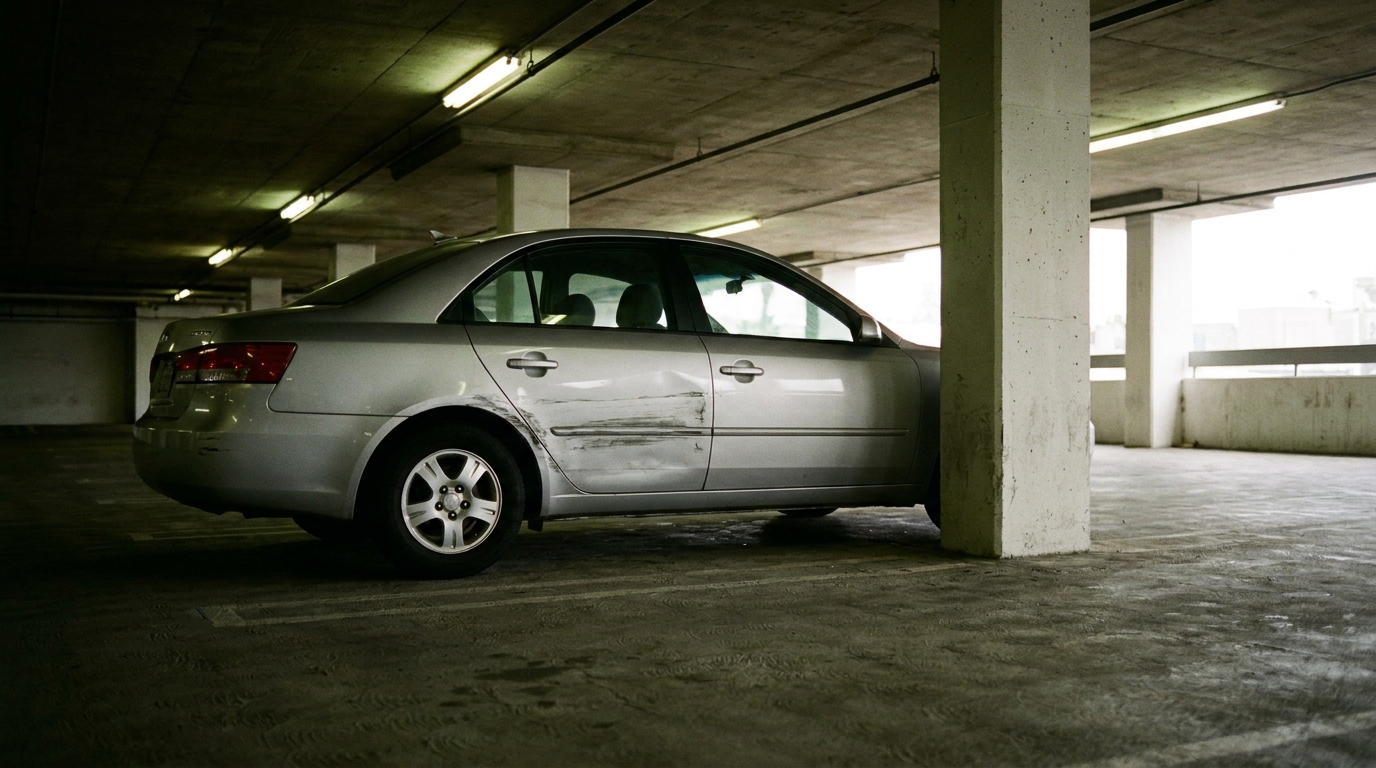
What Does Parking Garage Pillar Scrape Repair Cost in Los Angeles?
A parking garage pillar scrape repair in Los Angeles ranges from about $300 for a surface scuff that polishes out to well over $5,000 for a multi-panel wrap-around on a luxury or ADAS-equipped vehicle. Most drivers land somewhere in the $1,200 to $2,500 range for a single-door or door-plus-quarter-panel job. The exact number depends on three variables: how deep the paint damage goes, how many panels the pillar caught, and whether any cameras or sensors need recalibration afterward.
The reason the bill often surprises people is geometry. A parking structure pillar is stationary and sits at a slight angle relative to your car door. When you swing wide or misjudge the turn, the pillar doesn’t just nick one spot, it drags across the door skin, the quarter panel behind it, and sometimes the mirror cap or mirror housing. Each of those is a separate painted panel, and body shops repaint per panel, not per inch of damage. A four-inch visible scrape can mean two or three panels in the estimate.
How Deep Is the Damage? A Decision Tree Before You Call a Shop
Before getting an estimate, assess the scrape under good light, ideally direct sunlight or a phone flashlight at a low angle. Where the damage lands on this scale determines whether you need polish, touch-up, PDR, or a full repaint.
- Surface transfer only (concrete dust or another car’s paint on your clear coat): The scrape looks worse than it is. A clay bar or light polish can remove the transfer, and your clear coat is intact. Cost: $50 to $150 at a detailer, sometimes zero if you do it yourself with the right compound.
- Clear coat scratched but base coat intact: You can see white or hazy marks when you run your fingernail across the area. A machine polish or wet sand and buff removes this at a body shop. Cost: $150 to $400 depending on panel size and shop location.
- Scrape through the clear coat and into the color (base coat): The bare paint color is visible, or you see a dull, non-reflective line. This cannot be polished out. The panel needs spot refinishing at minimum, and most shops will blend into adjacent panels to match. Cost: $700 to $1,500 per panel, which is why even a modest scrape triggers a four-figure estimate.
- Metal exposed or panel creased: The metal shows bare silver, or you feel a ridge when you run your hand over the damage. Body filler, reshaping, and a full panel repaint are required. If the crease is sharp, PDR is not an option. Cost: $1,400 to $2,500+ for a door; more if the quarter panel also needs work.
- Mirror housing damaged or detached: Mirror caps and mirror housings are separate line items, and on modern vehicles the mirror integrates blind-spot radar or a side camera. Replacing a powered mirror with integrated ADAS adds parts costs of $200 to $900 and triggers a calibration requirement on top of paint work.
Is Paintless Dent Repair an Option for a Pillar Scrape?
PDR works when metal is dented but paint is unbroken. A pillar scrape almost always breaks the paint, which rules out PDR for the scraped area itself. However, if the pillar also pushed a slight crease into the door skin without breaking paint, a scenario where the scrape is on the leading edge but the panel itself has a shallow bulge, a technician may be able to PDR the dent separately and blend-repaint only the scratched zone, reducing overall cost. For a deeper look at when PDR is viable in LA, see our guide to Paintless Dent Repair Los Angeles Cost.
| Damage Level | What You See | PDR Viable? | Typical LA Cost |
|---|---|---|---|
| Surface transfer / clear coat scuff | Hazy mark, no groove | N/A, polish only | $50 – $400 |
| Clear coat scratched through | Dull line, fingernail catches | No | $400 – $900 |
| Base coat exposed, 1 panel | Color-coat visible, no metal | No | $900 – $1,500 |
| Crease + paint damage, 1 panel | Ridge visible or tactile | No | $1,400 – $2,000 |
| Multi-panel wrap (door + quarter + mirror) | Damage crosses panel gaps | No | $2,000 – $5,600+ |
Why Does a Small Scrape Produce Such a Large Estimate?
Three billing realities drive the gap between what you see and what you pay.
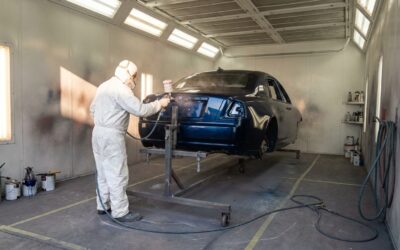
- Paint is billed per panel, not per square inch. LA-area body shops charge roughly $700 per panel for paint, a figure that reflects materials, prep labor, booth time, and clear coat application. A shop cannot spray half a door. If the scrape crosses into the quarter panel, that is a second panel repaint, often with a blend fee into the fender or rocker to match the color seamlessly.
- Blending adds cost but cannot be skipped. Modern metallic and pearl paints are nearly impossible to spot-match without a visible ring. Shops blend the fresh paint into adjacent panels by feathering the clear coat, which adds labor and materials. The blend is what makes the repair invisible, and what adds $200 to $400 per adjacent panel to your estimate.
- LA labor rates vary sharply by neighborhood. Valley shops (Van Nuys, North Hollywood, Reseda) commonly run $65 to $100 per body labor hour. Westside shops in Beverly Hills, Santa Monica, or West Hollywood typically charge $120 to $150 per hour, and shops with OEM certification or specialized frame equipment push toward the top of that range. The same two-panel repair can cost $400 more at a Westside shop than at a Valley shop.
The ADAS Calibration Line Item Nobody Warns You About
If your car was built in the last five to seven years, the mirror housing likely contains a blind-spot radar sensor, and the door or quarter panel area may be near side-facing cameras used for a 360-degree surround-view or lane-keeping system. When a shop removes and reinstalls a mirror, replaces a mirror cap, or performs significant bodywork on the door and quarter zone, those sensors must be recalibrated to OEM specs before the car is safe to drive.
Calibration is not a minor add-on. On ADAS-heavy vehicles like Tesla, a single side-panel job with mirror work can generate $1,500 or more in calibration charges alone, sometimes representing over 25% of the total repair invoice. Across most makes, individual system calibrations run $250 to $550 per system, and a mirror-plus-quarter-panel job may require blind-spot monitoring calibration, surround-view camera calibration, and a lane-departure camera reset simultaneously, stacking $500 to $1,200 onto the base body repair cost.
A shop that doesn’t flag calibration on a modern vehicle is either skipping a required step or planning to add it as a supplement after you’ve approved the initial estimate. Ask any shop upfront: “Does this vehicle require ADAS recalibration after this repair, and is it included in this estimate?”
Is It a Collision Claim or a Comprehensive Claim?
This is one of the most common points of confusion after a parking garage scrape, and the answer matters for your deductible and your future premium.
A single-vehicle scrape against a parking structure pillar is a collision claim, not a comprehensive claim. Comprehensive covers events outside your control: hail, theft, a tree falling on your car, or a fire. Hitting a stationary object, even a pillar you didn’t see, is a collision. That means your collision deductible applies (commonly $500 to $1,000), and the claim is recorded as an at-fault incident.
There is a common misconception that parking structures are partly responsible because pillars are poorly marked or placed too close to traffic lanes. In practice, California law treats a single-vehicle impact with a fixed structure as driver fault. The parking garage operator would only carry liability if a structural defect (a missing bollard, a collapsed barrier, an unmarked hazard) directly caused the impact, a very high bar that rarely applies to a typical scrape.
Should You File a Claim or Pay Out of Pocket? The California Math
California’s insurance environment in 2025 and 2026 has made this calculation more consequential than it used to be. California premiums have risen sharply in recent years, and an at-fault collision claim can raise your full-coverage premium by 44% to 49% on average. That surcharge typically stays on your policy for three to five years. On a $1,800 annual premium, a 45% increase costs $810 per year, over three years, that’s $2,430 in added premium, plus your deductible.
California’s Proposition 103 protects you in one key way: an insurer cannot legally surcharge your policy unless you were principally at fault, meaning at least 51% responsible. A single-vehicle pillar scrape clears that threshold without ambiguity, so expect the surcharge if you file.
| Scenario | Repair Cost | Deductible | Insurer Pays | Est. 3-Year Premium Increase | True Out-of-Pocket (Claim) | Verdict |
|---|---|---|---|---|---|---|
| Light single-panel scuff/repaint | $900 | $500 | $400 | ~$2,000+ | $2,500+ | Pay out of pocket |
| Moderate door + blend | $1,600 | $500 | $1,100 | ~$2,000+ | $2,500+ | Pay out of pocket |
| Door + quarter + mirror, no ADAS | $2,800 | $500 | $2,300 | ~$2,400+ | $2,900+ | Borderline, get full estimate first |
| Multi-panel + ADAS calibration | $4,500+ | $500 | $4,000+ | ~$2,400+ | $2,900+ | File the claim |
The general rule: if the total repair cost is under $1,500 to $2,000, paying out of pocket almost always saves money over three years. Above $3,000 to $4,000, filing likely makes financial sense. The middle range, $2,000 to $3,000, requires running your actual premium numbers before deciding. For a broader look at the same math applied to low-speed incidents, our guide on fender bender repair cost in Los Angeles walks through the same framework.
One more California-specific right worth knowing: you are legally entitled to choose any licensed body shop for the repair, regardless of which shop your insurer tries to steer you toward. Your insurer can recommend a shop, but they cannot require you to use one as a condition of coverage.
Does a Single-Panel Pillar Scrape Affect CARFAX or Diminished Value?
If you pay out of pocket without filing a claim, the repair generally does not appear on CARFAX, because CARFAX reports insurance claims and police reports, not shop invoices for self-pay jobs. A clean CARFAX after a private-pay pillar repair preserves your resale and trade-in value.
If you file a claim, the incident is reported, and a future buyer or dealer appraisal may factor it into their offer. For a higher-value vehicle, a licensed California shop can document a diminished value opinion, the difference between what the car is worth repaired versus what it would have been worth undamaged. California law allows you to pursue diminished value in certain scenarios, and the documentation from a qualified shop creates the paper trail you’d need. Our post on quarter panel repair in Los Angeles covers the repair-vs-replace decision for that specific panel in detail.
Common Mistakes to Avoid
- Confusing collision with comprehensive. A pillar scrape is always a collision (at-fault) claim. Filing under comprehensive by misrepresenting the incident is insurance fraud, and an adjuster will catch it.
- Approving an estimate that excludes ADAS calibration. If your car has blind-spot monitoring or a surround-view camera, and the estimate doesn’t include calibration, you will get a supplement bill, or worse, your safety systems will be misaligned when you pick up the car.
- Letting a quick-lube or dealership service department do body paint work. Panel repaints and blends require a spray booth, trained refinish technicians, and color-matching equipment. A dealer body shop may have this; a dealer service department often does not.
- Polishing a scrape that goes through the clear coat. Polish and compound remove paint. Applying them to bare metal or exposed base coat removes more material and can turn a refinish job into a deeper repair job.
- Filing a claim immediately without getting an estimate first. Get at least one written estimate before contacting your insurer. If the number falls below your effective out-of-pocket threshold, you can pay privately and no claim is filed, your policy is unaffected.
- Assuming the parking garage is liable. In nearly every LA pillar-scrape scenario, fault rests with the driver. Don’t delay your repair expecting the garage to pay, gather the evidence (photos, location, timestamp), but proceed on the assumption you are paying.
Frequently Asked Questions
How much does it cost to fix a parking garage pillar scrape in Los Angeles?
Expect $300 to $500 for a surface scuff that polishes out, $700 to $1,500 for a single-panel repaint, $1,400 to $2,500 for a creased door with paint damage, and $2,500 to $5,600 or more for a multi-panel wrap-around on a luxury or ADAS-equipped vehicle. LA Westside shops typically run $120 to $150 per body labor hour versus $65 to $100 per hour in the Valley, which accounts for much of the geographic price spread.
Is a parking garage pillar scrape a collision or comprehensive claim?
It is a collision claim. Hitting any fixed object, including a parking structure pillar, is treated as a collision event, not a comprehensive event. Your collision deductible applies, and since you are the only driver involved, the claim is at-fault. California insurers can surcharge your premium based on this.
Should I file an insurance claim or pay out of pocket for a pillar scrape?
If the repair estimate is under $1,500 to $2,000 and your deductible is $500, paying out of pocket almost always saves money when you factor in three to five years of elevated premiums. An at-fault collision claim in California raises full-coverage premiums by 44% to 49% on average, which can cost $2,000 or more in added premiums over three years, far exceeding what the insurer would pay on a small claim.
Will ADAS calibration be required after a pillar scrape repair?
On any vehicle with blind-spot monitoring, surround-view cameras, or lane-keeping assist, yes, if the repair involves removing and reinstalling the mirror housing or performing significant bodywork on the door and quarter zone, recalibration is required. Individual system calibrations run $250 to $550, and a mirror-plus-panel job can trigger two or three systems simultaneously, adding $500 to $1,200+ to the invoice.
Can a parking garage be held liable for the scrape on my car?
Rarely. The garage operator would only carry liability if a structural defect, missing safety barrier, or unmarked hazard directly caused the collision, a high legal bar. In the vast majority of pillar-scrape cases, California law treats the incident as driver-at-fault. Document the scene with photos and note the exact location, but plan for a collision claim or out-of-pocket payment rather than waiting on the garage.
0 Comments