

Is a Flood Damaged Car in Los Angeles Repairable or a Total Loss?
The answer depends almost entirely on how high the water rose inside and around your vehicle. If floodwater stayed below the dashboard and did not reach the engine air intake, the car is often repairable. If water reached or exceeded dash level, contacted the engine, transmission, or main electronic control modules, or submerged the vehicle overnight, expect a total-loss determination.
This is not just a rule of thumb, it is the practical standard that shops and insurers use when evaluating flood damaged car repair in Los Angeles. The critical dividing line is the electrical and mechanical threshold: carpet and upholstery can be dried, treated, and replaced; a hydrolocked engine or corroded ECU cannot be economically restored on most vehicles. Understanding where your car falls on that spectrum is the first decision you need to make, and a professional diagnostic is the only reliable way to find out.
Why LA Drivers Need a Local-Specific Flood Damage Guide
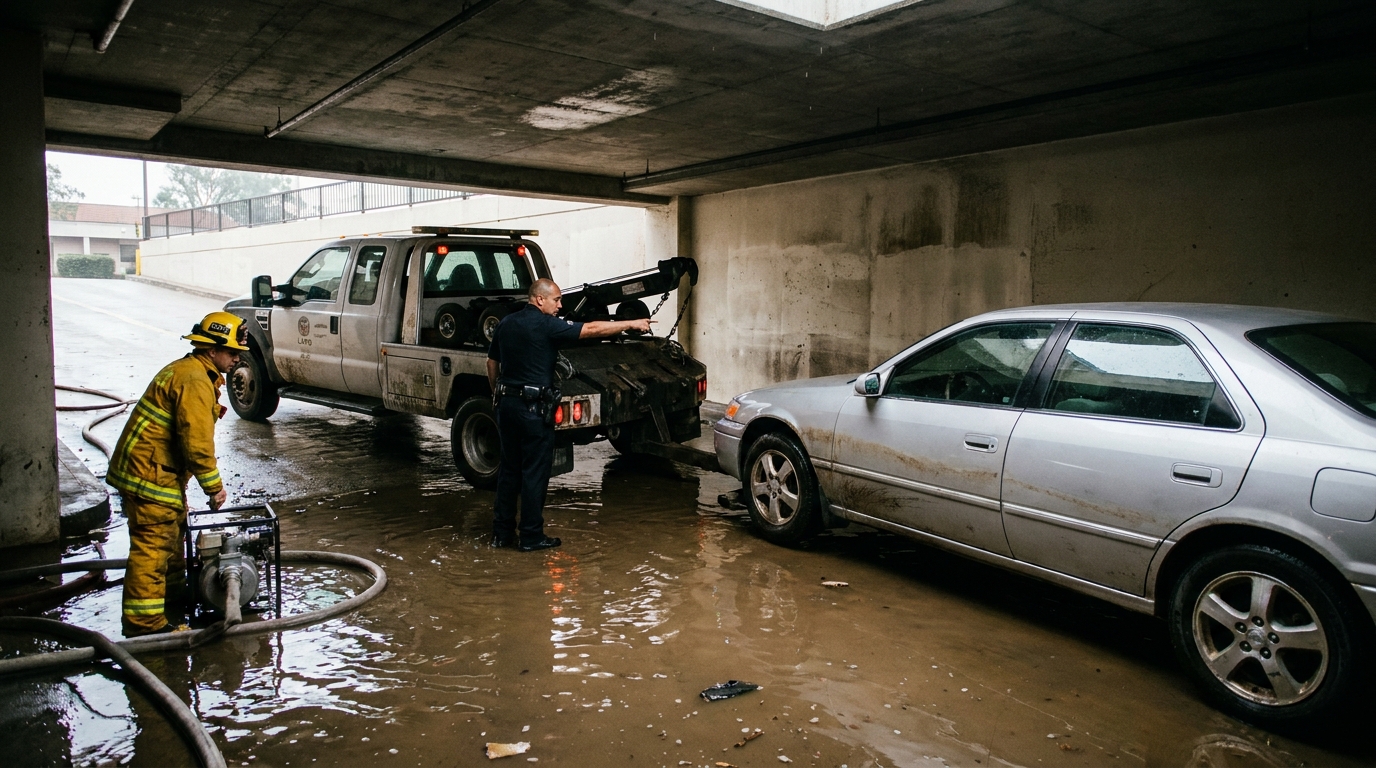
Los Angeles is not a flood desert. In November 2025, heavy rain sent water rushing into an underground parking garage on the 3700 block of Kelton Avenue in the Palms neighborhood, leaving roughly a dozen cars with water up to their door panels while LAFD crews ran pumps to drain the structure. Less than five weeks later, the December 2025 atmospheric river left cars partially submerged on Colorado Boulevard in Eagle Rock and flooded Vineland Avenue in North Hollywood. The February 2024 atmospheric river dropped over 10 inches of rain across parts of LA County, with Bel Air recording approximately 11.68 inches.
Beyond rainstorm flooding, post-wildfire burn scars in areas like Altadena and Pacific Palisades create a separate hazard: debris-flow and mud-plus-water intrusion, where mud, ash, and grit enter vehicle cavities along with the water. That scenario requires additional steps, grit removal from door sills, wiring channels, and undercarriage, that a standard flood-dry-out protocol does not fully address.
What to Do in the First 24 Hours After Your Car Floods
Speed matters because mold colonizes wet carpet in as little as 24 to 48 hours, and corrosion in electrical connectors begins within hours of water exposure. Follow this sequence exactly:
- Do not start or power on the vehicle. Cranking a flooded engine drives water deeper into cylinders and can destroy the engine through hydraulic lock. This applies equally to EVs and gas vehicles.
- Call a tow truck, do not drive it out. If the car is accessible, have it towed to a professional shop, not your driveway.
- Disconnect the 12V battery if it is safe to do so and the car is on dry ground. Skip this step for EVs, high-voltage system disconnects require a certified technician.
- Open all doors and windows to begin passive airflow drying as soon as the vehicle is out of the water.
- Document everything before anything is touched. Photograph the water line on the door panels, the interior, the engine bay, and the undercarriage. This documentation supports your insurance claim and any supplement requests later.
- File a comprehensive claim with your insurer and request a rental car or loss-of-use allowance if your policy includes it. See more on rental car and loss-of-use coverage in California if you are unsure what your policy provides.
- Get the car to a shop for a full diagnostic before authorizing any repair or accepting any settlement offer. A written diagnostic that documents exactly what water contacted is your best tool for contesting a total-loss valuation if you believe it is wrong.
The Repair vs. Total Loss Decision: A Water-Level Framework
No two flood events are identical, but this table captures how water level maps to typical outcomes. Use it to set expectations before your shop’s diagnostic, not as a final answer.
| Water Level Reached | Likely Damage | Typical Outcome |
|---|---|---|
| Below door sills (car moved quickly) | Minimal or none | Inspection recommended; often no repair needed |
| Floorboards to lower door panels (carpet/upholstery wet) | Carpet, insulation, lower wiring harness exposure | Usually repairable with professional dry-out and corrosion treatment |
| Seat level to below dashboard | Seat electronics, body control modules, wiring, HVAC intake | Repairable with thorough diagnostics; cost may approach total-loss threshold |
| Dashboard level or higher | ECU, airbag modules, instrument cluster, infotainment, engine intake | Frequently a total loss; repair cost often exceeds vehicle value |
| Engine submerged or fully submerged overnight | Engine hydrolocked, transmission, all electronics | Total loss in most cases |
One additional variable LA drivers often overlook: fresh rainwater versus standing water mixed with garage runoff, debris, or post-wildfire mud and ash. Mud-laden water from a burn-scar debris flow is far more damaging to wiring connectors and body cavities than clean rainwater, and it pushes repair costs higher. Similarly, salt or brackish water accelerates corrosion and can push a borderline case toward total loss faster than freshwater flooding of the same depth.
What Does a Flood Damage Diagnostic Actually Check?
A professional shop’s water-damage inspection goes well beyond sniffing for mold. Here is what a thorough evaluation should include, and what each check reveals:
| Inspection Area | What the Tech Looks For | Why It Matters |
|---|---|---|
| Interior / carpet / headliner | Moisture content, dried mud, musty odor, recently shampooed or replaced materials | Identifies water level and mold risk; recently replaced carpet is a red flag on used cars |
| Under-dash and body cavities | Dried mud, sediment, corrosion on connector pins | Mud under the dash confirms water reached electronic components |
| Wiring harness and connectors | Pin corrosion, white or green oxidation, water intrusion marks | Oxidized connectors cause intermittent failures weeks after the flood event |
| Engine bay | Water in air intake, coolant system, oil (milky appearance), and exhaust | Milky oil indicates water in the engine block, a total-loss indicator |
| Trunk and spare tire well | Standing water, rust, soggy insulation | Confirms overall water level; often missed in partial-intrusion cases |
| OBD/electronic scan | Stored fault codes across all modules (not just engine) | Reveals water-damaged ABS, airbag, ADAS, and body control modules |
| ADAS sensors and cameras | Calibration errors, moisture inside camera housings | Flood water can displace ADAS sensors; recalibration required before the car is safe to drive |
The hidden-damage timeline is the part most guides skip: mold, musty odor, intermittent electrical gremlins, and connector oxidation often surface weeks after the event. A car that seems fine three days after being pumped out of a Palms garage can develop a non-starting condition or trigger airbag warning lights a month later. That is why a comprehensive post-flood diagnostic, not just a visual inspection, is non-negotiable before you accept the car back or accept a settlement. Learn more about what a thorough post-repair check includes in our guide to post-repair safety inspections.
EV and Tesla-Specific Flood Risks in Los Angeles
Los Angeles has one of the highest EV concentrations in the country, which makes EV-specific flood guidance particularly relevant here. The risks are different from a gas vehicle, and the stakes are higher.
After any flooding event, do not attempt to drive or charge a flooded EV until a certified high-voltage technician has inspected it. Tesla’s own guidance treats a flooding event the same way as a collision, the vehicle should be towed, not driven, to an authorized repair facility. NHTSA advises keeping flood-submerged lithium-ion vehicles at least 50 feet away from buildings or other cars due to thermal runaway risk. That risk is most acute when the water involved is salty or brackish, because saltwater intrusion into battery cells can trigger short circuits and heat buildup hours or even days after the car is removed from the water.
For EVs where water reached the undercarriage or battery tray, which sits low on most Tesla and other EV platforms, expect the high-voltage battery pack to be evaluated separately from the rest of the vehicle. Many flood-damaged EV battery packs are declared total losses individually, even when the rest of the car is structurally intact. A shop with EV-specific experience and ADAS calibration capability is essential for this work. Our dedicated guide on EV and Tesla collision repair covers what makes these vehicles different in any damage scenario.
How Does a California Comprehensive Insurance Claim Work for Flood Damage?
Flood damage to your vehicle is covered under comprehensive auto insurance, not collision or liability. If you only carry the state minimum (liability only), your flooded car is not covered by your own policy. The California Department of Insurance has confirmed this repeatedly, including in official consumer alerts following the 2025 LA wildfire-related flood events: comprehensive auto coverage protects your vehicle from flood damage, while standard homeowners or renters policies typically do not cover the vehicle itself.
Here is how the claim process works step by step:
- Report promptly. Call your insurer as soon as the car is secured. Take photos before anything is cleaned or moved, the documentation you collect in the first hour is often the most valuable.
- Provide your chosen shop’s contact information. In California, you have the right to choose your own repair facility. You do not have to use your insurer’s preferred shop. If the adjuster steers you elsewhere, that direction is not legally binding.
- Pay your deductible. Comprehensive claims carry a deductible, typically $250 to $1,000 depending on your policy. For a repairable vehicle, you pay the deductible and the insurer covers the rest of the documented repair cost. For a total loss, the insurer pays you the car’s actual cash value (ACV) minus your deductible.
- Use your shop’s written diagnostic to support or contest the total-loss determination. If the adjuster declares a total loss based on a remote estimate but your shop’s diagnostic shows the damage is within a repairable range, a well-documented repair estimate can be used to push back. Understand that California’s total-loss threshold is based on whether the repair cost exceeds the vehicle’s ACV, not a fixed percentage. Read more about how supplements in collision repair work, since the same process applies when hidden flood damage is found after the initial estimate is written.
- Wildfire burn-scar flooding and debris flows: covered. California Insurance Commissioner Ricardo Lara has issued formal notices confirming that insurers are legally required to cover damage from mudslides and debris flows caused by wildfires. If your car was hit by debris-flow mud from the Eaton or Palisades fire burn areas during a subsequent rainstorm, your comprehensive policy should respond, document the connection clearly.
The “Partial Intrusion” Middle Ground Most Guides Ignore
The most common scenario for LA drivers, particularly those in underground apartment garages like the ones flooded in Palms in November 2025, is water that reached the carpet, lower door panels, and possibly the lower wiring harness, but did not submerge the engine or reach the dashboard. This is the repair-viable zone, and it is where fast, professional action produces the best outcomes.
Professional water extraction removes standing water and soaked carpet padding that manual drying cannot reach. Industrial dehumidifiers and air movers run for 48 to 72 hours to reduce relative humidity inside the vehicle’s cavities to acceptable levels. After drying, a corrosion-inhibitor treatment on exposed connectors and wiring helps prevent the oxidation that causes failures weeks later. Then a full electronic scan confirms no fault codes were set during the water intrusion. This process, done correctly, can return a partially flooded car to pre-loss condition. Done incorrectly or partially, it results in mold, persistent musty odor, and electrical problems that cost far more to fix months down the road.
If your car also sustained bodywork damage alongside the flooding, a common outcome when vehicles are moved by rushing water or impacted by debris, that structural and panel work should be assessed concurrently. Our guide to hail and storm damage repair in Southern California covers how combined storm-event claims are typically handled.
Common Mistakes to Avoid
- Starting the engine or powering on the car. This is the single fastest way to turn a repairable vehicle into a total loss. Never start a flooded car before it has been inspected.
- Attempting to dry it yourself with a shop vac and open windows. Consumer-grade equipment cannot extract water from seat foam, insulation layers, or door cavity drains. Incomplete drying guarantees mold within days.
- Waiting more than 24 hours to act. Mold begins growing quickly in a wet interior. Corrosion in electrical connectors starts within hours. Every delay narrows the repair window and increases cost.
- Accepting a total-loss offer without a professional diagnostic from your own shop. Insurers sometimes issue total-loss determinations based on remote estimates or water-level photos alone. A documented shop inspection can contest that and save the vehicle.
- Assuming the car is fine because it dried out and nothing looks wrong. Electrical corrosion, ADAS sensor faults, and mold inside door panels are all invisible to a visual inspection days after the event. A scan tool is required.
- Forgetting to document the water line on the car before towing. The waterline mark on the door panel or bodywork is your most objective piece of evidence for the insurance claim. Photograph it from multiple angles before anything is touched.
- Charging or driving a flooded EV. Until a certified high-voltage technician clears the battery system, a flooded EV should not be energized. Thermal runaway risk from water-damaged lithium-ion cells is real and can occur hours after the vehicle is out of the water.
Frequently Asked Questions
Does comprehensive insurance cover a flooded car in California?
Yes. Flood damage is covered under comprehensive auto insurance, not collision. The California Department of Insurance has confirmed that comprehensive coverage protects vehicles damaged by flooding, including debris flows caused by wildfire burn scars. If you only carry liability coverage, your flooded vehicle is not covered by your own policy. You pay your deductible; your insurer covers the documented repair cost or pays the actual cash value if the car is totaled.
How do I know if my flooded car is a total loss or repairable?
The water level is the primary indicator. Water that stayed below the dashboard and did not reach the engine air intake generally means the car is repairable. Water that reached dash level, submerged the engine, or left the car sitting overnight usually results in a total-loss determination, because repair cost typically exceeds the vehicle’s actual cash value. A written diagnostic from a professional shop is the only reliable way to know for certain, and that document is also your tool to contest a total-loss offer if you disagree.
My car sat underwater overnight in an LA parking garage. What should I do first?
Do not start it. Have it towed to a professional body shop for a full diagnostic before any other decision is made. Photograph the water line on the door panels and interior before anything is moved or cleaned. File a comprehensive insurance claim, document everything, and request a rental car under your loss-of-use coverage while the assessment is underway. Act within 24 hours to minimize mold risk and preserve your options.
Is flood damage from post-wildfire debris flows covered by insurance?
Yes. California Insurance Commissioner Ricardo Lara has formally notified insurers that they are legally required to cover vehicle damage from mudslides and debris flows resulting from wildfires that have destabilized hillsides. If your car sustained mud and water intrusion during a rainstorm in or near Altadena, Pacific Palisades, or another burn-scar area, your comprehensive auto policy should apply. Document the connection between the debris flow and the fire-affected hillside clearly when filing your claim.
Do I have to go to my insurance company’s preferred shop after flood damage?
No. California law gives you the right to choose your own repair facility for any insurance-covered claim, including comprehensive flood claims. Your insurer may recommend a preferred shop, but that recommendation is not binding. Choosing an independent shop with flood-damage and electronic diagnostic expertise gives you an independent assessment that is not influenced by insurer cost targets.
0 Comments