

What to Do the Moment You Find the Damage
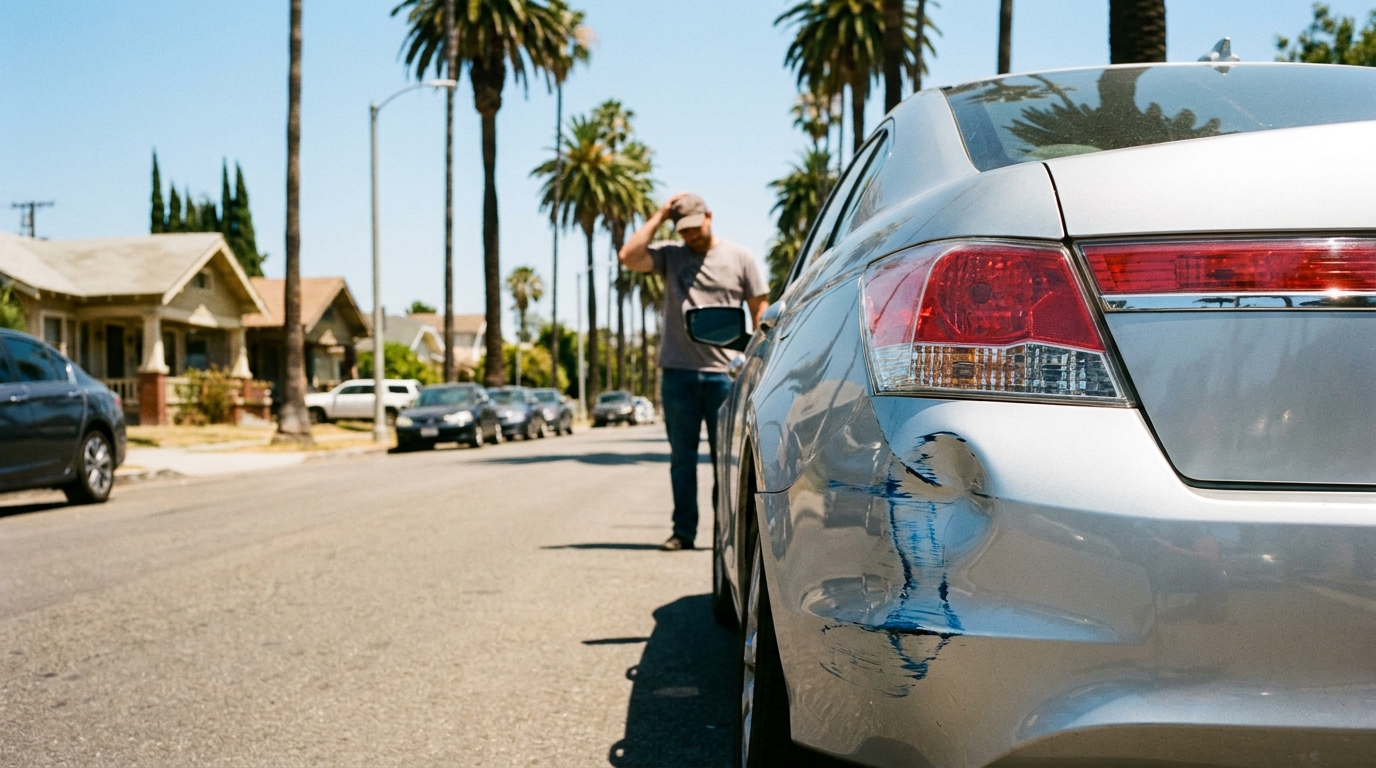
If someone hit your parked car and left in Los Angeles, do not move the car yet. Your first two minutes on scene directly affect your insurance claim and any chance of identifying the driver. Work through this sequence:
- Photograph everything before touching anything. Shoot the full vehicle, close-ups of every damaged panel, and wide shots showing your legal parking position. Capture paint transfer or debris on the ground, that smear of foreign paint is physical evidence.
- Check for a note, then photograph it. Some notes are incomplete or intentionally vague; photographing it locks in what was actually left. If there is no note, photograph that too (an empty windshield) as part of your documentation.
- Canvass for witnesses and surveillance footage. LA parking lots, storefronts, and Ring doorbells on adjacent streets are your best lead. Footage is often overwritten within 24 to 72 hours, so ask quickly. Nearby businesses and parking-structure operators may hand over footage only to police, which is another reason to file a report fast.
- Call LAPD non-emergency: 1-877-ASK-LAPD (1-877-275-5273). For a hit-and-run with no injuries, this is the correct line. You can also file online at the LAPD Community Online Reporting Service if no suspects are known and the incident occurred within city limits. Get the officer’s name and your case/report number, insurers require it.
- Aim to report within 24 hours. That is the standard window for a written crash report with LAPD, and several carriers will question delays.
Is a Parked Car Hit-and-Run Collision or Comprehensive Coverage?
This is the question that trips up most LA drivers, and the honest answer is: it depends on your specific carrier and policy language. Here is how the three coverage paths actually work.
Collision coverage pays when your car makes contact with another vehicle or object. Because a parked-car hit-and-run involves car-to-car contact, many insurers, including some major carriers, classify this as a collision claim. That means your collision deductible applies.
Comprehensive coverage pays for losses that are not collision-related: theft, vandalism, weather, and “acts of God.” Some insurers and agents argue that if the driver is never identified, the claim resembles a vandalism event and belongs under comprehensive, which sometimes carries a lower deductible. This logic is contested and not universal.
Uninsured Motorist Property Damage (UMPD) is often the cleanest fit for a genuine hit-and-run where the at-fault driver flees and is never found. UMPD is designed for exactly this scenario. It typically requires a police report, and in California it is an optional add-on, so check your declarations page to see whether you elected it.
The practical move: call your claims department, describe the situation as a hit-and-run on a parked, unoccupied car, and ask which coverage they will apply. Lock in the answer before you file so you can compare the applicable deductible against your repair estimate.
| Coverage Type | Applies When | Typical Deductible | Police Report Required? |
|---|---|---|---|
| Collision | Car-to-car contact; at-fault driver unknown | $500–$1,000 (varies) | Recommended; often required |
| Comprehensive | Some carriers treat unidentified-driver damage as vandalism | Often lower than collision | Yes, typically required |
| UMPD (Uninsured Motorist Property Damage) | At-fault driver fled and is unidentified | Often $250 or lower | Yes, required in California |
| At-Fault Driver’s Liability | Driver is later identified | None (their insurer pays) | Yes, strongly advised |
Will Filing a Claim Raise My Premium?
A not-at-fault hit while your car was legally parked should not trigger an at-fault surcharge with most California carriers. Many policies explicitly protect drivers from rate increases when the incident was reported to police and you were clearly not involved. That said, filing rules vary by insurer, confirm this directly with your agent before you file. The police report is your most important protection here: it is the paper trail that establishes you were parked and did nothing wrong.
The California Law the Driver Who Left Broke
The driver who hit your car and fled broke California Vehicle Code 20002. VC 20002 makes it a misdemeanor to be involved in a collision that causes property damage and leave without providing your name, contact information, and insurance details, even when the damaged vehicle is parked and unattended. If they could not find the owner, the law required them to leave a written note on the vehicle and notify law enforcement. Penalties for a VC 20002 conviction include up to six months in county jail, a fine up to $1,000, and two points on the driver’s California DMV record. If the driver is later identified through a dashcam image or witness statement, that information becomes part of your claim and their liability exposure.
Should You Even File a Claim? The Deductible vs. Repair Cost Decision
For small parking-lot hits, paying out of pocket often saves you money and keeps your claims history clean. Use this framework:
- Door ding, paint intact: Paintless Dent Repair (PDR) typically runs $50–$250 in Los Angeles. If your deductible is $500 or more, filing makes no financial sense. Pay the shop directly. See our breakdown of bumper scuff and scratch repair costs in Los Angeles for what minor hits actually cost.
- Creased or painted dent, no structural damage: Expect $200–$500 or more for conventional repair. Still likely below a $500 deductible; borderline for a $250 deductible. Get a written estimate before deciding.
- Cracked or scraped bumper needing repaint: Repairs commonly run from a few hundred dollars to roughly $1,500 depending on bumper complexity and sensor integration. Worth filing if your deductible is $500 or less.
- Smashed fender, jammed door, or structural concern: Costs climb into multiple thousands quickly once frame rails, door internals, or safety sensors are involved. Always file. See our guide on sideswipe repair cost in Los Angeles for what multi-panel damage actually involves.
- Luxury or EV: Parts scarcity and calibration requirements push repair costs significantly higher. Even moderate-looking damage can exceed $3,000 on a vehicle with radar sensors behind a bumper fascia.
| Damage Type | Estimated LA Repair Cost | File a Claim? |
|---|---|---|
| Door ding, paint intact (PDR) | $50–$250 | Rarely worth it |
| Creased/painted dent | $200–$500+ | Compare to your deductible first |
| Cracked or scuffed bumper + repaint | $300–$1,500 | Yes, if deductible is $500 or lower |
| Smashed fender + jammed door | $2,000–$5,000+ | Yes, always |
| Structural / frame concern | $3,000–$10,000+ | Yes, and prioritize a structural inspection |
LA auto-body labor rates commonly run $60–$120 or more per hour, and that spread alone can move a mid-level repair by several hundred dollars depending on the shop. Always request an itemized written estimate so you can compare apples to apples.
What a Good Shop Documents That Helps Your Recovery
Whether you are filing a claim, pursuing UMPD, or preserving evidence in case the driver surfaces later, what a shop puts in writing matters. Ask for the following at your estimate appointment:
- Itemized estimate by part and labor line, not a lump sum. Insurers supplement from line items, not totals.
- Paint transfer notation, the color, location, and photographs of foreign paint. This can help police match a suspect vehicle.
- Photos taken at intake, a professional shop documents the vehicle on arrival, which can counter any insurer argument that the damage pre-existed.
- Supplement-ready paperwork, hidden damage found during teardown should be added as a supplement, not absorbed. A shop that drops its price rather than document supplements costs you money.
If the at-fault driver is never found and the damage substantially affects resale value, read our post on diminished value in California and what a body shop can document, this applies to hit-and-run scenarios too.
Common Mistakes to Avoid
- Moving the car before documenting. Once you drive away, the scene is gone. Photograph everything first.
- Skipping the police report. Without an LAPD report number, UMPD claims are routinely denied and collision claims face additional scrutiny.
- Not checking for surveillance footage immediately. Parking-lot camera footage is often overwritten within 24 to 72 hours. Waiting until the next day can mean the evidence is gone.
- Filing a claim when repair cost is below your deductible. You pay the full repair cost anyway, plus you now have a claim on your record.
- Accepting a verbal-only insurer estimate without a shop review. Insurance estimates are starting points. A shop’s written estimate, especially after teardown, is what the repair actually costs.
- Assuming your insurer will always classify this as comprehensive. Many do not. Ask explicitly before filing so you know which deductible applies.
- Ignoring ADAS sensors behind damaged panels. A bumper that looks like a simple respray job can involve radar and camera calibration once it is removed. Factor that in before deciding whether to file.
Frequently Asked Questions
Is a parked car hit-and-run covered by collision or comprehensive insurance?
It depends on your carrier. Because another vehicle made physical contact with yours, many insurers classify it as a collision claim. Some apply comprehensive when the driver is never identified, treating it similarly to vandalism. A third option, Uninsured Motorist Property Damage (UMPD), is often the best fit when the at-fault driver fled, provided you elected UMPD on your California policy. Confirm with your claims department before filing so you know which deductible applies.
Do I have to call the police for a parked car hit-and-run in LA?
Yes, and you should do it promptly. Call the LAPD non-emergency line at 1-877-ASK-LAPD (1-877-275-5273) to report the incident and get a case number. Most UMPD and collision claims require a police report, and the report also creates a record that protects you from an at-fault rate surcharge. Aim to file within 24 hours.
Will my insurance go up if someone hit my parked car and left?
A hit-and-run on a legally parked car should not result in an at-fault surcharge with most California carriers, especially when a police report is on file. However, policies vary. Confirm the rate-impact question with your agent before filing, and always get the LAPD report to document that you were not at fault.
What if the driver is found later?
If the driver is later identified, through a dashcam, witness, or surveillance footage, their liability insurance becomes the primary source of payment and your deductible should not apply. Your LAPD report number and the shop’s itemized estimate are the documents that support the claim against their carrier. The driver also faces prosecution under California VC 20002 for leaving the scene.
How much does it cost to repair a parked car hit-and-run in Los Angeles?
Costs range from roughly $50–$250 for a paint-free door ding repaired by PDR, to $300–$1,500 for a bumper crack and repaint, to $2,000–$5,000 or more for a smashed fender with a jammed door. LA labor rates of $60–$120-plus per hour are a major factor. Always get an itemized written estimate before deciding whether to file a claim.
0 Comments