

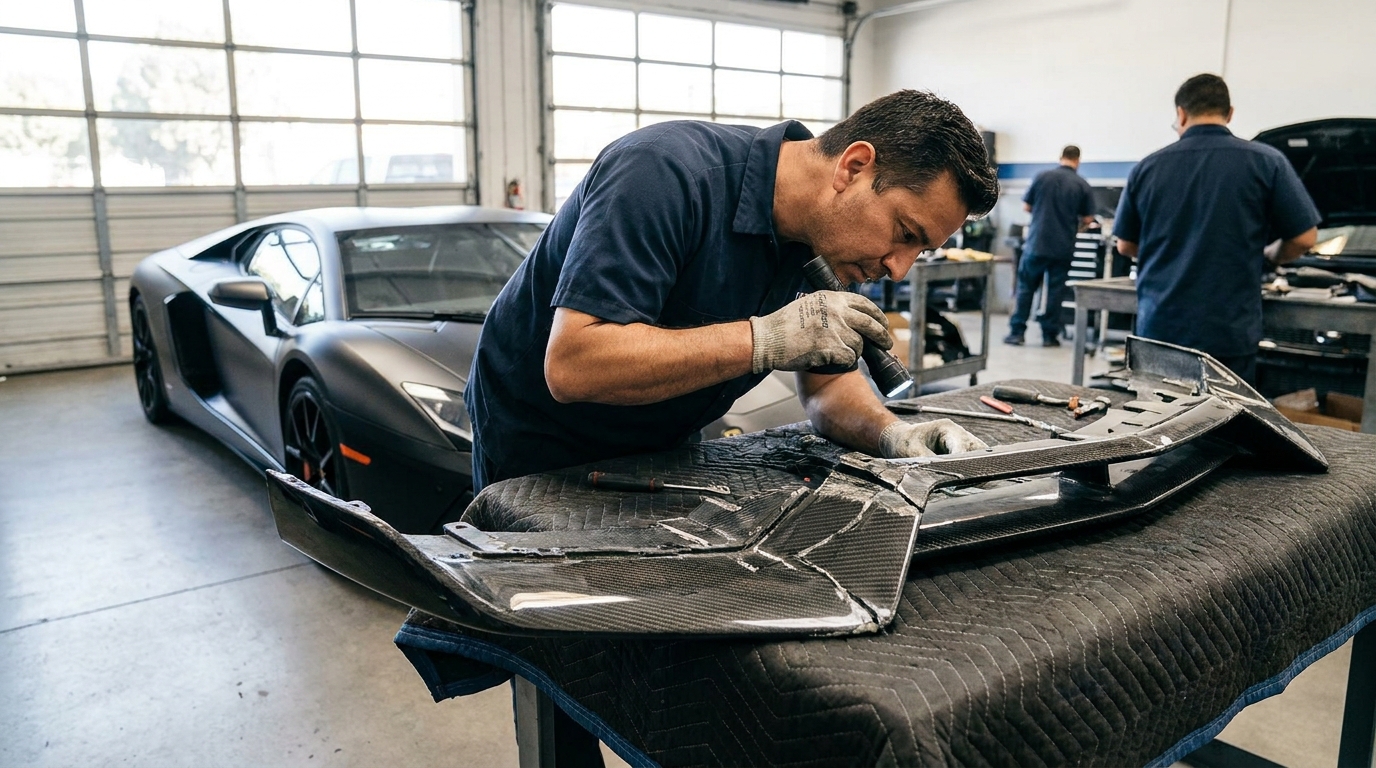
What Does Carbon Fiber Repair Cost in Los Angeles?
Carbon fiber repair in Los Angeles runs roughly $350 to $1,200 or more per part, with the final number driven by three things: how deep the damage goes, which part is affected, and whether the finish must match exposed weave. Here are the tiers you can expect at a qualified LA exotic-car body shop:
| Damage Type | Typical LA Cost Range | What It Involves |
|---|---|---|
| Surface scratches / clear-coat failure | $350 – $450 | Sand, re-resin if needed, UV-stable clear coat reapplied |
| Small cracks or dents (cosmetic) | $400 – $600 | Scarfing to remove damaged plies, patch layers, clear coat |
| Major fracture or delamination | $700 – $1,200+ | Full structural rebuild, multiple oriented plies, finish match |
| Exposed-weave finish upcharge | +50% – 100% over base | Weave direction and gloss must be optically matched |
One factor that inflates LA prices versus national averages: labor rates at shops that work on Ferraris, McLarens, Lamborghinis, and Porsches in areas like West Hollywood, Beverly Hills, and Santa Monica are higher than the national median. A repair priced at $500 by a national online estimator can easily run $700–$800 at a credentialed exotic shop in Los Angeles County. That premium buys proper composite training, the correct epoxy systems, and UV-stable clearcoats designed to survive Southern California sun.
Why Does LA Specifically Wreck Carbon Fiber Parts?
Los Angeles has a specific set of hazards that no other metro combines quite the same way. If you own a low-slung exotic here, you already know them:
- Steep residential driveways: Bel Air, Laurel Canyon, the Hollywood Hills, and Malibu roads regularly bottom out front splitters and rear diffusers on approach angles.
- Aggressive speed bumps: West Hollywood and Santa Monica deploy some of the most punishing speed humps in the country, hitting carbon at exactly the wrong angle for curb-rash and cracking.
- Parking-structure ramp lips: Century City, Beverly Center, and airport-area garages have abrupt transitions that scrape low-mounted aerodynamic pieces.
- UV and heat degradation: Southern California sun breaks down the resin that bonds carbon fiber filaments, causing that cloudy or milky appearance on exposed parts. Heat near exhaust exits accelerates the same process on rear diffusers. This is a re-resin and re-clear job, not a polish fix.
- Road debris on freeways: The 405, 101, and 10 carry heavy truck traffic. Loose aggregate and road debris at freeway speeds chips leading edges on front bumpers, hoods, and mirror housings.
Splitters, front lips, side skirts, and rear diffusers are the parts damaged most often because they sit lowest and take the first hit from curbs, ramps, and road debris. They also happen to be the parts where repair almost always beats replacement on cost.
Repair vs. Replace: Which Makes Sense for Your Part?
The decision depends on three things: the part’s function (cosmetic vs. structural), the damage depth, and whether the part is OEM or aftermarket. Use this table as your starting framework:
| Part | Typical Role | Repair Usually Makes Sense When… | Replace When… |
|---|---|---|---|
| Front splitter / lip | Aerodynamic / cosmetic | Crack, chip, or curb rash; no delamination into substrate | Multiple fracture points; OEM piece discontinued; aftermarket replacement cheaper than repair |
| Rear diffuser | Aerodynamic / cosmetic | Surface damage, clear-coat failure, minor crack | Heat-warped structure; mounting tabs broken; major delamination |
| Side skirts | Cosmetic / aero | Scrape, hairline crack | Crushed or fully fractured along length; aftermarket price is competitive |
| Hood / roof panel | Cosmetic (most cars) | Clear-coat failure, stone chips, minor crack near edge | Deep fracture near weld-flanges; damage to bonded structure underneath |
| Mirror housing | Cosmetic | Crack, scuff, weave damage | Mounting arm broken; camera/sensor housing cracked (ADAS concern) |
| Monocoque tub / structural chassis | Safety-critical structural | Only at an OEM-certified facility with verified repair data | Any time OEM does not publish a repair procedure for the damage zone |
The cost math on replacement: OEM carbon bumpers and aero components on supercars typically run $500 to $3,000 or more for the part alone, before any paint or labor. An OEM McLaren splitter, Ferrari diffuser, or Lamborghini mirror cap often exceeds $1,500 in parts. That makes a $500–$700 repair a clear financial win on most cosmetic damage, and it is exactly why exotic owners in LA should be asking their body shop about repair first, not replacement.
For aftermarket carbon upgrades (dry-carbon lips, aftermarket canards, etc.), the calculus sometimes flips: if a quality aftermarket replacement part is $300–$400 and the repair quote is $550, replacement may be the smarter call. Ask the shop to give you both numbers before you decide.
Cosmetic vs. Structural Carbon Damage: Why the Line Matters
Not all carbon damage is equal, and a good shop will be honest about where the safety line sits.
Cosmetic carbon damage affects the outer surface layers: clear coat failure (milky/UV-hazed appearance), surface scratches that do not penetrate through multiple plies, curb rash on splitters or skirts, and small isolated cracks on aero parts that carry no crash-load. These are repairable at a qualified shop with the right epoxy systems and UV-stable clearcoats.
Structural carbon damage is a different problem. On cars like a McLaren, Alfa Romeo 4C, or Lamborghini Aventador, the carbon fiber tub is the chassis, the component to which the suspension, engine, and body panels attach. Damage to that tub raises genuine safety questions about crash performance and airbag timing. An honest shop will tell you that structural tub repairs require OEM-published repair data and specialized composite training. If a shop can’t show you that documentation or dismisses the question, walk away.
The practical rule for LA exotic owners: if the damaged part is bolted on and purely aerodynamic or cosmetic, repair is almost always safe and appropriate. If the part is bonded into the vehicle’s safety cell, verify the shop’s credentials and insist on OEM repair procedures before approving work. See our post on aluminum-body vehicle repair for a parallel discussion on how advanced materials change what a shop needs to do correctly.
How Does a Proper Carbon Fiber Repair Actually Work?
The technique used in a legitimate composite repair is called scarfing. Understanding it helps you tell a real repair from a bondo patch.
Carbon fiber parts are built from multiple layers (plies) of woven cloth, each oriented at a specific angle, commonly 30°, 45°, or 90°, because the material is stronger in the direction of the fibers. A finished part can have 12 to 14 or more plies stacked in a precise sequence. When one area is damaged, the repair technician uses a die grinder to carefully grind outward from the center of the damage, exposing each layer of cloth in a graduated taper. This is scarfing. Each repair ply is then applied from the center outward, with its fiber orientation matched to the original structural ply it is replacing. The repair is built back up layer by layer, smallest ply first, largest on top.
On an exposed-weave carbon part (the glossy visible-fiber look on most exotic aero pieces), the shop must also match the weave pattern and gloss level of the surrounding material after curing and clearing. Achieving an invisible repair on exposed carbon is genuinely difficult craftsmanship, it is why the exposed-weave finish upcharge can effectively double the base repair cost. A painted carbon part (one that will be color-coated over) is more forgiving, because the repair seam is hidden under paint.
After curing, a UV-resistant clear coat is applied. This is non-negotiable in Los Angeles. Skipping UV protection on an exposed carbon part in Southern California leads to resin degradation and that milky/hazy look within one or two seasons.
How to Spot a Cheap or Fake Carbon Fiber Patch
LA has no shortage of shops that will fill a cracked splitter with body filler and call it a repair. Here is exactly what a bad repair looks like versus a proper one:
Red flags on a cheap patch
- Bondo or polyester filler over carbon: Body filler does not bond to carbon fiber the way epoxy does. It will crack and delaminate within months, especially on parts exposed to heat or flexing. Run your finger across the repair edge, filler repairs have a slightly different surface texture and often micro-crack at the boundary.
- Mismatched weave: A proper repair uses carbon cloth that matches the original 2×2 or 1×1 twill or plain weave. If the patch area has a different weave pattern visible under the clear coat, the shop used whatever cloth was on hand, not a matched ply.
- No UV clear coat: Ask specifically what clear coat was used and whether it contains UV inhibitors. If the shop can’t answer, assume it doesn’t have them.
- Orange peel or fish-eye in the clear: A rushed clear application on carbon shows up quickly. The surface should be as smooth and reflective as the original part.
- Repair done without removing the part: Most quality carbon repairs require the part to be removed from the car so the technician can access the back face, apply a backing plate or caul plate during cure, and control the repair environment. On-car quick patches on structural geometry are a red flag.
- No cure time given: Epoxy-based composite repairs require proper cure time and often heat. A shop that promises same-day turnaround on a structural carbon crack is cutting corners on cure.
The Insurance Angle: Filing a Claim vs. Paying Out of Pocket
For a collision that damages a carbon fiber hood, splitter, or mirror on a high-value exotic, the insurance question matters. A few LA-specific points:
- Document the part’s OEM value before negotiating: If your insurer wants to pay aftermarket pricing for an OEM carbon component, you have the right to dispute that in California. Our guide on OEM vs. aftermarket vs. reconditioned parts explains how California’s insurer rules work.
- Diminished value matters on exotics: A documented carbon repair on a supercar can reduce resale value, even if done correctly. California allows diminished-value claims after not-at-fault collisions. See our post on diminished value documentation in California for what a shop can put in writing for you.
- Minor cosmetic damage: consider paying out of pocket. A $450 clear-coat repair on a splitter is often not worth a claim that raises your premium. Get a written estimate and do the math before calling your insurer.
- Major fractures on OEM carbon parts: When the part costs $1,500–$3,000+ to replace and the at-fault driver’s insurer is involved, file the claim. Document everything with photos before touching the car.
- Supplements are common: On exotic carbon work, shops frequently need to submit a supplement after disassembly reveals damage not visible in the initial estimate. This is normal and legitimate on composite repairs.
What to Ask a Los Angeles Shop Before Approving Carbon Fiber Work
- Do you have composite repair training or certifications? (I-CAR composite training is the baseline; OEM-specific credentials are better for structural work.)
- Will you remove the part from the car to make the repair?
- What epoxy system and clear coat are you using? Is the clear UV-stabilized?
- Can you match the weave pattern on exposed carbon?
- What is your cure process, room temperature, heated booth, or autoclave?
- Can I see examples of previous carbon repairs you have done, particularly on exposed-weave parts?
- Will you give me a written estimate that breaks out labor, materials, and any replacement parts separately?
A shop confident in its carbon work will answer all of these without hesitation. If you get vague answers or pushback on the cure process question, move on. For broader guidance on evaluating any LA body shop, our post on how to choose a collision repair shop in Los Angeles covers what to look for across all repair types.
Common Mistakes to Avoid
- Polishing a milky/hazy carbon part instead of re-clearing it. UV-degraded resin and failed clear coat cannot be polished back to clarity. Polishing removes what little clear remains and accelerates deterioration. The fix is a proper re-resin and re-clear, not a detail.
- Accepting a “bondo and paint” quote on exposed carbon. Body filler over carbon fiber is not a repair, it is a temporary hide. It will crack within a season in LA heat.
- Choosing a shop by price alone on structural carbon. The cheapest quote for a tub or monocoque repair may be from a shop without proper composite credentials. On safety-critical parts, the consequences of a failed repair in a future collision are severe.
- Skipping the insurance supplement conversation. Carbon repairs frequently require supplemental approvals. Do not let a shop start work on expensive carbon parts without getting insurer sign-off on the full scope, or you may be responsible for the difference.
- Assuming any body shop can match exposed weave. Exposed-carbon finish matching requires specific cloth, the right epoxy viscosity, and finishing experience. Most general collision shops cannot do it invisibly. Ask for portfolio photos specifically of exposed-carbon repairs.
- Not addressing clear-coat failure early. A small area of UV-haze left untreated will spread. Once the resin begins degrading under compromised clear coat in Southern California sun, the affected area grows quickly. Early re-clear is far cheaper than a full panel re-finish.
Frequently Asked Questions
How much does carbon fiber repair cost in Los Angeles?
Expect $350–$450 for surface scratches and clear-coat repairs, $400–$600 for small cracks or cosmetic dents, and $700–$1,200 or more for major fractures requiring structural rebuilding. An exposed-weave finish match, needed on most visible exotic aero parts, adds roughly 50–100% to the base cost because of the craftsmanship required to align weave pattern and gloss.
Is it better to repair or replace a carbon fiber splitter?
For a single crack, chip, or curb-rash damage on a splitter, repair is almost always the better financial choice. OEM carbon splitters on supercars routinely cost $1,000–$3,000 or more for the part alone. A repair at $500–$700 preserves the original part and saves significantly. Replace when there are multiple fracture points across the length of the piece, mounting tabs are destroyed, or the part is so heavily delaminated that structural integrity is compromised.
What is scarfing in carbon fiber repair?
Scarfing is the process a technician uses to prepare a damaged carbon fiber part for repair. Using a die grinder, the technician grinds outward from the center of the damage to expose each individual layer (ply) of carbon cloth in a graduated taper. Replacement plies are then laid back in from the center out, each oriented to match the fiber direction of the original layer. Scarfing is what separates a structurally sound composite repair from a surface patch.
Why does my carbon fiber part look cloudy or milky?
The cloudy or milky appearance on exposed carbon is caused by UV degradation of the resin and/or failure of the clear coat layer. Los Angeles’s intense sun is one of the most aggressive environments for carbon fiber finishes. Heat near exhaust components accelerates the same process on rear diffusers. The correct fix is to re-clear with a UV-inhibiting clear coat after assessing whether the underlying resin needs treatment. Polishing will not solve the problem and usually makes it worse by removing the remaining clear.
Can I file an insurance claim for carbon fiber damage on my exotic car?
Yes, if the damage resulted from a collision or covered event. For high-value OEM carbon components, California law gives you the right to insist on OEM parts rather than aftermarket substitutes. For minor cosmetic damage under $500, paying out of pocket often avoids a premium increase. For damage to expensive OEM carbon parts ($1,000+), filing the claim and getting the shop to submit a proper supplement for the full repair or replacement scope is the right move.
0 Comments