

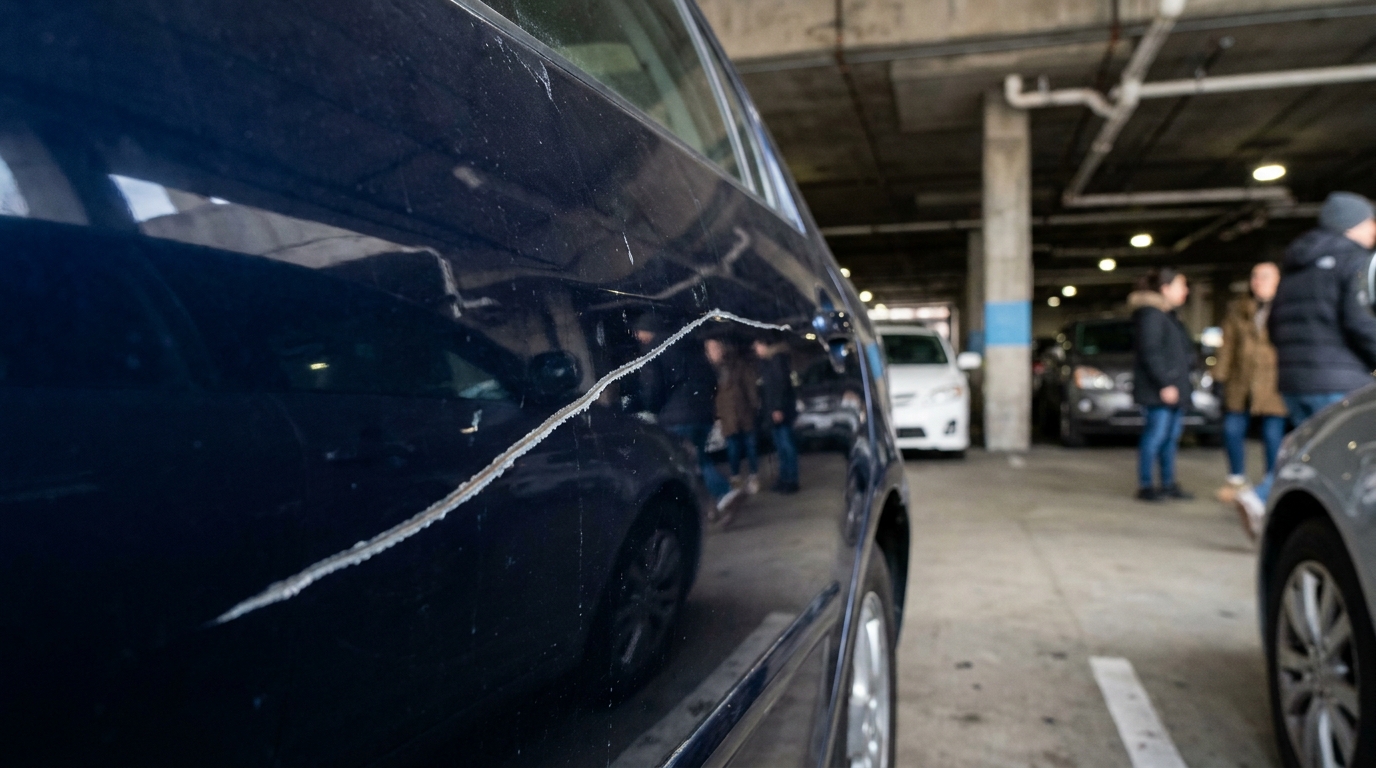
What Does Keyed Car Repair Cost in Los Angeles?
Repair cost depends almost entirely on how deep the scratch penetrates your car’s paint layers, and how many panels the keyer crossed. A scratch that stays in the clear coat runs roughly $150–$300 at an LA shop. One that cuts through to bare metal on a single panel typically runs $800–$1,500. A long key line that travels from fender to door to quarter panel, which is common in tight LA parking structures, can exceed $4,000 once blending into adjacent panels is factored in. This is the number that surprises most drivers, because the national DIY guides focus on single-panel touch-ups and skip the blending cost entirely.
Why Is the Damage Often More Expensive Than It Looks?
Your car has three paint layers: clear coat on top, color coat (base coat) underneath, and primer below that. A key usually drags hard enough to reach at least the color coat and frequently hits primer or bare metal. The deeper the scratch, the more labor-intensive the repair. But the hidden cost multiplier is panel blending. When a shop repaints one panel, the new color rarely matches the surrounding panels perfectly under direct California sunlight, especially on metallics, pearls, or aged paint. To produce a seamless result, a competent shop sprays a blend coat into the edges of the adjacent panels. That means a single keyed door can generate a line item for the door itself plus partial blending on the fender and the quarter panel. For more on why this step matters, see why paint color matching and blending matter in auto body repair.
Keyed Car Repair Cost by Scratch Depth
| Scratch Depth | What You See | Repair Method | Typical LA Cost | Turnaround |
|---|---|---|---|---|
| Clear coat only | White or hazy line; fingernail glides over it | Machine polish and UV clear-coat sealant | $150–$300 | 1–2 days |
| Through color coat | Base color (grey, blue, red) visible in scratch | Spot spray, color match, fresh clear coat | $400–$1,000 per panel | 2–4 days |
| Through to primer | Light grey or white primer exposed | Sand, prime, base coat, clear, blend | $800–$1,500 per panel | 3–5 days |
| Bare metal exposed | Silver metal visible; rust risk | Full refinish, anti-rust primer, blend adjacent panels | $1,200–$1,800+ per panel | 4–7 days |
| Multi-panel (2–4 panels) | Continuous scratch line across body sections | Full refinish with mandatory blend coat on neighboring panels | $2,500–$4,500+ | 5–8 days |
LA labor rates trend toward the higher end of national ranges. Standard shop rates in Los Angeles commonly run $100–$150 per hour, versus the $75–$100 average in less competitive markets. That gap explains why a quote from an LA shop often runs 20–30% higher than online national cost calculators suggest.
Should You DIY or Go to a Shop?
A DIY touch-up pen or scratch-removal kit is a reasonable choice for one condition only: a true clear-coat-only scratch that your fingernail slides across without catching. In that case, a quality polish and UV sealant can restore the gloss without visible evidence. Any scratch where your fingernail catches, drops into a groove, or reveals a color other than your car’s paint finish needs professional attention for two reasons. First, bare-metal exposure starts rusting within days in LA’s marine-layer humidity, and if rust forms before you repair, your insurer may decline to cover the deterioration. Second, a DIY touch-up pen applied to a primer- or metal-level scratch will leave a visible texture mismatch that a shop will still have to sand out before refinishing, costing you more than if you had gone straight to professional repair.
Does Insurance Cover a Keyed Car in California?
Yes, but only under comprehensive coverage, not collision. Keying is classified as vandalism, which is a covered peril under comprehensive. If you carry only liability, you have no coverage for this damage. California does not require comprehensive, so drivers who dropped it to save on premiums are paying the full repair bill out of pocket. If your car is financed or leased, your lender or lessor requires comprehensive, meaning you almost certainly have it. Check your declarations page for the word “comprehensive” and look at the deductible listed there, which is a separate line from your collision deductible. Common comprehensive deductibles are $250, $500, and $1,000.
If you have a leased vehicle, your obligation to return it undamaged makes repair non-negotiable regardless of the insurance math. For a full look at that scenario, see lease return damage repair in Los Angeles.
Should You File a Comprehensive Claim? The LA Break-Even Calculation
Filing a comprehensive claim is not always the right move, even when you have coverage. The decision comes down to three numbers: your repair estimate, your deductible, and the likely premium impact over the next two to three policy years.
| Scenario | Repair Estimate | Deductible | Insurer Pays | Est. 3-Year Premium Increase | Net Outcome |
|---|---|---|---|---|---|
| Minor clear-coat scratch, low deductible | $250 | $500 | $0 (repair < deductible) | , | Pay out of pocket; do not file |
| Single panel, mid-range deductible | $900 | $500 | $400 | ~$150–$300 | Marginal; filing likely still worth it |
| Multi-panel, mid deductible | $2,800 | $500 | $2,300 | ~$150–$300 | File, clear net benefit |
| Single panel, high deductible | $1,200 | $1,000 | $200 | ~$150–$300 | Do not file, net loss after premium increase |
The practical rule: only file if the repair estimate is meaningfully higher than your deductible, generally at least 1.5 to 2 times your deductible amount. A single comprehensive vandalism claim typically adds roughly $30–$140 per year to your premium, and many insurers won’t surcharge at all for one small comprehensive claim. Multiple comprehensive claims within three to five years do trigger noticeable increases, however, so if you’ve filed one recently, the calculus for filing again shifts toward paying out of pocket.
One often-missed wrinkle: if the repair cost is only slightly above your deductible, the insurer’s payout after you pay the deductible may be so small that any premium bump wipes it out. For example, a $1,100 repair with a $1,000 deductible means the insurer covers $100, and a modest premium increase of even $50 per year over two years erases that entirely.
How to Document a Keyed Car for an Insurance Claim in Los Angeles
Vandalism claims, including keying, are a known fraud vector. Adjusters in LA frequently inspect in person rather than relying solely on photos, so thorough documentation from the moment you discover the damage is essential.
- Photograph immediately. Take wide shots showing the scratch’s location on the vehicle with your license plate visible, then close-up shots at an angle so the depth and length are clear. Place a coin or ruler in frame to show scale.
- File a police report. Call the non-emergency LAPD line (or your local municipality’s line) and report vandalism. Get the report number. Many California insurers require this before processing a comprehensive vandalism claim. Without it, they may question whether the damage was truly intentional.
- Get two written estimates. Independent written estimates let you compare scope, not just price. Ask each shop to itemize prep, primer, base coat, clear coat, blend coat, and labor hours separately. A quote that lumps everything into one line, or omits a blend line entirely on a multi-panel job, is almost certainly a lowball that will generate a supplement later.
- Submit the police report and estimates together when opening your claim. Note the exact date, time, and location where you discovered the damage.
For a deeper look at how to read a repair estimate line by line so you can spot a lowball quote, see how to read a collision repair estimate.
What a Proper Keyed Car Estimate Should Show
A legitimate line-item estimate for anything beyond a clear-coat-only scratch should include the following entries. If any are missing, ask why before signing.
- Wash and prep, masking, surface prep, and any solvent wipe-down
- Feather, fill, and sand, leveling the scratch edges before any primer is applied
- Primer or sealer, required for any scratch that reached the color coat or deeper
- Base coat (color coat), the actual color, mixed to your paint code
- Clear coat, the protective topcoat, typically two or more stages
- Blend coat, transitional overspray into adjacent panels for color match; listed as a separate panel line on any multi-panel repair
- Labor hours per panel, Los Angeles shops typically bill 3–6 hours per panel for a full refinish
- Curing and polish, final machine polish and inspection after clear coat cures
LA-Specific Factors That Affect Keyed Car Repair Cost
Los Angeles adds its own variables on top of national benchmarks. Labor rates at quality independent shops in LA typically run higher than the national $75–$150/hr range, reflecting higher rent, insurance, and technician wages. Metallic and pearl finishes, which are extremely common on luxury vehicles in neighborhoods like Beverly Hills, West Hollywood, and Brentwood, require additional flake or pearl matching time and often a test panel before the shop commits to the full repair. Matte and satin finishes add another 30–50% across all repair categories because standard buffing and polish steps damage the finish. If your car is an EV or Tesla, be aware that some Tesla body colors are proprietary formulations and require longer lead times on paint materials; see EV and Tesla collision repair: what makes it different for the full picture.
Common Mistakes to Avoid
- Skipping the police report. Without a vandalism report, California insurers may dispute coverage or require an in-person adjuster inspection that delays repairs by days.
- Waiting on bare-metal scratches. Rust can set in quickly in coastal LA microclimates. If rust forms before you repair, the insurer may deny coverage for the corrosion portion of the damage.
- Accepting a quote that has no blend line on a multi-panel job. A shop that skips blending will deliver a visible color mismatch. Get it itemized before authorizing work.
- Filing a claim when the repair is below your deductible. If the estimate is $400 and your deductible is $500, you pay the full $400 out of pocket anyway, and the claim still shows on your CLUE report.
- Using a touch-up pen on a color-coat or primer-level scratch. Touch-up pens do not level the scratch edges. The result is a raised, paint-filled groove that will need to be sanded out before a proper refinish can happen.
- Choosing a shop based on price alone. A quote that skips blend coats or uses generic rather than factory-matched paint may cost $300 less upfront but will look wrong in sunlight and may affect your car’s resale value. For guidance on evaluating shops, see how to choose a collision repair shop in Los Angeles.
Frequently Asked Questions
Does comprehensive insurance cover a keyed car in California?
Yes. Keying is classified as vandalism, which is a covered peril under comprehensive auto insurance. You still pay your deductible before the insurer covers the remainder. Liability-only policies do not cover vandalism at all. California does not require drivers to carry comprehensive, so confirm you have it before filing.
How much does it cost to fix a keyed car in Los Angeles?
Clear-coat-only scratches run roughly $150–$300. A single panel with color-coat or primer damage costs $400–$1,500. Multi-panel damage requiring blend coats on adjacent panels commonly runs $2,500–$4,500 or more. LA labor rates trend higher than national averages, and metallic or specialty finishes add additional cost.
Is it worth filing a comprehensive claim for a keyed car?
File only when the repair estimate meaningfully exceeds your deductible, generally at least 1.5 times the deductible amount. On small repairs that are at or below your deductible, filing produces little or no insurer payout while still potentially triggering a modest premium increase and a mark on your claims history.
Do I need a police report to file a keyed car insurance claim in California?
Most California insurers require a police report for vandalism claims because keying is a common insurance fraud scenario. File a report with your local LAPD division or city non-emergency line as soon as you discover the damage and include the report number with your claim submission.
How long does keyed car repair take at an LA body shop?
A clear-coat-only repair typically takes one to two days. A single-panel full refinish with primer and clear coat runs three to five business days, accounting for prep, application, and curing time. Multi-panel repairs with blend coats generally require five to eight business days at a properly equipped shop.
0 Comments