

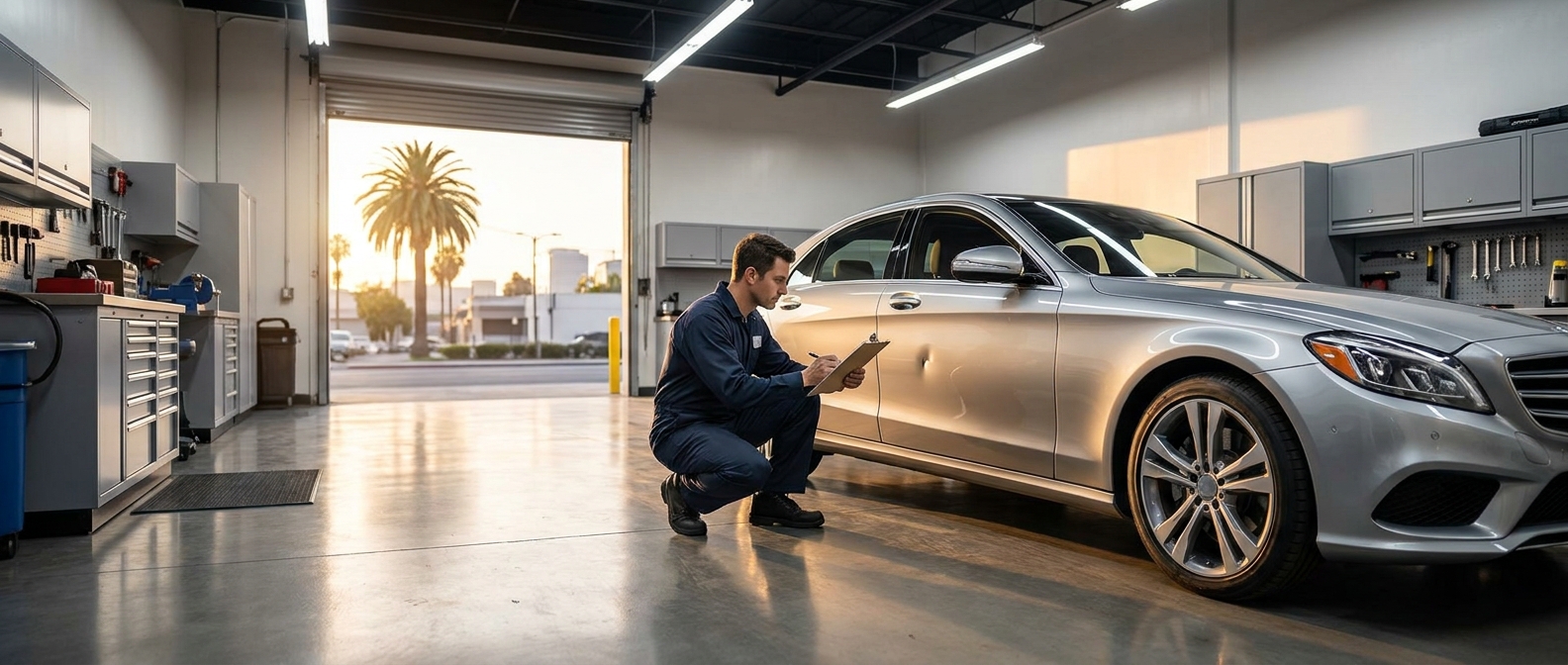
Should You Repair Damage Before Returning a Leased Car?
Yes, in most cases. Lease return damage repair in Los Angeles usually costs less than what the leasing company will bill you for the same damage after the turn-in inspection. Lease-end inspectors apply standardized penalty rates to every dent, scratch, and scuffed wheel that falls outside “normal wear and tear,” and those rates are set by the leasing company, not by a competitive repair market. Fixing chargeable damage at a local body shop before the inspection puts the pricing back under your control.
This guide covers what inspectors actually flag, which repairs are worth doing before you turn the car in, when paying the charge is the smarter move, and how to time the work so the car is ready on inspection day.
What Do Lease-End Inspectors Charge You For?
Every lease contract includes a wear-and-tear standard that separates free “normal wear” from billable “excess wear.” The exact thresholds vary by leasing company, so request your company’s wear-and-tear guide, but most standards flag the same things:
- Dents larger than a credit card, or several small dings clustered on a single panel
- Scratches that cut through the paint, or that run longer than a few inches
- Bumper scuffs with broken paint, gouged plastic, or a cracked bumper cover
- Curb rash on alloy wheels that goes beyond light surface marks
- Cracked, chipped, or starred windshield glass
- Mismatched paint or visible evidence of an earlier low-quality repair
- Missing parts and trim, from wheel center caps to the cargo cover
Anything inside the standard costs you nothing. Anything beyond it is itemized per panel and per wheel on your final statement, and the total often surprises people because each line item is billed at the leasing company’s flat rate rather than what the repair actually costs locally.
Is It Cheaper to Repair the Damage or Pay the Lease-End Charge?
For most cosmetic damage, repairing first is cheaper. The leasing company charges a fixed penalty per defect and has no incentive to price it competitively. A local body shop quotes the specific repair, and for small cosmetic work the modern repair methods are far less expensive than a full panel replacement or repaint. Here is how the common lease-return items compare:
| Damage | How the inspector treats it | Best pre-return repair |
|---|---|---|
| Door dings and small dents | Charged per dent beyond the allowance | Paintless dent repair (PDR), no repaint needed |
| Bumper scuffs and scratches | Charged per bumper face | Spot repair and localized respray of the bumper cover |
| Curb rash on alloy wheels | Charged per wheel | Wheel refinishing |
| Paint chips and light scratches | Pooled into a per-panel charge | Touch-up or a blended spot repaint |
| Cracked windshield | Billed as a full replacement | Glass replacement, often covered by comprehensive insurance |
| Old mismatched repair | Flagged as a substandard repair | Professional color-matched respray of the panel |
There are two situations where paying the charge, or doing nothing, is the smarter move. First, if the damage sits inside the wear-and-tear allowance, leave it alone; you will not be billed for it. Second, if you plan to buy the car at the end of the lease, the inspection charges never apply, so cosmetic repairs become a personal choice rather than a financial necessity.
Which Repairs Make Sense Before a Lease Return in Los Angeles?
Paintless dent repair for door dings
Parking lots in Los Angeles are hard on door panels, and dings are the most common lease-return charge. PDR removes small dents from behind the panel without filler or paint, preserves the factory finish, and is typically completed in a day. Because no repaint is involved, there is no color-match risk for the inspector to flag. See our comparison of paintless dent repair vs. conventional repair for when each method applies.
Bumper scuff and scratch repair
Bumper corners collect scuffs from parallel parking and tight garages, and inspectors check both bumper faces closely. A localized bumper repair and respray restores the panel to factory appearance without replacing the cover. We break down the process in our guide to bumper scuff and scratch repair in Los Angeles.
Wheel and rim refinishing
Curb rash is billed per wheel, so a car with all four wheels scuffed generates four separate charges. Refinishing repairs the machined or painted face of the wheel and is almost always cheaper than the penalty. Our post on wheel and rim repair after curb damage explains which wheels can be refinished and which need replacement.
What not to bother fixing
Skip repairs on items that fall within your allowance: light stone chips on the front of the hood, faint swirl marks, normal tire wear above the minimum tread, and minor interior wear. Fixing damage the inspector would not charge for turns a money-saving strategy into an expense.
When Should You Schedule Lease Return Repairs?
Start about 90 days before your turn-in date. That window gives you time to find every defect, get a pre-inspection, and complete repairs without rush fees or schedule pressure.
- 90 days out: Request the wear-and-tear guide from your leasing company. Wash the car and inspect it panel by panel in direct sunlight, which reveals dents and scratches that garage lighting hides.
- 60 days out: Schedule the free pre-inspection most leasing companies offer. The inspector produces an itemized condition report, which becomes your repair shopping list. Bring that report to a body shop for an estimate.
- 30 to 45 days out: Complete the repairs. Cosmetic work like PDR, bumper respray, and wheel refinishing is measured in days, not weeks. Our guide to collision repair timelines in Los Angeles shows what to expect for each repair type.
- Final week: Detail the car, photograph every panel and wheel with date stamps, and keep your repair invoices. Documentation protects you if the final inspection report disagrees with the car’s condition at drop-off.
Do You Need Insurance for Lease Return Repairs?
For small cosmetic work, usually not. Door dings, scuffs, and curb rash typically cost less than a collision deductible, so most drivers pay out of pocket and avoid a claim on their record. Larger damage is different: if the car was in an accident during the lease, your lease contract requires a proper, documented repair, and your collision coverage handles it the same way it would on a financed car. Leasing companies can flag substandard or undisclosed repairs at turn-in, so a cheap respray that does not match the factory color can cost you twice, once for the bad repair and again for the inspection charge that follows it.
Should You Use the Dealership or a Local Body Shop?
Returning the car to the dealer you leased it from does not waive damage charges. The inspection is performed by the leasing company or a third-party inspection service, not by the salesperson who takes the keys, so the dealership has no power to overlook a dented panel. Dealerships also subcontract most body work to outside shops and add their margin on top. Going directly to a qualified local body shop removes that markup, and you deal with the people doing the work. We cover the tradeoffs in detail in dealerships vs. body shops.
Lease Return Repairs at LUXE Auto Body
LUXE Auto Body handles lease return damage repair for drivers across West Los Angeles, Santa Monica, Culver City, and Beverly Hills. Bring your pre-inspection report or simply bring the car, and we will walk the panels with you, separate the damage that is actually chargeable from the wear your allowance already covers, and quote only the repairs that save you money against the lease-end bill. Factory color matching, PDR, bumper and wheel refinishing are all done in house, with documentation you can hand to the inspector.
0 Comments