

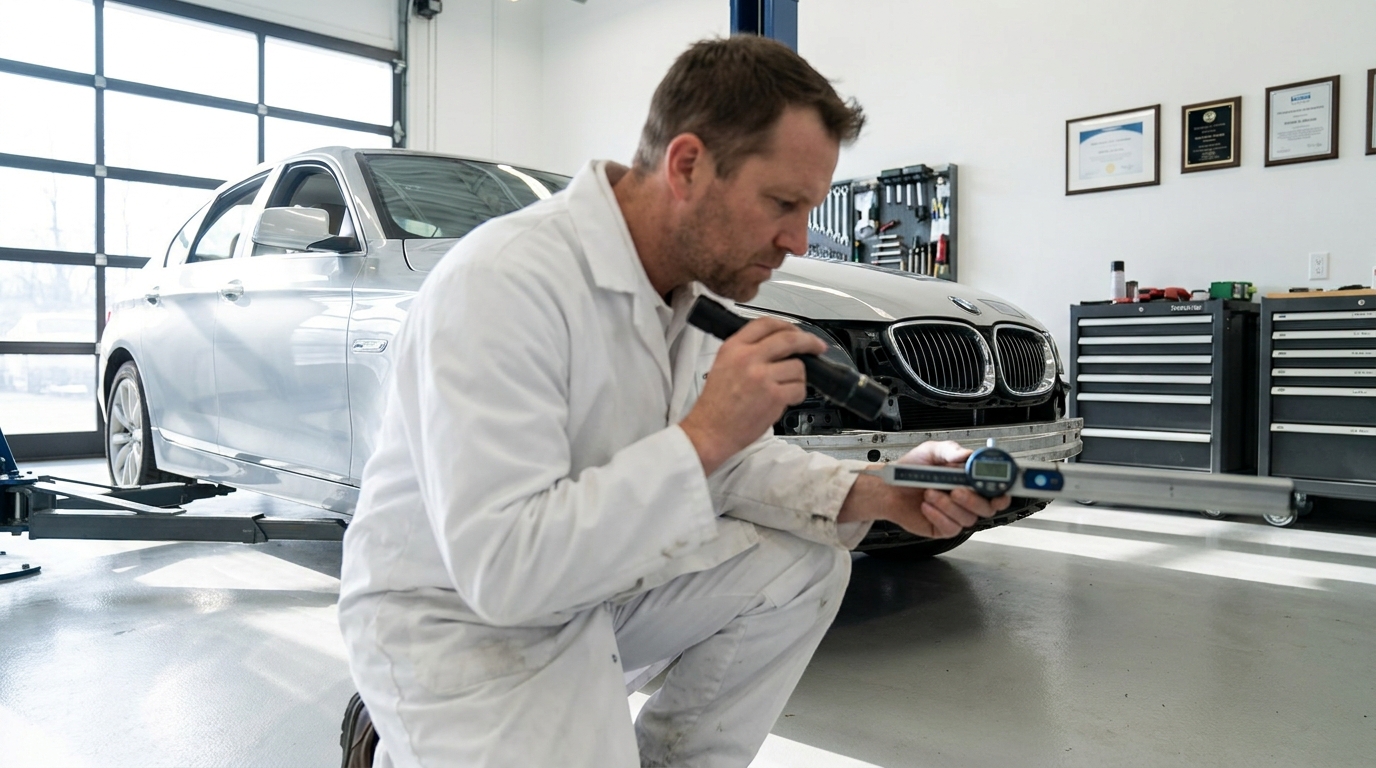
What Does an OEM Certified Collision Center in Los Angeles Actually Mean?
An OEM certified collision center is a shop that a specific automaker has approved to repair its vehicles to factory standards. To earn that designation, the shop must invest in brand-specific equipment, send technicians through the manufacturer’s own training programs, purchase access to factory repair manuals and structural schematics, and pass regular on-site audits. That is a different bar than simply being a good body shop.
The phrase gets misused constantly in LA. Shops describe themselves as “manufacturer certified,” “OEM-quality,” or “factory-trained” when what they really hold is a general industry credential. Before you leave your BMW 5 Series, Porsche Taycan, or Tesla Model S anywhere in the greater Los Angeles area, it pays to understand the difference and verify it yourself.
How Is OEM Certification Different from I-CAR Gold Class or ASE?
I-CAR Gold Class and ASE certifications are the baseline competency credentials in collision repair. They confirm that technicians have general training in repair methods, materials science, and safety procedures. They do not confirm that the shop is approved by your car’s manufacturer, knows your model’s repair procedures, or has the brand-specific equipment your vehicle requires.
Think of it this way: I-CAR Gold Class tells you the shop can repair cars. OEM certification from BMW or Porsche tells you the shop has been vetted by those companies to repair their cars correctly. For a Lucid Air or a Tesla Model S with an aluminum unibody, you need both general competency and brand-specific certification. One without the other leaves critical gaps.
| Credential | What It Confirms | What It Does NOT Confirm |
|---|---|---|
| I-CAR Gold Class | Ongoing technician training in general repair methods | Brand-specific equipment, OEM parts access, manufacturer audits |
| ASE Certification | Technician knowledge across repair disciplines | Brand approval, current OEM repair procedures |
| OEM / Manufacturer Certification | Automaker-approved equipment, training, parts sourcing, and audit compliance | Nothing extra if lapsed, see below |
| OEM + I-CAR Gold | Both general competency and brand-specific factory approval | N/A, this is the correct combination |
How Do You Verify That an LA Shop’s OEM Certification Is Still Current?
This is the step most drivers skip, and it is the most important one. Some shops in Los Angeles display certification plaques, logos, or website badges for programs they once held but have since lost through failed audits, unpaid program fees, or equipment that fell out of compliance. The fix is simple: go directly to the automaker’s official certified-shop locator, enter your ZIP code, and confirm the shop appears there today.
Here is where to verify for the most common luxury and EV brands in LA:
- BMW: BMW’s official “Find a Collision Center” tool at bmwusa.com lets you search by ZIP and confirm Certified Collision Repair Center status.
- Mercedes-Benz: The Mercedes-Benz Certified Collision Centers locator at mbusa.com lists currently approved shops by location.
- Porsche: Porsche’s approved collision center search is available through porsche.com/usa; the list is shorter than most owners expect for the LA area.
- Tesla: Tesla’s scheduling tool at tesla.com/support/body-shop-support lists active Tesla Approved Body Shop Network locations. Tesla is notably strict about audit compliance.
- Audi: The Audi Certified Collision Repair locator is searchable at audiusa.com under Ownership.
- Lucid: Lucid Motors maintains an approved service and collision network listed at lucidmotors.com; the network is still expanding in Southern California.
If a shop you are considering does not appear in your brand’s official locator, that is not a minor paperwork gap. It means the manufacturer has not approved that shop’s current setup. Do not proceed based on a shop’s own marketing.
Why Your Insurer’s Preferred Shop May Not Be Certified for Your Brand
When you file a claim, your adjuster will likely suggest shops from their Direct Repair Program (DRP). DRP shops have pre-arranged agreements with the insurer that prioritize claim processing speed and cost containment. Those agreements have nothing to do with brand-specific OEM certification.
The good news: under California Insurance Code Section 758.5, your insurer cannot require you to use their preferred shop. The law is explicit that an insurer may recommend a shop but may not coerce, penalize, or financially pressure you for choosing your own licensed facility. If an adjuster implies that using a non-DRP shop will cost you more or delay your claim, ask them to put that in writing. They will not, because doing so violates state law.
The practical consequence is this: a DRP shop that is not OEM-certified for your BMW or Porsche may use aftermarket structural components, skip manufacturer-required ADAS recalibration steps, or perform repairs in a shared steel-and-aluminum bay. Any of these can void affected portions of your factory warranty and create safety exposure you will not discover until your automatic emergency braking fails to react in time. For a deeper look at how parts choices affect your claim, see our guide to OEM vs aftermarket vs reconditioned parts and what your insurer pays.
Brand-by-Brand Verification Guide for Los Angeles Drivers
The table below summarizes what each major program requires of certified shops and where to verify current status. This is not an endorsement of any shop; it is a starting framework for your own verification.
| Brand | Program Name | Key Shop Requirements | Verify At |
|---|---|---|---|
| BMW | BMW Certified Collision Repair Center | BMW-specific frame bench, factory scan tool, OEM parts mandate, technician training | bmwusa.com locator |
| Mercedes-Benz | Mercedes-Benz Certified Collision | MB-approved equipment, paint system, OEM parts, ADAS recalibration capability | mbusa.com locator |
| Porsche | Porsche Approved Collision Center | Porsche-specific repair data access, aluminum repair infrastructure, audit compliance | porsche.com/usa locator |
| Tesla | Tesla Approved Body Shop Network | Tesla scan tool, OEM parts sourcing, high-voltage safety training, aluminum bay isolation | tesla.com body shop support |
| Audi | Audi Certified Collision Repair | Audi/VW Group repair procedures, MIG brazing capability, OEM parts, ADAS calibration | audiusa.com ownership |
| Lucid | Lucid Approved Collision Network | High-voltage isolation, aluminum unibody tooling, Lucid diagnostics access | lucidmotors.com |
What Special Infrastructure Does EV and Aluminum Repair Actually Require?
High-end EVs and aluminum-bodied luxury vehicles need physical shop infrastructure that most general collision centers in Los Angeles do not have. Steel particles left in an aluminum repair bay cause galvanic corrosion that weakens the repair over time, so a properly equipped shop runs dedicated, isolated aluminum bays where no steel work is performed. That separation is not optional for vehicles like the Lucid Air, Tesla Model S, or Audi A8.
Beyond bay isolation, a shop certified for EV collision repair needs dedicated battery-handling tables, high-voltage isolation tools, and technicians with manufacturer training in high-voltage safety. Frame benches must be calibrated specifically for aluminum unibody tolerances, which are tighter than steel structures. If a shop cannot describe these specific assets when you ask, it is not equipped for your vehicle. For more on what makes this work different, our post on EV battery damage after a minor accident in Los Angeles covers the structural considerations in detail.
Why ADAS Recalibration Is Non-Negotiable After Any Structural Repair
Every manufacturer-certified program mandates in-house ADAS recalibration using the automaker’s own diagnostic software after any repair that moves a sensor, replaces a bumper cover, or touches structural components. This is not a luxury step. A forward-facing camera misaligned by just 0.6 degrees can meaningfully reduce the reaction time of automatic emergency braking systems. At highway speeds, that margin determines whether a collision is avoided.
Ask any shop you are considering whether they perform ADAS calibration in-house with manufacturer-approved software, or whether they outsource it to a mobile calibration service. In-house is the correct answer for a certified program. Outsourced calibration can introduce delays, documentation gaps, and software version mismatches that the manufacturer’s audit process exists to prevent. Our detailed guide on what a post-repair safety inspection covers explains every system a certified shop should verify before returning your vehicle.
Questions to Ask Before You Commit to Any LA Body Shop
Use this list verbatim. A shop certified for your brand will answer every question clearly and in writing:
- Is your OEM certification for my specific brand current, and can you show me documentation or point me to your listing on the manufacturer’s locator?
- Do you perform ADAS recalibration in-house with manufacturer-approved software, and will that be included in the written repair plan?
- Will you commit in writing to using only OEM parts in structural and safety-critical areas?
- What does your repair warranty cover, how long does it last, and does it apply to both parts and labor?
- Will you handle direct communication with my insurer, including filing supplements if the initial estimate is insufficient?
- What is a realistic turnaround estimate for my specific damage, and what factors could extend it?
- Do you have isolated aluminum repair bays if my vehicle has an aluminum structure or battery pack?
Realistic LA turnaround benchmarks: moderate bumper or panel work typically runs three to seven business days at a certified shop; major structural or specialty luxury and EV repairs often run one to two weeks or longer, particularly when specific OEM parts require ordering from the manufacturer. Any shop that promises unusually fast turnaround on complex structural work is worth scrutinizing.
Common Mistakes to Avoid
- Taking a shop’s website at face value. Logos and badges do not expire on a webpage. Always cross-reference the official manufacturer locator.
- Assuming I-CAR Gold Class equals OEM certification. It does not. General competency and brand approval are separate qualifications.
- Defaulting to your insurer’s DRP list without checking for brand certification. DRP status and OEM certification are independent of each other.
- Skipping the ADAS calibration conversation. Ask explicitly whether it is in-house and manufacturer-software-driven, not just “included.”
- Not getting OEM parts confirmed in writing before work begins. Verbal assurances do not protect you if aftermarket parts show up on the final invoice.
- Ignoring diminished value documentation. A repair done outside a certified program at a non-approved shop can suppress resale value even if the repair looks fine. See our guide on how a body shop documents diminished value in California.
Frequently Asked Questions
What is an OEM certified collision center in Los Angeles?
It is a body shop that a specific automaker has formally approved to repair its vehicles to factory specifications. Earning that status requires brand-specific equipment, factory technician training, access to the manufacturer’s repair manuals, and compliance with periodic on-site audits. It is separate from general credentials like I-CAR Gold Class or ASE certification.
How do I verify that a shop’s OEM certification is still active?
Go directly to the automaker’s official certified-shop or dealer-locator tool online and search by ZIP code or city. If the shop does not appear on the manufacturer’s own list, their certification is either lapsed or was never active. Do not rely on the shop’s own website, printed certificates, or verbal claims.
Can my insurance company force me to use their preferred body shop in California?
No. Under California Insurance Code Section 758.5, your insurer may recommend a shop but cannot require you to use it, cannot penalize you for choosing your own licensed facility, and must process your claim regardless of which licensed shop you select. If an adjuster implies otherwise, ask for that position in writing.
Does a non-certified repair void my factory warranty?
It can. Most manufacturer warranty agreements require repairs in structural and safety-critical areas to be performed using OEM parts and approved procedures. A repair done at a non-certified shop with aftermarket parts can void the factory warranty on affected systems, including ADAS components. Check your owner’s manual and the specific warranty terms for your brand.
How long does certified collision repair take in Los Angeles?
For moderate bumper or panel work, plan on roughly three to seven business days. Major structural repairs, aluminum unibody work, or specialty luxury and EV repairs commonly run one to two weeks or longer, particularly when OEM parts must be ordered directly from the manufacturer. Your shop should give you a written timeline and update you when parts lead times change.
0 Comments