

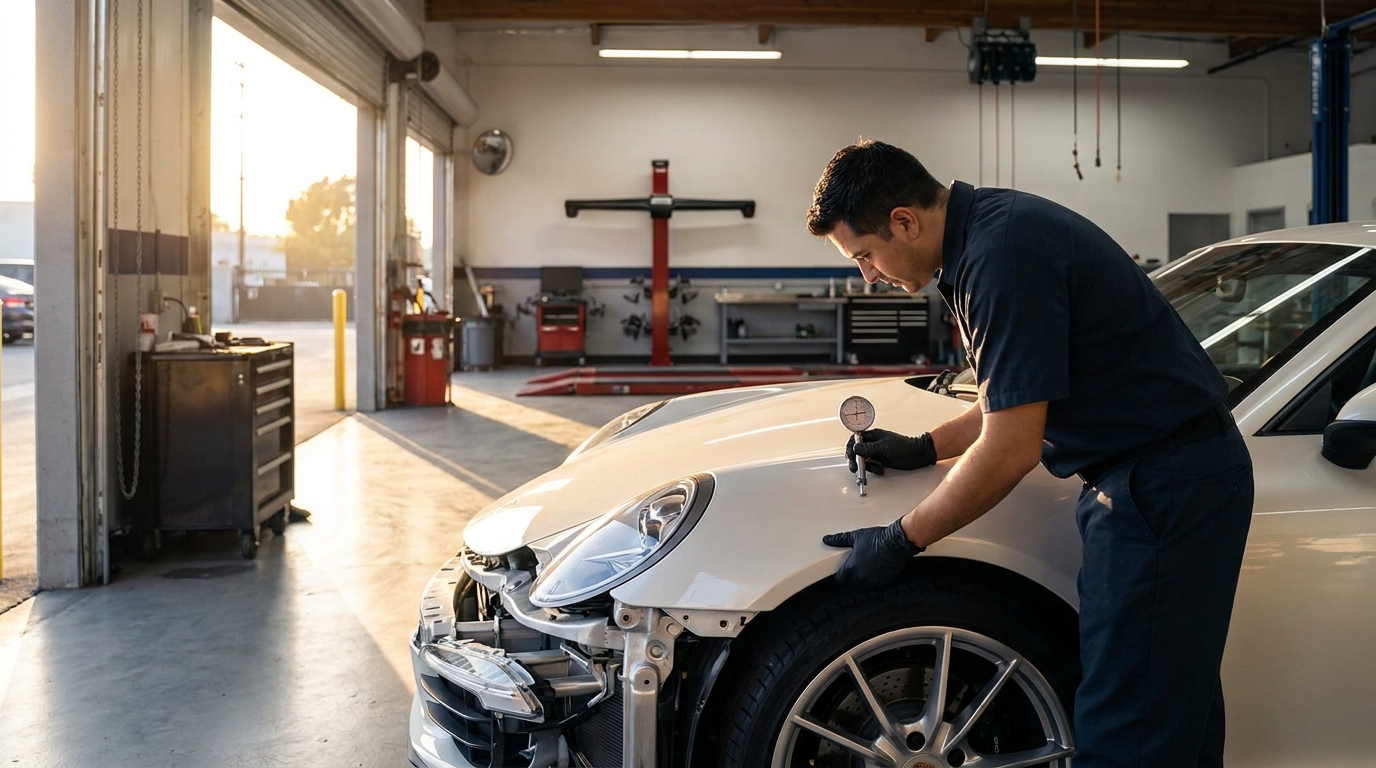
What Is a Porsche Approved Collision Center?
A Porsche Approved Collision Center is a body shop that has been individually selected by Porsche Cars North America (PCNA) to repair Porsche vehicles to factory standards. To earn and keep that designation, a shop must commit to using genuine Porsche parts, materials, tools, and equipment, and must submit to the same full audit every year, not just at initial approval.
That last point matters. Porsche approval is not a one-time credential a shop earns and then coasts on. PCNA annually inspects each facility to verify proper equipment, technician training, cleanliness, and overall shop operation. The renewal audit covers everything the initial audit covered. A shop that let its standards slip would lose its standing in the program. This is why the approved list in Los Angeles stays short: Porsche is selective by design.
What Does Porsche Certification Actually Require a Shop to Have?
Generic “certified” claims from body shops can mean almost anything. Here is what Porsche’s program specifically mandates:
- Porsche Workshop Manual access. Every repair must be assessed and planned using Porsche’s own repair documentation, not generic body-shop software guesses.
- OEM parts procurement. Parts must be sourced through Porsche’s authorized supply network. Non-certified shops cannot access certain key Porsche structural components at all, those parts simply will not be sold to them.
- Approved structural repair equipment. This includes computerized frame straightening systems set to Porsche-specified jigs and fixtures, specialized welding equipment for mixed-material construction (aluminum and high-strength steel together), and paint booths engineered to apply and cure Porsche’s proprietary colors correctly.
- Carbon-fiber repair capability. Models like the 911 GT3, Panamera Sport Turismo, and various Taycan and Cayenne trims use carbon-fiber reinforced components. Approved shops must handle these correctly, which includes knowing when a panel can be repaired versus when it must be replaced entirely. See our full breakdown of carbon fiber repair in Los Angeles for what that process involves.
- ADAS recalibration to factory spec. Every Porsche built in the last several years carries radar, camera, and ultrasonic sensors that control emergency braking, lane-keeping, and adaptive cruise. After any structural or bumper repair those systems must be recalibrated to factory tolerances, not simply reset.
- Continuous factory oversight. Approved centers are monitored by factory technical personnel on an ongoing basis, not just at audit time.
How Do You Verify a Shop Is Actually Approved Right Now?
Do not take a shop’s word for it. Certification status can lapse, and some shops use language like “Porsche-trained” or “Porsche-specialist” that sounds official but carries no program standing. Here is how to confirm independently:
- Go to porschecollisioncenter.com, Porsche’s official Approved Collision Center locator. Enter your ZIP code and view only shops that appear there.
- Cross-check against Porsche’s main website shop-finder at porsche.com using your ZIP or city name.
- Ask the shop to show you its current PCNA certification documentation and confirm the expiration date. Approvals renew annually; a certificate more than 12 months old is a flag.
- Call your nearest Porsche dealer (Porsche Downtown LA, Porsche Beverly Hills, Porsche Santa Clarita) and ask which shops they refer collision customers to. Dealers generally point to shops they know are currently in good standing.
As one LA-area Porsche owner discovered on the Carpokes forum, when he searched the official locator after an accident he found “only a few approved shops in Los Angeles”, far fewer than the number of shops claiming Porsche expertise online. That gap is exactly why you verify through Porsche directly rather than trusting a shop’s own marketing.
Why Is Porsche Collision Repair Different by Model?
Not every Porsche is the same repair challenge. The model on your title changes which skills and tools actually matter.
911 (992 and 991 generations)
The 911 uses a mixed-material body structure combining aluminum-intensive panels with high-strength steel in the safety cage. Aluminum work requires dedicated tools, storage, and welding equipment kept entirely separate from steel repair areas, cross-contamination causes corrosion. A shop set up only for steel body work cannot correctly repair a 911’s front or rear structure. For more context on why aluminum body repair demands a different setup, see our post on OEM certified collision centers in Los Angeles.
Cayenne and Macan
These SUVs carry the most complex ADAS loads in the Porsche lineup: front radar, surround cameras, parking sensors, and on newer trims night-vision and head-up display systems. A fender-bender that moves a radar bracket even a few millimeters can push the adaptive cruise system out of spec. ADAS recalibration after any front or rear structural repair is not optional, it is a safety requirement. Our dedicated post on what ADAS calibration actually costs (written for Tesla but directly applicable here) walks through why calibration bills add to every modern luxury-vehicle repair.
Panamera
The Panamera’s size and long wheelbase make frame geometry measurements more complex. Porsche-approved jigs and computerized measuring systems designed to the Panamera’s specific geometry are the only way to confirm a structural repair returned the car to factory tolerances. An incorrect measurement that looks close on paper can show up as uneven tire wear or degraded handling months later.
Taycan (EV)
The Taycan adds high-voltage system isolation to the collision-repair checklist. Before any structural work, the battery must be safely isolated. After repair, the vehicle requires both standard ADAS recalibration and high-voltage system verification. Not all Porsche-approved shops are yet fully equipped for Taycan EV-specific steps, ask explicitly when you call.
| Model | Key Repair Complexity | Specific Requirement |
|---|---|---|
| 911 (991/992) | Mixed aluminum/steel structure | Dedicated aluminum repair bay, Porsche-approved jigs |
| Cayenne / Macan | Dense ADAS sensor load | Full multi-sensor recalibration after any front/rear work |
| Panamera | Long wheelbase frame geometry | Computerized measuring to Panamera-specific tolerances |
| Taycan | High-voltage EV system + ADAS | HV isolation, battery check, plus full ADAS recalibration |
| 718 Cayman / Boxster | Sport-tuned geometry | Precise alignment verification post-structural repair |
What Does Porsche Collision Repair Cost in Los Angeles?
LA-area auto body labor rates are among the highest in the country, regularly exceeding $150 per hour at certified shops. That baseline, combined with Porsche OEM part prices and mandatory calibration, pushes repair totals well above what a generic estimate might suggest.
To put that in perspective: a single hood repaint at a high-cost metro shop typically runs 6 to 10 labor hours, putting the paint-and-materials cost alone at $500 to $900 before parts. Replace that hood with a Porsche OEM panel rather than repainting it, add primer and color matching, and the bill climbs further. Add front-radar recalibration after a front-end collision and you are looking at another $300 to $600 in diagnostic and calibration time.
| Repair Type | Generic LA Shop (est.) | Porsche Approved Center (est.) | Key Cost Driver |
|---|---|---|---|
| Bumper repair and repaint | $600 – $1,200 | $1,000 – $2,000+ | OEM bumper cover + sensor recalibration |
| Front-end collision (hood, fenders, radiator support) | $3,000 – $6,000 | $6,000 – $14,000+ | Aluminum structure, OEM parts, ADAS recal |
| Rear-end collision (quarter panel, trunk lid) | $2,500 – $5,000 | $5,000 – $12,000+ | Rear radar/camera recalibration + OEM parts |
| Side-impact (door, rocker, quarter panel) | $2,000 – $5,000 | $4,500 – $10,000+ | Mixed-material structure, color match complexity |
| Full repaint (Porsche exclusive color) | $4,000 – $7,000 | $8,000 – $15,000+ | Porsche-approved paint materials, multi-stage blending |
These are realistic ranges, not worst-case figures. Total-loss thresholds in California are also worth knowing: if the repair estimate approaches or exceeds the vehicle’s actual cash value, your insurer may declare it a total loss rather than authorize repairs. For a late-model 911 or Cayenne, that threshold is high, but for an older 991 or Macan, a severe front-end hit can get close. Our post on rear-end collision repair costs in Los Angeles goes deeper on how estimates are built line by line.
Do You Have to Use Your Insurer’s Preferred Shop for a Porsche Repair in California?
No. Under California Insurance Code Section 758.5, your insurer cannot require you to use a specific repair facility. The law explicitly prohibits insurers from requiring policyholders to use a preferred shop, and it also bars them from penalizing you, through slower claim processing, reduced payouts, or coverage threats, for choosing an independent or OEM-certified shop instead.
This matters enormously for Porsche owners. Insurance Direct Repair Programs (DRPs) are built around cost control for the insurer, not around what your vehicle needs. A shop in a DRP network has agreed to work within the insurer’s pricing guidelines, which can mean pressure to use aftermarket or non-OEM parts, skip calibration steps, or complete repairs faster than is appropriate for a vehicle of Porsche’s structural complexity.
Here is how to hold your ground:
- Choose your shop first, then notify your insurer. California law confirms that if you elect to use a different shop than the insurer recommends, the insurer cannot limit or discount reasonable repair costs based on what their preferred shop would have charged.
- Request OEM parts in writing. Put it in your claim correspondence. Your insurer cannot mandate aftermarket parts without your agreement, and a Porsche-approved shop will write OEM parts into its estimate by default.
- Watch for steering language. If an adjuster says “we can only guarantee the work at our preferred shop” or “your claim may take longer if you use a different shop,” those statements can constitute illegal steering under California law. Ask them to put any such claim in writing, they rarely will.
- File a CDI complaint if needed. The California Department of Insurance investigates unfair claims practices and anti-steering violations. Keep notes of every conversation: adjuster name, date, and exactly what was said.
- Use the supplement process. If the insurer’s initial estimate is lower than the Porsche-approved shop’s written estimate, the shop and insurer negotiate supplements directly. You generally do not pay the difference out of pocket when the repair is necessary and properly documented.
Where Are Porsche Approved Collision Centers Located Across the LA Metro?
Approved shops are distributed across the metro, which matters for Porsche owners concentrated in Beverly Hills, West LA, the Wilshire Corridor, DTLA, Burbank, and the San Fernando Valley. Verified locations currently operating in the network include shops in Burbank, North Hollywood, Silver Lake/East LA, Downey, and areas near Inglewood/LAX. Porsche Downtown LA officially partners with an approved center for its collision referrals.
Because the list is short and approval can change year to year, always confirm current status through porschecollisioncenter.com before dropping your car off. A shop that was approved last year may not be today, and vice versa, new approvals do get added as shops complete the certification process.
Common Mistakes to Avoid
- Trusting a shop’s self-claimed “Porsche certified” status without verifying on porschecollisioncenter.com. “Porsche-trained” and “Porsche-approved” are not the same thing.
- Letting the insurer schedule the repair before you choose a shop. Once your car is at a DRP shop and teardown has started, switching becomes logistically complicated.
- Accepting an estimate that omits ADAS recalibration. If a front or rear collision moved any sensor bracket, calibration is required for safety, not optional. An estimate without it is incomplete.
- Skipping the diminished value conversation. Even a perfectly repaired Porsche loses market value after a recorded collision. California allows diminished value claims against the at-fault party. Document this before you sign off on the repair.
- Choosing a shop based only on location or wait time. An approved shop in Burbank is worth the drive from Beverly Hills if the alternative is an uncertified shop that cannot access OEM structural components.
- Not confirming Taycan/EV readiness explicitly. Not every Porsche-approved shop has completed EV-specific high-voltage training. Ask before you tow.
Frequently Asked Questions
What does “Porsche Approved Collision Center” actually mean?
It means the shop has been individually selected by Porsche Cars North America and has committed to using genuine Porsche parts, materials, tools, and equipment, following Porsche Workshop Manual procedures, and submitting to annual facility inspections. It is the only designation backed by PCNA’s own audit process, other labels like “Porsche-specialist” or “Porsche-trained” carry no program accountability.
How do I find a verified Porsche approved collision center in Los Angeles?
Go to porschecollisioncenter.com and enter your ZIP code. That is Porsche’s official locator and the only source that reflects current program membership. Cross-check with your local Porsche dealer’s collision referral list. Do not rely solely on a shop’s own website claim.
Can my insurance company make me use their preferred shop for my Porsche?
No. California Insurance Code Section 758.5 prohibits insurers from requiring you to use a specific repair facility. They can recommend a shop, but they cannot mandate one or penalize you for choosing a Porsche-approved center instead. If they try, that can constitute illegal steering, document it and file a complaint with the California Department of Insurance if needed.
Why does Porsche collision repair cost more in Los Angeles than a generic estimate suggests?
Three factors compound: LA metro labor rates that regularly exceed $150 per hour at certified shops, Porsche OEM part prices (which run significantly higher than aftermarket equivalents), and mandatory ADAS recalibration costs that generic estimates often omit entirely. A complete front-end repair on a Cayenne or 911 that looks like a $4,000 job at a generic shop can legitimately reach $10,000 or more at an approved center once all three factors are accounted for.
Does Porsche certification cover the Taycan EV?
The Porsche Approved Collision Center program covers all Porsche models including the Taycan. However, EV-specific work, high-voltage system isolation, battery inspection, and HV-system verification post-repair, requires additional training beyond standard certification. Ask any approved shop explicitly whether their technicians are trained and equipped for Taycan EV repair before authorizing work.
0 Comments