

What Happens When Your Stolen Car Is Found Damaged in Los Angeles?
Your stolen car was recovered damaged in Los Angeles, comprehensive coverage is the policy that pays, and you owe the deductible whether the car is repaired or totaled. That is the short answer every insurer will give you. What they will not tell you is what a body shop actually finds when the car rolls in, what that damage costs to put right, and how a California title brand can quietly erase thousands in resale value even after a flawless repair.
The LA theft context matters. The Los Angeles-Long Beach-Anaheim area recorded 66,565 vehicle thefts in 2024, the highest total of any metro in the country. In California overall, 84.59 percent of stolen vehicles were successfully recovered in 2024. According to NICB data, 34 percent of recovered stolen vehicles come back the same day as the theft, and 45 percent are recovered within two days. In other words, most stolen LA cars do come back, and most come back damaged.
Who Pays for a Recovered Stolen Vehicle’s Damage?
Comprehensive coverage pays, not liability, not collision. Comprehensive is the only part of an auto policy that covers theft and theft-related damage to a recovered vehicle. Your comprehensive deductible applies regardless of how extensive the damage is.
There is one pivotal timing issue that determines who owns the car after recovery. If the car is found before the insurer has issued a total-loss settlement, the claim converts to a comprehensive repair claim: you pay the deductible and keep the car. If it is found after a total-loss check has been issued, the insurer now owns the vehicle. That window between theft and settlement is typically one to four weeks, insurers deliberately hold the claim open to see whether the car surfaces.
| Recovery Timing | What Happens | Who Gets the Car |
|---|---|---|
| Found before total-loss settlement | Claim converts to comprehensive repair; you pay deductible | You keep the car |
| Found after total-loss settlement | Insurer owns the vehicle; you keep the settlement check | Insurer (then typically auctioned) |
| Repair cost exceeds ACV | Insurer declares total loss; salvage title issued | Insurer, unless you buy it back |
Personal belongings are a separate matter. A laptop, phone, or child’s car seat left in the stolen vehicle is not covered by your auto policy. That claim goes through renters or homeowners insurance, with its own deductible, and coverage is sometimes capped. File that claim separately, do not assume the auto adjuster will mention it.
Custom and aftermarket parts (upgraded audio, custom wheels, non-factory accessories) are generally excluded from standard comprehensive unless you added Custom Parts and Equipment (CPE) coverage. If you did not, those items typically are not reimbursed at replacement cost.
What Does a Body Shop Actually Find on a Theft-Recovered Car in LA?
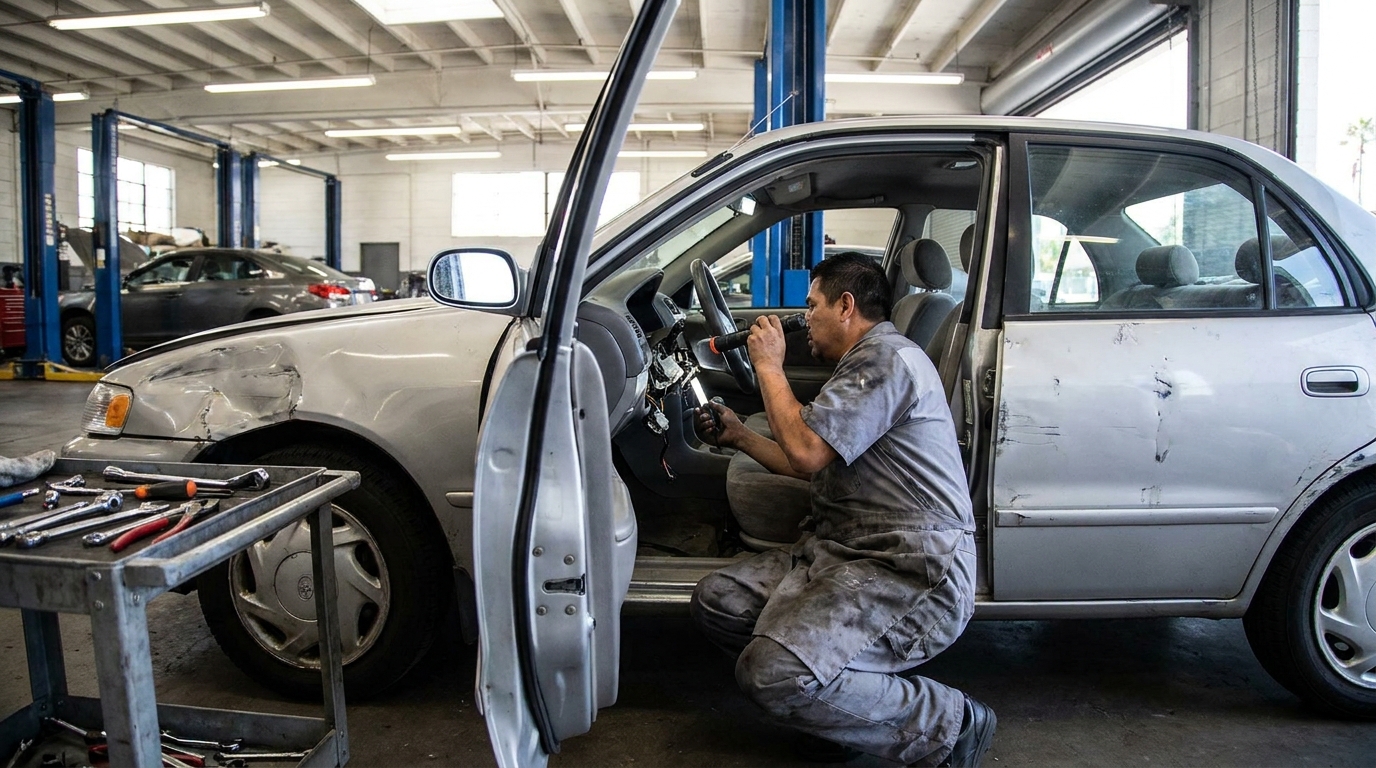
This is the section no insurer’s FAQ covers. When a theft-recovered vehicle arrives at our shop, the visible exterior damage is rarely the whole picture. Here is the layered scope we check for:
Ignition and Steering Column Damage
Getting the car started is the thief’s first task. Thieves often damage ignition systems while stealing vehicles, steering column covers are pried off, ignition cylinders are pulled, and wiring harnesses are cut. On a common domestic vehicle, a faulty ignition lock cylinder or ignition switch replacement typically runs $200 to $500 in combined parts and labor. A full column replacement is a different story: replacing the entire steering column assembly is generally necessary after significant damage from a theft attempt, and the total cost typically falls between $530 and $1,550. On a European luxury vehicle that figure can be considerably higher, and key reprogramming adds to the bill on any car with a transponder or push-button start system.
Stripped Parts, The LA Theft Pattern
Los Angeles has an organized parts-stripping problem that goes well beyond the smash-and-grab. Here is what a recovered LA car is most likely to be missing:
- Catalytic converter: Replacement plus welding runs $800–$3,500 depending on make; hybrids and luxury vehicles are at the top end. See our dedicated guide on what stripped-parts repair involves after vehicle damage in Los Angeles for broader context.
- Wheels and tires: A set of four factory alloys can run $1,200–$4,000 plus TPMS sensor reprogramming.
- Airbags: A stolen driver’s airbag module is $400–$1,200 in parts alone; the steering wheel and clock spring often need replacement too, plus module reset.
- Headlights and tail lights: OEM assemblies on modern vehicles frequently contain ADAS cameras and require calibration after installation, budget $300–$1,500 per assembly.
- Infotainment screens and audio: Factory head units run $500–$2,500; aftermarket units are typically not covered unless you have CPE coverage.
- Battery: A common target, especially on hybrids and EVs, replacement ranges from $150 for a 12V to several thousand for a high-voltage pack.
Joyride Collision and Body Damage
Thieves drive recklessly. Curb strikes, scraped panels, bent wheels, broken mirror housings, and bumper damage from low-speed impacts are routine. We regularly see cars arrive with damage on two or three separate panels that have nothing to do with how the car was originally taken. Each of those impacts needs to be documented as part of the comprehensive claim, not buried as a separate collision event. Our post on fender bender repair costs in Los Angeles shows how quickly individual panel damage adds up.
Interior Vandalism
Kicked door panels, slashed seats, broken window regulators, pried trim, and smashed rear-view mirrors are common. Interior component theft targets leather seats, steering wheels, and trim panels, seats cost $300–$800 each, steering wheels $200–$600, and dashboard trim varies widely.
What Does a Theft-Recovery Repair Cost in Los Angeles?
There is no single number, because every recovered car presents a different combination of damage layers. The table below reflects realistic ranges at an LA-area body shop for the most common theft-recovery repair scopes:
| Repair Item | Typical LA Cost Range | Notes |
|---|---|---|
| Ignition cylinder / switch replacement | $200–$500 | Add $150–$400 for key reprogramming |
| Full steering column replacement | $530–$1,550+ | Higher on European/luxury vehicles |
| Catalytic converter replacement | $800–$3,500 | Hybrids and luxury at top end |
| Wheel and tire set (4) | $1,200–$4,000 | Add TPMS reprogramming |
| Airbag module replacement + reset | $600–$1,800 | Steering wheel / clock spring often added |
| Headlight assembly with ADAS calibration | $300–$1,500 each | Calibration is mandatory after replacement |
| Window glass (per pane) | $200–$600 | More on quarter glass or panoramic roofs |
| Panel and bumper body repair (per panel) | $400–$1,800 | Joyride collision damage |
| Interior: seats, trim, door panels | $300–$2,500+ | Varies by material and OEM availability |
A moderate theft-recovery repair in LA, ignition, one missing catalytic converter, smashed window, two scuffed panels, can easily land at $4,000–$8,000 before paint. A heavily stripped car with airbag and wheel theft can exceed $15,000, pushing the total toward a total-loss declaration.
What Should You Do First, and in What Order?
The sequence matters both for the claim and for preserving your rights:
- Get the police report number. When the car is found, LAPD or the recovering agency will issue a report. Get that number before anything moves.
- Call your insurer immediately. Notify them the vehicle has been located. This triggers the pivot from theft claim to repair claim and stops the total-loss clock.
- Have the car towed to an independent body shop for a complete estimate, not the insurer’s preferred shop. Under California law, you have the right to choose your own repair facility. An insurer cannot legally require you to use a specific shop.
- Photograph everything before any cleaning or temporary repairs. Document every missing part, every damaged surface, and every interior item.
- File a separate renters/homeowners claim for any personal property stolen from the vehicle.
The Title Brand Problem Nobody Warns You About
This is the angle insurers almost never discuss when they hand you a repair-claim approval. Stealing a car can brand its title, and branded-title cars sell for lower prices than identical cars with clean titles. In California, the official term for a repaired and re-inspected salvage vehicle is “Revived Salvage.” California’s official term for a repaired, re-inspected salvage vehicle is Revived Salvage, and that brand stays on the title permanently.
Salvage and rebuilt title cars sell for 20–40 percent less than the same vehicle with a clean title. CarMax and Carvana both explicitly refuse branded titles, you cannot sell to them. Even if the repair is flawless, the brand follows the car through every future VIN check. That gap between what your car is worth with a clean title and what it is worth post-theft is called diminished value, and it is a legitimate California claim. A body shop can document the pre-theft value, the branded-title market discount, and the specific damage history to support a diminished value demand against the at-fault party or, in some cases, your own insurer. Our post on what a total-loss threshold looks like in Los Angeles explains how insurers make that call and what your options are if the numbers are close.
Should You File a Claim or Pay Out of Pocket?
If the total repair cost is only moderately above your comprehensive deductible, run the numbers before you file. A claim on your record can raise premiums for three to five years. If your deductible is $1,000 and the total repair is $1,400, paying out of pocket may cost less over time than the premium increase. However, if the damage involves the ignition system, missing catalytic converter, airbags, or multiple panels, the repair will almost always clear $3,000–$5,000, making the claim worth filing.
Common Mistakes to Avoid
- Moving the car before photographing everything. Once parts are cleaned or inventoried by a tow yard, the evidence of exactly what was taken and what was damaged is gone.
- Assuming the insurer’s first estimate is complete. Adjusters often miss interior damage, ADAS calibration costs, and secondary panel damage from joyriding. Always get an independent shop estimate and request a supplement if the adjuster’s number is low.
- Forgetting about personal property. Your auto policy does not cover the laptop, the car seat, or the sunglasses. File a separate renters or homeowners claim promptly.
- Skipping key reprogramming. Even if the car runs fine, a compromised ignition system or transponder can cause intermittent no-start issues months later. Full reprogramming is non-negotiable.
- Ignoring ADAS calibration after part replacement. Any camera or sensor disturbed during theft, by the thief or by the repair, requires recalibration. Skipping it creates a safety liability and may void coverage on a future claim.
- Not asking about diminished value. If the theft resulted in a title brand, that financial loss is real and may be claimable. Ask your shop to document it before you close the claim.
- Using aftermarket parts without checking your CPE coverage first. If your policy does not include Custom Parts and Equipment coverage, the insurer will pay OEM replacement value only, not the upgraded value of anything you added.
Frequently Asked Questions
Does comprehensive insurance cover all damage to a stolen car that was recovered?
Comprehensive covers theft-related damage including broken ignitions, smashed windows, damaged steering columns, stolen factory-installed parts, body damage from joyriding, and vandalism. It does not cover personal belongings inside the car (use renters or homeowners insurance), aftermarket or custom parts unless you have CPE coverage, or rental car costs during repairs unless you separately added loss-of-use coverage to your policy.
What if my recovered car is declared a total loss in California?
If repair costs exceed the insurer’s total-loss threshold relative to the car’s actual cash value (ACV), the insurer issues a salvage certificate. You can accept the settlement and surrender the car, or in some cases buy it back at salvage value and repair it yourself. If the car is bought back and repaired, it will carry a Revived Salvage brand in California permanently, which reduces resale value by 20–40 percent even after a quality repair.
Can I choose my own body shop in California for a theft-recovery repair?
Yes. California law gives you the right to select any licensed repair facility. Your insurer can suggest preferred shops but cannot legally require you to use one. If the shop you choose identifies damage the insurer missed, the shop can file a supplement to increase the approved repair amount. This is especially important on theft-recovery vehicles where damage scope is often underestimated in the initial estimate.
How long does a theft-recovery repair take in Los Angeles?
A straightforward theft-recovery repair, ignition, one or two panels, window glass, typically takes five to ten business days. A heavily stripped car needing a catalytic converter, wheels, airbag module, and multiple body panels can run three to six weeks, partly due to OEM parts availability in LA. If ADAS calibration is required after headlight or sensor replacement, budget extra time for that appointment.
Can I claim diminished value after my stolen car is recovered and repaired?
In California, diminished value claims against a third party are well established. If the theft resulted in a title brand or documented structural/mechanical damage, the gap between your car’s pre-theft market value and its post-repair value with a branded title is a real financial loss. A body shop can prepare documentation of the damage scope and value impact to support your claim. Note that first-party diminished value claims against your own comprehensive policy are more difficult to pursue in California and are not guaranteed.
0 Comments