

What Does Rear-End Collision Repair Cost in Los Angeles?
The honest answer: rear-end collision repair cost in Los Angeles starts around $500 for a bumper cover scuff and routinely climbs past $5,000 once a shop tears down the repair and finds what the impact actually hit. Most real SoCal repairs land in the $1,000–$5,000 range, but jobs involving structural damage, multiple panels, or modern driver-assistance sensors regularly exceed that. The first estimate you receive is almost always incomplete, and LA’s higher labor rates make that gap wider than it would be elsewhere in the country.
The sections below break down cost by damage tier, explain what a tear-down inspection uncovers, walk through ADAS sensor recalibration costs specific to rear impacts, and explain the supplement process in plain language, all from the shop’s perspective, not a law firm’s.
Why Does LA Charge More Than Other Markets?
Location is the single largest variable in a collision estimate. Real-world data from 162 SoCal repair estimates shows labor rates ranging from $56 per hour in Van Nuys to $98 per hour in West Hollywood, a 75% gap for the exact same type of work within the same metro area. Shop overhead, rent, certification costs, and local market demand all feed into that number. A shop in Beverly Hills or West LA simply operates at a higher cost basis than one in the San Fernando Valley, and that difference goes directly onto your estimate.
Over half of every dollar spent on a collision repair goes to labor, not parts. That makes the hourly rate the most important number on any estimate. LA-area rates generally run $85–$150 per hour for certified collision work, with premium-certified shops (those holding manufacturer authorizations for brands like BMW, Mercedes-Benz, or Tesla) at the higher end. Rates can differ 30–40% between shops just a few miles apart, which is why two estimates on the same car can look dramatically different.
Stop-and-go freeway traffic on the 405 and 101 means rear-enders in LA are constant, but LA body shops also deal with a uniquely dense luxury-vehicle market. Repairing a Lexus or Cadillac can cost roughly three times what the same job costs on a comparable Honda, because parts prices, OEM procedures, and recalibration requirements all scale with vehicle complexity.
What Are the Damage Tiers and What Does Each One Cost?
Every rear-end collision falls into one of four damage tiers. The visible damage on the surface tells you almost nothing about which tier you are in, that is what the tear-down inspection is for.
| Damage Tier | What’s Affected | Typical LA Cost Range |
|---|---|---|
| Tier 1: Cosmetic Only | Bumper cover (paint, scuffs, small cracks); no structural contact | $500 – $1,500 |
| Tier 2: Bumper System | Cover + reinforcement bar and/or foam absorber replaced; possible sensor removal/reinstall | $1,200 – $3,000 |
| Tier 3: Multi-Panel + Sensors | Quarter panel, trunk lid, tail lights, frame rail kink, plus ADAS recalibration | $3,000 – $7,500 |
| Tier 4: Structural / Frame | Rear frame rails, floor pan, unibody distortion; may require partial replacement | $6,000 – $12,000+ |
Tier 4 repairs that exceed roughly 70–75% of the car’s actual cash value will trigger a California total-loss evaluation. At that threshold, your insurer may declare the car a total loss rather than authorize the repair. If you are approaching that number, read about what to do after a car accident in Los Angeles before signing anything.
Quarter-panel damage, common when a rear-ender pushes the bumper into the body, typically runs $1,500–$4,000 on its own, depending on whether the panel can be repaired in place or must be replaced. The full decision framework is covered in our Quarter Panel Repair in Los Angeles guide.
What Does a Rear-End Tear-Down Inspection Actually Find?
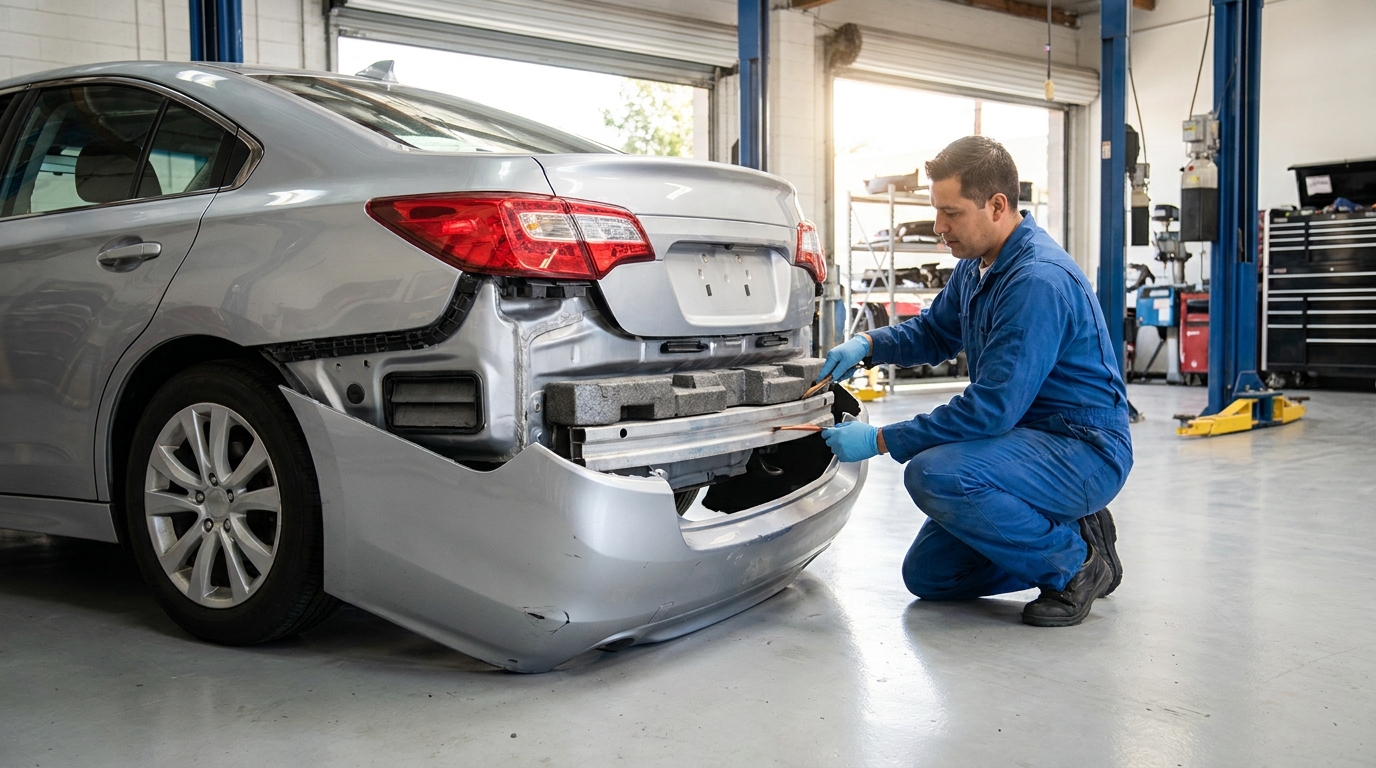
The first estimate, whether written by an insurance adjuster at the curb or a shop technician looking at the outside of the car, is based on visible damage only. The real inspection happens after a technician removes the bumper cover. Here is what a proper tear-down checks, in order:
- Bumper reinforcement bar: The steel or aluminum bar behind the cover absorbs energy. Even a 10 mph hit can bend or crack it with no visible sign on the cover. A bent reinforcement bar means the cover alone is never the right fix.
- Foam or plastic energy absorber: Sits between the cover and the reinforcement bar. Designed to crush on impact. Once crushed, it must be replaced, it does not spring back.
- Trunk seal and trunk floor: A hard enough push sends force through the bumper system into the trunk opening. A misaligned trunk gap or a broken seal means water intrusion and, eventually, rust.
- Rear frame rails: These run front-to-back along the underside of the vehicle. Even a moderate impact can kink a rail without any panel damage being visible. A kinked frame rail affects suspension geometry and makes the car unsafe to drive until straightened or replaced.
- Rear sensors and cameras: Backup cameras, parking sensors, blind-spot radar modules, and rear cross-traffic alert sensors are mounted in or behind the rear bumper. Any one of them can be physically damaged or knocked out of alignment by the same impact that dented the cover.
A shop that skips the tear-down and writes an estimate from the outside is handing you an incomplete number. In LA, where labor rates mean every additional hour found in a supplement adds $85–$150 to the bill, the gap between the initial estimate and the final bill can be substantial.
How Much Does ADAS Recalibration Add to a Rear-End Repair?
This is the cost category almost no one expects, and it is now standard on rear-end repairs for any vehicle built after roughly 2017. Modern rear bumpers house backup cameras, ultrasonic parking sensors, blind-spot radar modules, and rear cross-traffic alert sensors, and a rear impact disturbs all of them at once.
Recalibration is not optional. A sensor misaligned by just one degree translates to roughly a 20-foot error in detection at highway speed. The systems appear to work normally from the driver’s seat, the dashboard shows no warning lights, but the safety margin has been silently eliminated. Skipping recalibration after a covered repair can also give an insurer grounds to dispute a future claim if one of those systems fails to prevent another crash.
| ADAS System | Typical Recalibration Cost (LA Market) | Notes |
|---|---|---|
| Backup camera | $250 – $350 | Required any time the camera mount, bumper cover, or trunk lid is disturbed |
| Blind-spot radar (per side) | $200 – $450 | Sensors mounted inside rear bumper fascia; often damaged in direct hits |
| Rear cross-traffic alert | Typically bundled with blind-spot cal | Shares radar modules with BSM on most vehicles |
| 360-degree surround-view camera | $350 – $550 | Requires controlled lighting and target placement; often missed initially |
| Multi-system calibration (2+ systems) | $400 – $800 | Common on 2020+ vehicles with full ADAS suite |
On a vehicle with a full ADAS suite, calibrations alone can add $600–$1,200 to a repair that looked like a simple bumper job. That is before any physical sensor replacement. If a radar module was cracked in the impact, the part itself runs $300–$800 depending on the make, plus labor to install and calibrate it. To understand the full scope of what calibration involves and why it is required, see our detailed guide on ADAS calibration after collision repair.
What Is a Supplement and Why Is It Almost Inevitable After a Rear-End Hit?
A supplement is an additional repair authorization the shop requests from the insurer after hidden damage is found during tear-down. It is not a scam, it is a structural feature of how collision estimating works, and it is especially common on rear-end repairs because so much of the damage is behind the bumper cover.
Here is how the process works in California:
- The insurer writes an initial estimate based on visible damage, often for the bumper cover and paint only.
- The shop tears down the repair and finds additional damage, a bent reinforcement bar, a kinked frame rail, a cracked sensor bracket, or a trunk seal that no longer closes square.
- The shop documents the additional damage with photos and line-item detail, then submits a supplement request to the insurer.
- Under California law, the insurer is required to restore your vehicle to its pre-accident condition. If additional damage is found during repair, the shop contacts the insurer for approval of the added cost. The insurer may send an adjuster to re-inspect.
- Repair resumes once the supplement is approved. In straightforward cases this takes one to three business days; complex structural jobs can involve multiple rounds.
The supplement process is why a “minor” rear-end hit in LA that comes in at an initial $1,800 estimate can leave the shop at $5,500 or higher once the tear-down is complete. This is not price gouging, it reflects what the impact actually did to the vehicle. For a deeper explanation of how supplements work and how to track them, see What Is a Supplement in Collision Repair?
OEM vs. Aftermarket Bumper Parts: Which Should You Choose?
The rear bumper system, cover, reinforcement bar, absorber, and sensor brackets, is a crash-management component, not just body trim. The choice of parts matters more here than on a quarter panel or door skin.
- OEM bumper cover and reinforcement: Manufactured to the vehicle’s exact specifications. Sensor mounting holes are pre-drilled in the correct location. Paint adhesion and texture match the rest of the car. Required by most OEM certification programs. Cost is 20–40% higher than aftermarket.
- Aftermarket bumper cover: Can fit adequately on older or high-volume vehicles (Honda Accord, Toyota Camry). Quality varies widely by supplier. Sensor mounting points may be off by millimeters, which creates recalibration problems or requires additional drilling. Some automakers’ position statements explicitly do not approve aftermarket covers for vehicles with sensors mounted in the bumper.
- Recycled/OEM-pull bumper cover: A used OEM part from a salvage vehicle. Can be a sound middle ground on older cars where new OEM parts are expensive. Must be inspected for prior damage and paint-adhesion condition before use.
Roughly 60% of SoCal repair estimates use OEM parts exclusively. Insurance policies in California are required to restore the vehicle to pre-loss condition, which means if the insurer proposes aftermarket parts and you want OEM, you have the right to negotiate. For the full breakdown of how that conversation works, see our guide on OEM vs. Aftermarket vs. Reconditioned Parts: What Your Insurer Pays.
Common Mistakes to Avoid After a Rear-End Collision in Los Angeles
- Accepting an estimate written without a tear-down. A curbside or photo estimate cannot account for what is behind the bumper cover. Always get a full tear-down inspection before authorizing repair.
- Skipping sensor recalibration to save money. The backup camera and blind-spot system may appear to work normally with no dashboard warning, but could be misaligned. This creates real safety risk and can complicate a future insurance claim.
- Choosing the insurer’s preferred shop to avoid hassle. In California, you have the right to choose any licensed body shop. The insurer must pay reasonable costs to restore your car to pre-accident condition, regardless of which shop you use.
- Ignoring trunk seal and gap inspection. A rear-end hit that moves the trunk opening even slightly can allow water intrusion that will cause rust and electrical problems months later, none of which will be covered by your claim after the fact.
- Approving aftermarket sensor-mounting brackets without review. Sensor holes on aftermarket parts are not always in the correct location. A bracket that is off by a few millimeters can prevent accurate recalibration or void an OEM calibration warranty.
- Not asking about diminished value. A properly repaired car still carries a collision history on its CARFAX. California allows you to pursue a diminished-value claim against the at-fault party’s insurer. A good shop can document the pre- and post-repair condition to support that claim.
Frequently Asked Questions
How much does rear-end collision repair cost in Los Angeles on average?
Most real SoCal rear-end repairs land between $1,000 and $5,000 once tear-down is complete. Simple bumper cover scuffs with no structural contact run $500–$1,500. Jobs involving the reinforcement bar, frame rails, multiple panels, or ADAS recalibration regularly reach $5,000–$8,000. LA labor rates of $85–$150 per hour push totals higher than the national average for the same scope of work.
Why is my repair bill higher than the first estimate?
The first estimate is written from visible damage only. Once a technician removes the bumper cover, they often find a bent reinforcement bar, a crushed absorber, trunk misalignment, sensor damage, or a kinked frame rail that was not visible from the outside. The shop submits a supplement to the insurer for the additional damage. This is standard practice and required under California law, the insurer must restore the vehicle to pre-accident condition.
Do I need ADAS recalibration after a rear bumper repair?
Yes, on any vehicle with a backup camera, parking sensors, blind-spot monitoring, or rear cross-traffic alert. These sensors are mounted in or behind the rear bumper. Even removing and reinstalling the bumper cover without any physical sensor damage requires recalibration, because the sensor’s precise angular position may have shifted. Expect to add $250–$800 per system to your repair cost.
Can I choose my own body shop in California after a rear-end accident?
Yes. California law gives you the right to choose any licensed body shop for your repair. Your insurer cannot require you to use a specific shop, and it must pay the reasonable costs to restore your vehicle to pre-accident condition at the shop of your choice. If the insurer’s initial payment is lower than the shop’s estimate, the supplement process exists specifically to resolve that difference.
Does a rear-end collision repair show up on CARFAX and affect my car’s value?
Collision repairs that go through insurance are typically reported to vehicle history services. A CARFAX showing a rear-end collision will reduce the car’s resale value even after a perfect repair, this is called diminished value. In California, you may have the right to pursue a diminished-value claim against the at-fault driver’s insurer. A body shop can document the repair scope and quality to support that claim.
0 Comments