

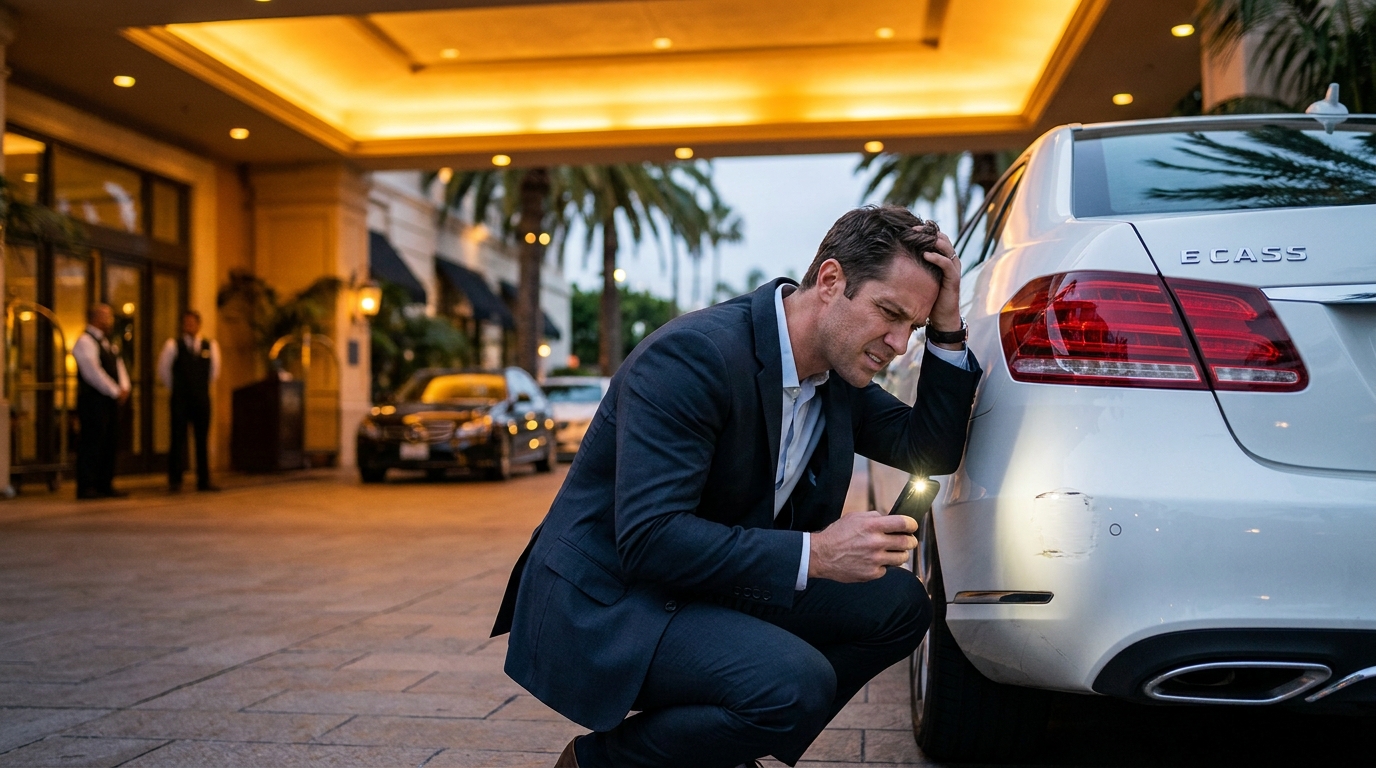
What Should You Do First When a Valet Damages Your Car in Los Angeles?
Stop, document everything before you leave the property, and request a written incident report on the spot. If you drive away without documentation, the claim becomes exponentially harder to prove. A hotel valet in Los Angeles scraped a car against a column; the owner collected a paint-transfer photo off the pole and asked the hotel for their parked-location log. The valet service accepted the ~$1,200 repair cost without a lawsuit, precisely because that paper trail made the cause undeniable. The same logic applies to every valet damage scenario in Los Angeles, the documentation you gather in the first ten minutes determines whether someone else pays or you do.
When the keyword valet damaged my car Los Angeles drives someone to search, they want to know three things fast: who pays, how the repair works, and what it costs. This guide answers all three from a body shop’s perspective, covering the angles the national insurance pages skip entirely.
Who Actually Pays When a Valet Damages Your Car?
The valet operator is responsible when their attendant caused the damage. Whether they can actually pay depends on what coverage they carry.
Garage keepers legal liability is the specific policy that covers physical damage to a customer’s vehicle while it is in the operator’s care, custody, and control. Garage keepers insurance is designed specifically for businesses that store or handle vehicles; unlike general liability, it covers physical damage to customers’ cars while they are in the care of the operator. General garage liability (also called non-owned auto liability) protects the business against bodily injury and property damage claims, but it does not cover damage caused to your vehicle itself. In short, a valet company needs both policies, and a second, separate insurance policy, garage keepers legal liability, is required to actually pay for repairs to the vehicle being driven by the attendant.
Los Angeles sets the floor here. The Los Angeles Municipal Code requires valet operators to carry garage keeper’s legal liability coverage with minimum limits of $250,000 per occurrence and $1,000,000 in the aggregate. Operators must also obtain a permit, carry liability insurance, provide proof of off-street parking spaces, and ensure their attendants hold valid California driver’s licenses. If you operate a valet service in Los Angeles, you are required to carry a Los Angeles County Valet Parking License Bond as well. These are real requirements you can cite when pushing back on an operator who claims they bear no responsibility.
One important nuance: a disclaimer printed on a valet ticket does not automatically eliminate liability when the attendant clearly caused the damage. California courts have consistently held that a bailee, the valet company, which holds your car in trust, owes a duty of reasonable care. A printed waiver does not override that duty when negligence is established by evidence.
What If the Valet Company Denies Responsibility?
If the operator refuses to file with their garage keepers insurer, or if a third-party patron (not the attendant) hit your car in the lot and cannot be identified through footage or witnesses, you may need to fall back on your own collision coverage and pay your deductible. In that scenario, your insurer may subrogate against the valet company if fault can later be established. Either way, get an estimate from a body shop you choose before any insurer, yours or theirs, directs you to a preferred shop. In California, you are not required to use your insurer’s preferred shop.
What Does Valet Damage in Los Angeles Actually Look Like?
Tight hotel drop-offs in Beverly Hills, multi-level condo structures in West Hollywood, and narrow restaurant valet lanes in Brentwood or Silver Lake all create a recognizable damage pattern: pillar scrapes at the front corner, bumper drag marks at parking-structure curbs, door dings from cramped rows, and wheel/rim curb scuffs from low-speed mis-judgments. Modern luxury vehicles add a hidden variable: a low-speed impact against a bumper cover containing surround-view cameras or parking sensors can trigger ADAS recalibration requirements that have nothing to do with the visible paint. Owners have reported that sensor recalibration alone accounted for more than $1,400 of a roughly $5,600 garage-scrape bill. That cost belongs in the valet company’s repair invoice, but it will not appear there unless your body shop’s estimator specifically checks for it. Our post on ADAS calibration after collision repair explains why this step is mandatory, not optional.
What Does Valet Damage Repair Actually Cost in Los Angeles?
Los Angeles labor rates are not national averages. The spread across the region runs roughly $56/hr in Van Nuys to $98/hr in West Hollywood, so any national estimate you find online is immediately unreliable. Here are realistic LA cost anchors for the most common valet-damage scenarios:
| Damage Type | Typical LA Cost Range | Notes |
|---|---|---|
| Clear-coat-only surface scratch (single panel) | $150 – $300 | Polish/compound first; repaint if cut through color coat |
| Through-to-metal single-panel scrape | $800 – $1,500 | Includes primer, color, clear, and blend into adjacent panel |
| Multi-panel scrape line (e.g., pillar to door to quarter) | $2,500 – $4,500+ | Blending 3–4 panels adds significant labor; common in tight LA structures |
| Bumper cover repair + paint | $500 – $1,800 | Higher end for sensors, PDC, or camera housing damage |
| Curb-scuffed wheel/rim | $150 – $400 per wheel | More for forged or custom finishes; see our wheel and rim repair guide |
| ADAS / surround-view camera recalibration | $400 – $1,600 | Required any time a bumper cover with sensors is disturbed |
Why Luxury Finishes Cost More to Repair
The Beverly Hills and West Hollywood valet corridor runs a disproportionate number of metallic, tri-coat pearl, and matte/satin finishes. Each one raises the repair cost in a specific way that the national claim-education pages never explain.
Metallic and pearl finishes require the painter to match not just the color but the flake orientation and pearl intensity under multiple light angles. Metallics and pearls require extra base layers and precise blending to match light reflection, and they need higher-grade clear coats and controlled curing in a paint booth, which adds time and equipment use. A test panel is often sprayed and approved in daylight before the car is touched. Expect a 30–40% premium over a standard solid color repair.
Matte and satin finishes are more expensive still. The standard machine-buff and polish steps used to blend conventional paint will destroy a matte surface’s texture, there is no way to correct it without respraying the entire panel. These repairs require matte-specific clear coat, no cutting compound at any stage, and a painter who has done it before. Budget a 40–50% premium over the equivalent gloss repair. Our post on why paint color matching and blending matter goes deeper on the technical process.
| Finish Type | Premium Over Standard Solid Color | Why |
|---|---|---|
| Solid color (gloss) | Baseline | Single-stage or base/clear; straightforward blend |
| Metallic | +20 – 35% | Flake orientation matching; test panel required |
| Tri-coat pearl | +30 – 45% | Three-stage process; mid-coat pearl matching is labor-intensive |
| Matte / satin | +40 – 50% | No machine polish possible; full panel respray often required |
| OEM specialty (e.g., BMW Individual, Porsche exclusive) | +50%+ | Manufacturer paint codes may require authorized-shop sourcing |
Does the Repair Path Change Depending on Who Pays?
Yes, and this is the detail every national insurance guide leaves out.
When the valet company’s garage keepers insurer pays: You are the claimant against a third-party insurer, which means you have more leverage on shop choice and parts quality. Push for OEM parts explicitly, the insurer may initially write the estimate with aftermarket or reconditioned components. Our guide on OEM vs. aftermarket vs. reconditioned parts explains exactly how to counter that. You also have the right to document diminished value, because the cause of the damage is a verifiable third-party negligent act, a stronger DV position than an at-fault claim.
When your own collision coverage pays: You pay the deductible, and your insurer steers the claim. California law gives you the right to choose any licensed shop, but your insurer will write its initial estimate against its own labor rates, which may be below what a quality West LA shop actually charges. A supplement process will likely follow. Read our post on what a supplement in collision repair is so you know what to expect.
When you pay out of pocket: You choose the shop, you control the parts, and there is no claim on your record. For a single-panel repair under roughly $1,200, this often makes mathematical sense given California’s premium-increase exposure after an at-fault-coded claim can raise your rate over three years.
How to Document a Valet Damage Claim in Los Angeles
The strength of your claim rests entirely on what you collect before leaving the venue. Follow these steps in order:
- Photograph the damage immediately, multiple angles, close-up and wide, showing the car’s position relative to the parking structure, pillar, or other vehicle. Timestamp metadata matters.
- Photograph any paint transfer on the pillar, column, wall, or adjacent car that matches your color. This is the single most persuasive piece of physical evidence.
- Request a written incident report from the venue manager, hotel, restaurant, or condo. Get a copy on site; do not rely on being emailed one later.
- Get the operator’s permit number and insurance carrier. A legitimate LA valet operator carries a Police Commission valet permit, a business license, and a garage keepers insurance certificate. Ask for all three.
- Request the parked-location log, the timestamp record of when your car was moved and where it was placed. Hotels with structured valet operations maintain these. This log is what connects the damage to the operator’s custody of your vehicle.
- Get a professional estimate before any insurer closes the claim. A shop’s written estimate documents the full scope, including any ADAS recalibration line items the insurer might otherwise miss or dispute.
Should You Claim or Pay Out of Pocket?
The answer depends on who is paying and how large the repair is. Use this framework:
- Valet insurer paying, damage over $1,000: Always claim against the valet company’s garage keepers policy. No deductible, no premium exposure for you, and you preserve your DV rights.
- Your collision coverage, damage under your deductible: Pay out of pocket, filing a claim below your deductible makes no financial sense.
- Your collision coverage, damage modestly above your deductible: Calculate the three-year premium increase before filing. A $500 net payout that costs $900 in rate increases over three years is a losing trade.
- Multi-panel scrape on a luxury finish, damage over $3,000: File regardless. The dollar difference is too large to absorb, and at this scope, the valet operator’s liability is easier to establish because the damage pattern clearly requires professional judgment to execute, a single attendant moving through a tight space.
For a detailed breakdown of how California’s premium-increase mechanics affect this decision in the context of similar damage scenarios, see our post on keyed car repair in Los Angeles, which walks through the same out-of-pocket versus claim calculus.
What About Diminished Value After a Valet Repair?
A repair to your vehicle, even a perfect one, creates a CARFAX entry and reduces what the market will pay for the car. When a third party, like a valet operator, caused the damage, you have the right to claim diminished value against their insurer in California. The key is having the body shop document the pre-repair condition, the repair scope, and the post-repair condition in writing, with photos, before the car leaves the shop. Our full guide on diminished value in California explains exactly what a shop documents and how to use that documentation in a DV claim.
Common Mistakes to Avoid
- Leaving without an incident report. Once you drive off the property, the operator’s version of events carries as much weight as yours. An unsigned incident report is still better than nothing.
- Accepting a cash settlement on the spot. A $200 handshake payment sounds easy until your body shop quotes $1,800 for the actual repair. Get an estimate first, always.
- Filing against your own collision coverage before pursuing the valet operator. You may waive subrogation leverage and absorb a deductible that the operator should have covered.
- Assuming the valet ticket disclaimer absolves the operator. It does not when negligence is proven by physical evidence. California courts treat this as a bailment relationship with a duty of care.
- Skipping ADAS recalibration because it is invisible damage. Any bumper or sensor housing disturbed in a scrape may require recalibration. A shop that does not check this is leaving you with a safety gap and potential liability.
- Using any shop the valet company or hotel recommends without independent research. In California you choose your shop. A shop referred by the party at fault has a conflict of interest.
- Not documenting paint finish type before the repair. If your car has a matte or tri-coat pearl finish, document it in writing with the shop’s estimate so the insurer cannot retroactively downgrade the repair method to a standard clear coat.
Frequently Asked Questions
Who is responsible when a valet damages my car in Los Angeles?
The valet operator is responsible if their attendant caused the damage while your car was in their care, custody, and control. Garage keepers insurance is designed for businesses that provide parking or storage services, and it protects against financial losses from damage to vehicles under the care, custody, or control of those businesses. Under the Los Angeles Municipal Code, valet operators are required to carry garage keeper’s legal liability coverage with minimums of $250,000 per occurrence and $1,000,000 in the aggregate. A valet ticket disclaimer does not eliminate that liability when the attendant’s fault can be established with evidence.
What does garage keepers insurance cover versus general liability?
Garage liability (non-owned auto liability) protects the business from claims involving bodily injury and property damage, but it does not cover damage to the customer’s vehicle itself. Garage keepers liability specifically covers damage to any vehicle in the parking lot that is under the valet company’s care, including collisions and theft for vehicles in their care, custody, and control. Both policies are needed; general liability alone leaves the car owner unprotected.
How much does a valet scrape repair cost in Los Angeles?
A clear-coat-only surface scratch runs roughly $150–$300. A through-to-metal single-panel repair runs $800–$1,500. A multi-panel scrape line, common in tight LA hotel and condo structures, can exceed $4,000 once blending into adjacent panels is factored in. Metallics and pearls require extra base layers and precise blending to match light reflection, and they need higher-grade clear coats and controlled curing in a paint booth. Matte and satin finishes add roughly 40–50% above a standard gloss repair because machine polishing is not possible on these surfaces.
Should I file a claim or pay out of pocket for a valet repair in Los Angeles?
If the valet operator accepts liability, always claim against their garage keepers insurer, no deductible and no premium exposure for you. If you must use your own collision policy, weigh the repair amount against your deductible and the three-year premium impact before filing. For single-panel repairs under roughly $1,200 to $1,500, many Los Angeles owners pay out of pocket to protect their insurance rate.
What documentation do I need to get the valet company to pay?
Photograph the damage and any matching paint transfer on the structure before leaving. Request a written incident report from the venue. Get the operator’s name, permit number, and insurance carrier on site. Ask for the parked-location log, which timestamps when and where your car was moved. Bring all of this to your body shop before your first call with any insurer. That combination of physical evidence and custody timeline is exactly what compelled a valet service to cover a ~$1,200 paint repair without litigation in a documented Los Angeles case.
0 Comments