

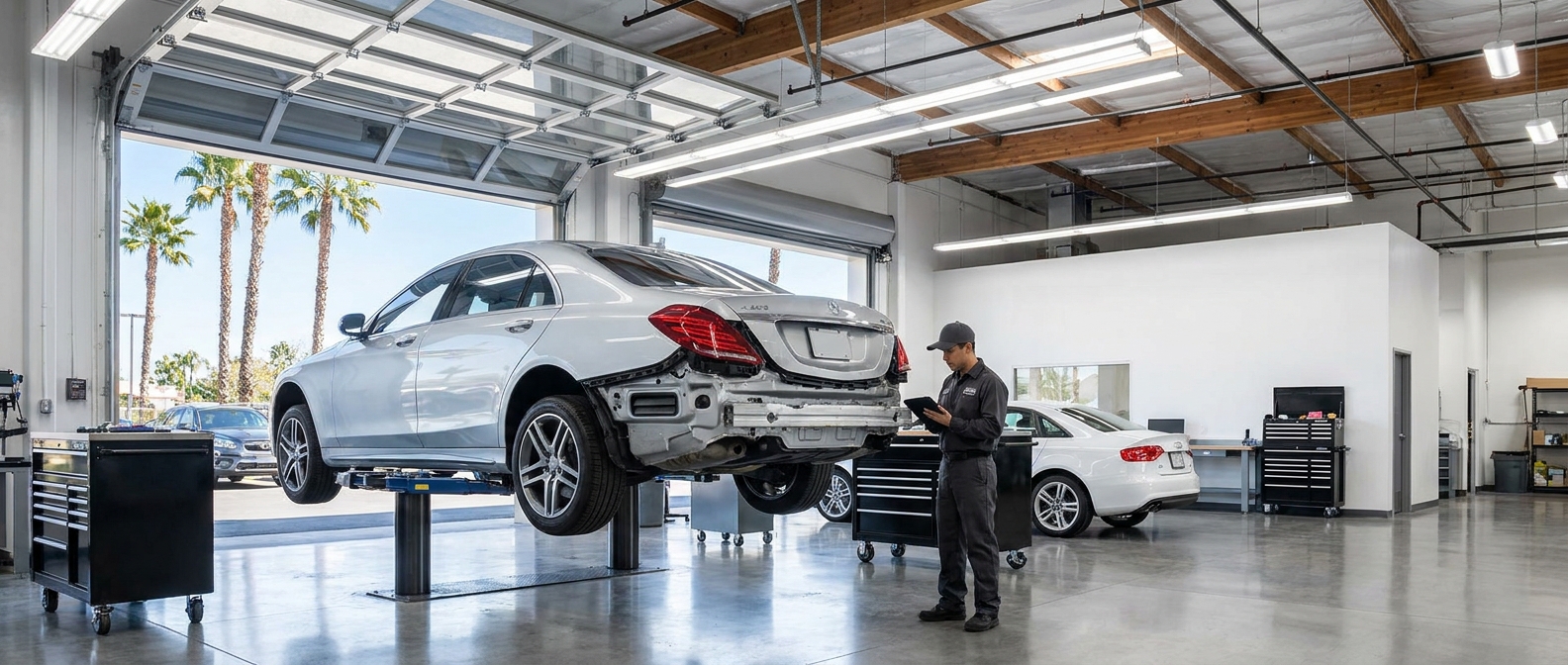
What should you do right after a hit-and-run in Los Angeles?
Hit-and-run car repair in Los Angeles starts the moment the other driver leaves the scene. Stay where it is safe, do not chase the other vehicle, and start building a record. The notes and photos you take in the first ten minutes decide how smoothly your claim and repair go later.
Take these steps in order:
- Move your car out of traffic if it still drives, then turn on your hazard lights.
- Write down anything you remember about the other vehicle: make, color, partial plate, direction it left.
- Photograph all damage, the surrounding area, skid marks, and any debris or paint transfer left behind.
- Ask nearby drivers, pedestrians, or businesses for witness contact information and security camera footage.
- Call the LAPD. For property damage only, you can file online through the LAPD; for injuries, call 911.
- Notify your insurer the same day and request a claim number.
A police report number matters more in a hit-and-run than in a normal collision, because there is no other driver to bill. Most insurers ask for that report before they approve repairs under your own coverage.
Does insurance cover hit-and-run car repair?
Yes, if you carry the right coverage. With no at-fault driver to pay, the repair is funded by your own policy through either collision coverage or uninsured motorist property damage (UMPD). Liability coverage alone will not pay to fix your car after a hit-and-run.
The two coverages work differently, and the gap usually comes down to the deductible and whether the striking car has to be identified.
| Factor | Collision coverage | Uninsured motorist property damage (UMPD) |
|---|---|---|
| Pays for a hit-and-run | Yes, in California | Often yes, but rules vary by policy |
| Typical deductible | Set on your policy, commonly $500 to $1,000 | Frequently lower, sometimes $0 |
| Contact requirement | No contact requirement | Some policies require proof the other car hit yours |
| Effect on rate | Not raised for a not-at-fault claim in California | Not raised for a not-at-fault claim in California |
Check your declarations page or ask your agent which coverage applies before you authorize work. If both apply, your insurer will usually route the claim through whichever path costs you less out of pocket.
Who pays the deductible after a hit-and-run?
You pay it up front, then you may get it back. Because the other driver fled, your own coverage handles the bill, so the deductible on that coverage applies even though the crash was not your fault.
Two things can change that:
- If your claim runs through UMPD with a $0 deductible, you may owe nothing toward the repair.
- If police later identify the driver and recover money, your insurer can reimburse the deductible you paid.
Before filing, get a written repair estimate. If the damage is close to your deductible, paying out of pocket may make more sense than opening a claim. A shop can give you that number in one visit.
How does the body shop repair process work after a hit-and-run?
The repair follows the same path as any insurance job, with extra weight on documentation because your insurer is standing in for the missing driver. A clear paper trail protects both your claim and the quality of the fix.
A typical sequence looks like this:
- Estimate and photos. The shop documents every damaged panel and writes a line-by-line estimate. Reviewing it line by line helps you spot anything missed, as covered in our guide on reading a collision repair estimate.
- Insurer review. The estimate goes to your adjuster. If hidden damage shows up during teardown, the shop files a supplement for the added work.
- Parts ordering. The shop sources panels, lights, and trim. Parts that affect safety systems are matched to factory specifications.
- Structural and panel repair. Frame measurements, panel replacement, and refinishing happen here, with color matched and blended into surrounding panels.
- Calibration and safety checks. Cameras and sensors often need recalibration, which is why ADAS calibration after collision repair is part of the job on newer cars.
- Final inspection and delivery. The shop verifies fit, finish, and function before returning the car.
In California you are not required to use your insurer’s preferred shop. You can read more in our breakdown of whether you have to use an insurer’s preferred body shop.
How long does hit-and-run repair take in Los Angeles?
Most cosmetic hit-and-run repairs take a few days to about two weeks. Heavier structural damage, back-ordered parts, and calibration steps can push that timeline out further. The biggest variable in a hit-and-run is the claim itself, since the shop usually cannot start until your insurer approves the estimate.
Rough ranges by damage type:
- Bumper or single-panel cosmetic damage: 2 to 5 business days once approved.
- Multiple panels with paint blending: 1 to 2 weeks.
- Structural or frame work with calibration: 2 weeks or more.
For a fuller picture of what drives these numbers, see our Los Angeles collision repair timeline. If you carry rental coverage, ask about rental and loss-of-use coverage while your car is in the shop.
Can you choose your own body shop in California?
Yes. Under California law you have the right to take your vehicle to any licensed repair shop you choose. An insurer can recommend a shop and can offer a list of options, but it cannot require you to use one to settle the claim.
When you compare shops, look for these signals:
- A current Bureau of Automotive Repair license.
- Experience with your vehicle type, including EV or luxury models if that applies.
- In-house or partnered ADAS calibration.
- A written warranty on workmanship.
What documents should you keep for a hit-and-run claim?
Keep everything that proves the crash happened and what it cost to fix. In a hit-and-run, your own insurer is paying, so the burden of showing the damage is real falls on you.
Save these records:
- The police report number and any case updates.
- Your scene photos and any witness statements or video.
- The repair estimate and final invoice.
- Claim correspondence and your claim number.
- Receipts for towing or a rental car.
If the repair is extensive, the documentation also supports a diminished value position later, since a repaired hit-and-run can still affect resale.
Common questions about hit-and-run repair
Will a hit-and-run raise my insurance rate in California?
No. California insurers cannot surcharge you for a claim where you were not at fault, and a hit-and-run where you are the victim qualifies. Filing the claim to repair your car should not raise your premium on that basis.
Should I file a claim if the damage is minor?
Get an estimate first. If the repair cost is at or below your deductible, paying out of pocket avoids opening a claim for little benefit. If it clearly exceeds the deductible, filing usually makes sense, especially when structural or safety components are involved.
What if police find the driver later?
If the at-fault driver is identified and has coverage, your insurer can pursue them to recover what it paid, a process called subrogation. If that succeeds, you can be reimbursed for the deductible you already paid.
The bottom line on hit-and-run repair in Los Angeles
A hit-and-run leaves you covering the first move, but your own collision or UMPD coverage and a clear record get the car repaired properly. Report it fast, photograph everything, get a written estimate, and choose a shop you trust to handle both the bodywork and the safety systems. If you were just hit and are not sure where to start, our guide on what to do after a car accident in Los Angeles walks through the next steps.
0 Comments