

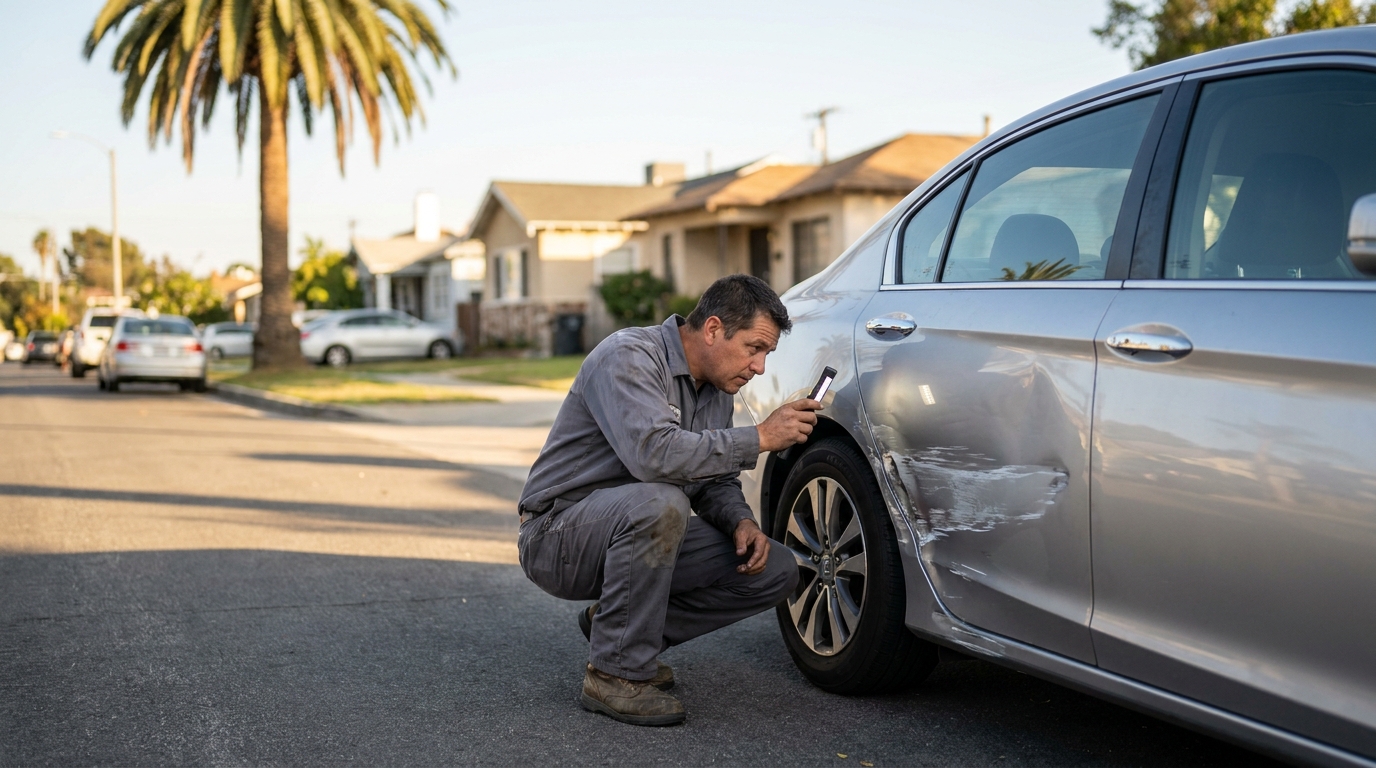
What Makes a Quarter Panel Different From a Bumper or Fender?
A quarter panel is the sheet-metal section that sits behind the rear door and wraps around the rear wheel well. Unlike a bumper cover or a front fender, a quarter panel is welded directly to the vehicle’s body structure at the factory. It is not a bolt-on part. That single fact is what makes every quarter panel job more labor-intensive, more expensive, and more consequential for your car’s value than most other body repairs.
When someone sideswiped your car on the 405 or clipped it in a parking structure in West Hollywood, they did not just scuff paint. They may have stressed a welded structural skin. Understanding that distinction is the first step to getting the right repair in Los Angeles.
Can a Damaged Quarter Panel Be Repaired, or Does It Have to Be Replaced?
The honest answer is: it depends on five things a trained technician checks during teardown. Most quarter panel damage falls somewhere on a spectrum between a paintless dent repair (PDR) touch-up and a full panel replacement with welding. Here is the five-point framework a reputable LA shop uses.
1. Crease Severity and Metal Stretch
A smooth, round dent with intact paint is a strong PDR candidate. A sharp crease or a fold means the metal has stretched past its yield point. Stretched metal cannot be reliably pushed back flat; trying to do so leaves low spots that show through paint. Sharp creases almost always rule out PDR and frequently rule out cosmetic filler repair, pushing the job toward panel replacement.
2. Paint Integrity
PDR only works when the factory paint is unbroken. If the impact cracked, chipped, or abraded the clear coat down to bare metal, the panel needs conventional body work: filler, primer, paint, and clear coat. That changes the cost category entirely.
3. Inner Wheelhouse and Structural Damage
The quarter panel has a double wall. Behind the outer skin sits an inner wheelhouse and, in many vehicles, a structural reinforcement rail. Collision damage often travels inward and damages these hidden components, which cannot be assessed until teardown. When the inner structure is compromised, repair costs climb and a simple cosmetic fix is no longer safe. This is also the point where a shop may flag structural damage concerns that go beyond the quarter panel itself.
4. Wheel-Arch Deformation
Sideswipe collisions that contact the rear wheel arch can push the arch lip inward far enough to rub the tire. Even slight misalignment here means the inner structure is involved. A shop will check whether the wheel well gap is consistent all around. Uneven gaps signal that the car needs more than surface work.
5. Paint Blend Feasibility
Even after a perfect repair, a quarter panel is a large, curved surface. Matching paint on a big rear panel and making it blend invisibly into the adjacent trunk lid, rear bumper cover, and door requires skill and the right spray environment. On tri-coat pearl, candy, or specialty colors common on luxury vehicles in Los Angeles, blending is not optional. A shop that skips blending will produce a visible color mismatch. We go deeper on why this matters in our post on paint color matching and blending.
What Does Quarter Panel Repair Cost in Los Angeles?
Los Angeles sits at the high end of California labor rates. Labor rates across SoCal range from $56/hr in Van Nuys to $98/hr in West Hollywood, a 75% gap for the exact same type of work. That spread directly affects your repair bill. Here is a realistic cost table for the most common quarter panel scenarios in LA.
| Repair Scenario | Typical LA Cost Range | Notes |
|---|---|---|
| Minor dent, paint intact (PDR) | $150 – $450 | Only viable with no crease and unbroken paint; access holes may be needed |
| Moderate dent or crease, paint damaged | $500 – $1,200 | Filler, primer, paint, and clear coat; blend to adjacent panels recommended |
| Severe dent with inner panel damage | $1,000 – $2,500 | Conventional repair plus inner wheelhouse work; may require patch panels |
| Full quarter panel replacement (welded) | $1,800 – $5,500+ | Spot-weld removal, new skin fitted and MIG welded, seam-sealed, painted; luxury or specialty colors add cost |
| Adjacent panel blending (per panel) | $150 – $350 | Typically needed on door, trunk lid, or bumper cover to avoid visible mismatch |
Luxury vehicle owners pay significantly more than economy-car drivers for comparable damage because luxury makes require more specialized labor, plus factory-spec paints and OEM or equivalent-quality panels. A Tesla, BMW, or Lexus quarter panel replacement in LA can reach the top of or exceed the ranges above. For more on what your insurer will pay for parts, see our guide on OEM vs. aftermarket vs. reconditioned parts.
What Does a Full Quarter Panel Replacement Actually Involve?
This is the process national cost guides gloss over. A welded replacement is a multi-day operation, not a swap. Here is what happens at a qualified LA body shop:
- Interior disassembly: Rear seat panels, trunk liners, and sometimes rear glass are removed to access the welds from inside.
- Spot-weld removal: Technicians grind or drill out factory spot welds along every seam. On a typical sedan this is 60 to 100+ weld locations.
- Panel cutting and fitting: The damaged skin is cut away. The new panel is temporarily fitted and checked for gap consistency around the door, trunk, and wheel arch before any permanent welds are made.
- MIG or spot welding: The new panel is welded in, replicating factory seam locations as closely as possible. Proper welding matters structurally, not just cosmetically.
- Seam sealing and corrosion protection: Every seam is sealed and inner cavities are treated with cavity wax or corrosion inhibitor to prevent rust.
- Paint, blend, and clear coat: The panel is primed, painted to match the vehicle’s color code, and clear-coated. Adjacent panels are blended to the feather edge.
- ADAS and sensor checks: Many vehicles now have blind-spot monitoring sensors mounted in or near the rear quarter panel. After any quarter panel repair, those sensors require recalibration. Learn more in our post on ADAS calibration after collision repair.
Repair vs. Replace: Side-by-Side Decision Guide
| Factor | Lean Toward Repair | Lean Toward Replace |
|---|---|---|
| Dent shape | Smooth, round, no crease | Sharp crease, fold, or multi-impact area |
| Paint condition | Fully intact | Cracked, chipped, or bare metal exposed |
| Inner structure | No inner wheelhouse damage | Inner panel or reinforcement bent |
| Wheel arch gap | Even all around | Uneven or tire contact present |
| Vehicle age and value | Older car, lower ACV | Newer or high-value vehicle where proper fix preserves resale |
| Color complexity | Single-stage solid color | Pearl, candy, tri-coat, or specialty finish |
Will This Show Up on CARFAX, and Does It Hurt My Car’s Value?
Yes, in most cases. A quarter panel replacement is a structural-adjacent repair, and any insurer-paid collision claim is typically reported to vehicle history databases. That disclosure can reduce your car’s resale value, a concept known as diminished value. In California, you have the right to pursue a diminished-value claim against the at-fault driver’s insurer. A qualified body shop can help document the pre- and post-repair condition. Our full breakdown of this topic is in the post on diminished value in California.
The key point: a repair done correctly by a certified shop minimizes the value impact. A cheap repair with visible paint mismatch, uneven panel gaps, or missing seam sealer will be caught by any competent buyer’s pre-purchase inspection and will cost you more at resale than the repair saved you up front.
Should You File an Insurance Claim for a Quarter Panel Repair in LA?
It depends on the cost vs. your deductible and your vehicle’s actual cash value (ACV). Run the math before you call your insurer:
- If the repair estimate is less than or close to your deductible, paying out of pocket avoids a claim on your record.
- If the repair cost approaches 75–80% of your car’s ACV, your insurer may declare it a total loss rather than pay for repair. California uses a total-loss threshold, so a $4,000 repair on a $5,500 car triggers a serious conversation about whether to proceed.
- If another driver hit your parked car or sideswiped you, the claim goes through their liability coverage, not yours. Document the scene and file a police report even if the other driver is cooperative.
- Hit-and-run? Your uninsured motorist property damage (UMPD) or collision coverage applies. See our guide on hit-and-run car repair in Los Angeles for the exact steps.
Common Mistakes to Avoid
- Choosing a shop on price alone. A very low quote on a quarter panel replacement usually means fewer weld points, skipped seam sealing, or a one-panel paint job without adjacent blending. All of these show up later.
- Skipping the inner panel inspection. Agreeing to a surface repair without authorizing teardown means hidden wheelhouse damage stays hidden. It will rust and may affect crash protection.
- Ignoring adjacent-panel blending. Repainting only the quarter panel on any vehicle with a pearl or metallic finish will produce a noticeable color step at the door or trunk edge. Budget for blending from the start.
- Forgetting ADAS sensors. Blind-spot monitoring modules mounted in the rear quarter area need to be recalibrated or reinstalled correctly after any panel work. Skipping this leaves your safety systems inaccurate.
- Assuming a welded repair is always worse than PDR. PDR is excellent when it fits. On creased or paint-broken damage, forcing a PDR approach produces a result that looks worse than a properly done conventional repair.
- Not getting the supplement in writing. Inner wheelhouse and structural damage found during teardown must be added to the original estimate as a written supplement. Verbal promises from a shop or adjuster are not binding. Here is what a supplement means and how to handle one: What Is a Supplement in Collision Repair?
Frequently Asked Questions
Can a quarter panel dent be repaired without replacing the whole panel?
Yes, if the dent is smooth and round with no crease and the factory paint is fully intact, PDR can save the panel without any cutting or welding. If the paint is broken or the metal is creased, conventional body repair using filler and paint is the next option before replacement becomes necessary. The deciding factor is always what happens behind the outer skin, which requires physical inspection.
How long does quarter panel repair or replacement take in Los Angeles?
A PDR-eligible minor dent can be completed in one to two days. A conventional repair with paint and blending typically takes three to five business days. A full welded replacement on a complex vehicle can take seven to fourteen days, partly because parts sourcing, welding, seam sealing, and paint curing all require dedicated time. LA rental car coverage under your policy can offset the wait; read more in our post on rental cars and loss-of-use coverage in California.
Will my quarter panel repair show up on CARFAX?
Any insurer-paid claim is typically reported to vehicle history services including CARFAX. A cash repair paid without an insurance claim may not appear, though a future pre-purchase inspection by a trained technician can still detect prior body work through paint thickness readings and panel gap analysis. Proper repairs minimize, but do not eliminate, the value impact.
Does a quarter panel repair affect crash safety?
A correctly performed repair restores structural integrity. A poorly done repair with insufficient weld points, missing seam sealer, or uncorrected inner panel damage can compromise the vehicle’s designed crumple behavior in a subsequent collision. Blind-spot sensors in the rear quarter area also need post-repair recalibration to function correctly. Always request a post-repair safety check from your shop.
Is it worth repairing a quarter panel on an older or high-mileage car in LA?
Run the numbers: if the repair estimate exceeds roughly 70–75% of the car’s current market value, the financial case for repair weakens significantly, and your insurer may total the vehicle anyway. For an older car with a low ACV, a cosmetic-only repair that stabilizes the damage without a full replacement may be the most practical path. Get a written estimate first, then check the car’s ACV on a source like Kelley Blue Book before deciding.
0 Comments